Yvon Chouinard Gave Patagonia Away but Preserved Its Voting Control
Yvon Chouinard transferred Patagonia to two entities in 2022, separating its environmental funding from the voting rights designed to protect its purpose.
View all stories about this mogul
On September 14, 2022, Patagonia announced that the Chouinard family had transferred its ownership to two organizations. One received 98 percent of the stock but no votes. The other received just 2 percent of the stock and every vote. Those unequal allocations were the mechanism of founder Yvon Chouinard’s succession plan: direct the financial benefits toward environmental work while placing corporate control in a separate institution.
The outdoor clothing company remained a commercial business. Customers would still buy jackets, employees would still need salaries, and managers would still decide how much money to retain. What changed was the destination of the surplus and the organization authorized to protect the company’s purpose. Patagonia’s ownership announcement described an exit from family ownership without a sale or stock-market listing.
The distinction matters because giving away economic ownership and surrendering all influence are different acts. The family’s arrangement did the first while preserving a defined role in the second. It was the latest in a series of decisions in which Chouinard changed the rules governing his business after finding that its existing practices conflicted with the activities and landscapes that supported it.
A climbing business confronted the damage from its own product
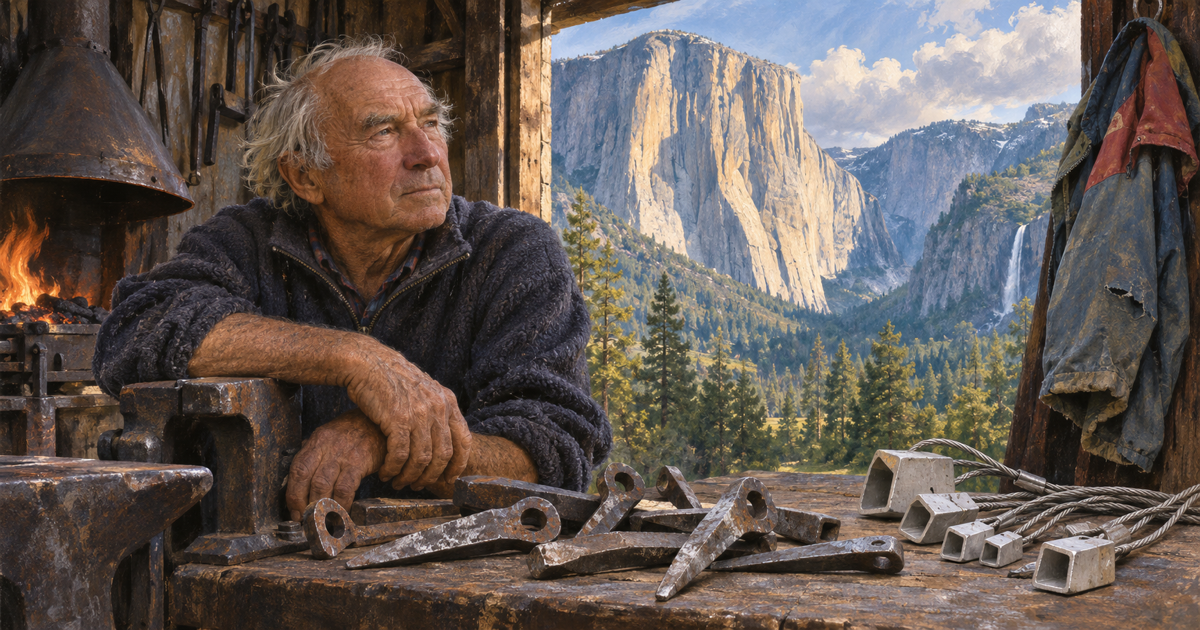
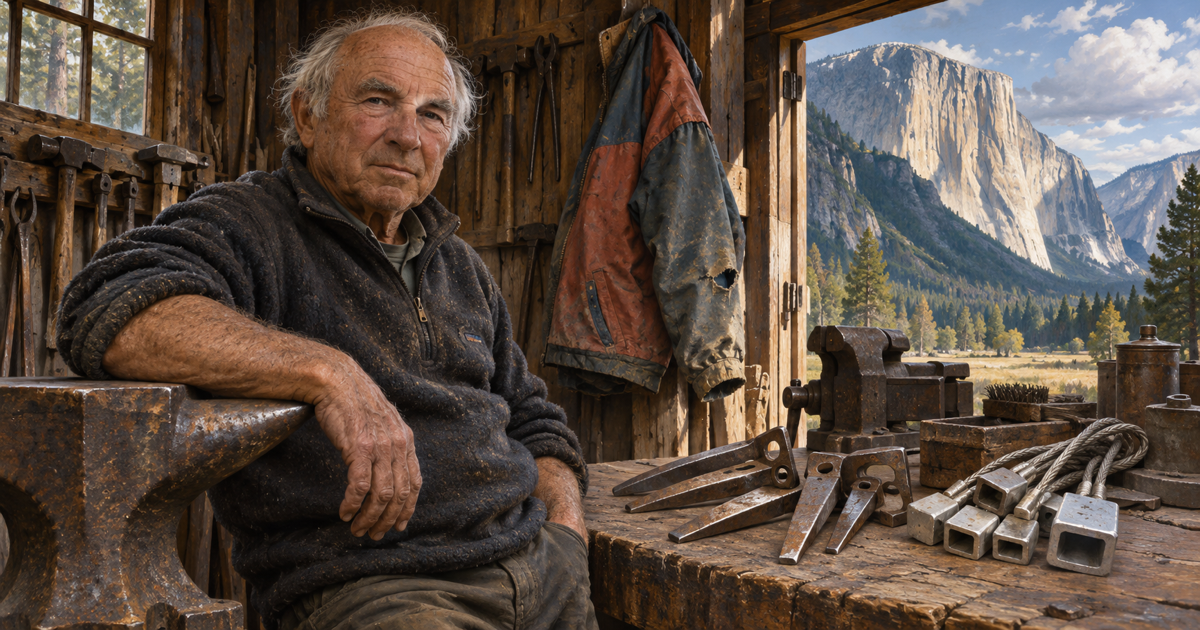
Chouinard’s commercial education began with metal rather than clothing. According to Patagonia’s company history, in 1957 he acquired a used coal-fired forge, an anvil weighing 138 pounds and blacksmithing tools. He made his early climbing pitons from an old harvester blade. These metal spikes went into rock cracks to help climbers establish protection; he initially sold his equipment to other climbers.
The early workshop offered unusually direct feedback. Chouinard used the equipment in the same terrain as his customers. Strength, weight and reliability were practical questions tested on climbs, rather than specifications supplied by a distant purchasing department. In 1965, he entered a partnership with climber and engineer Tom Frost. Their company, Chouinard Equipment, improved climbing hardware for a demanding specialist market.
Success exposed a defect that better manufacturing could not solve. Repeatedly hammering pitons into established routes, then removing them, enlarged and scarred the cracks. A durable tool could be reused, but its repeated use still damaged the surface on which the sport depended. Selling more of an effective product could therefore worsen the conditions that made the product valuable.
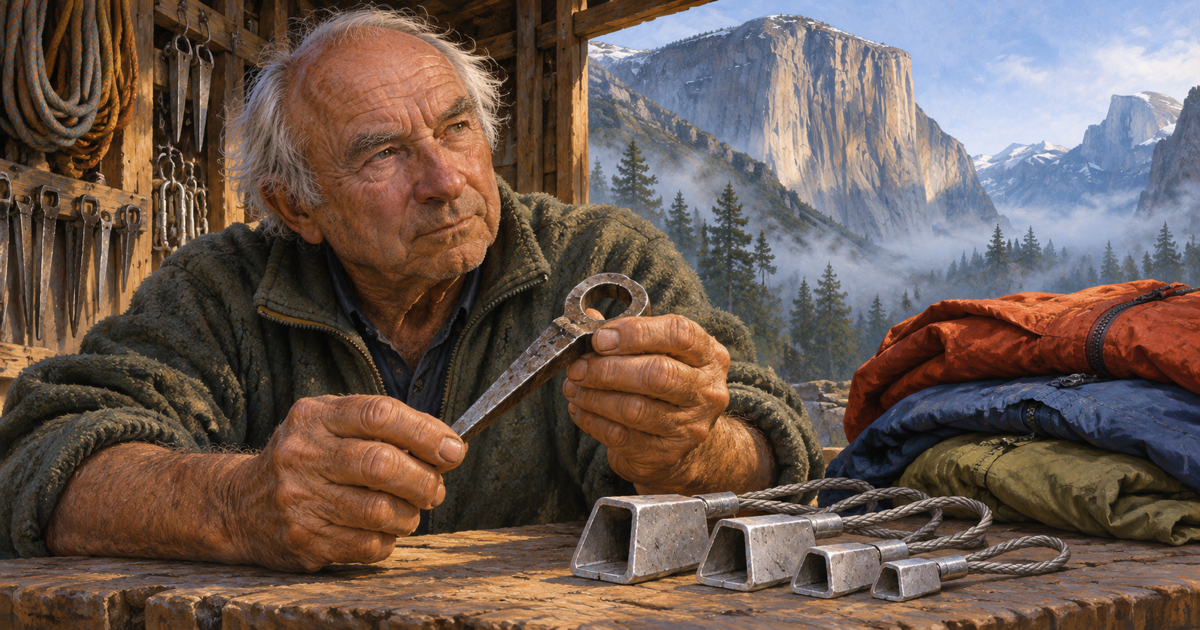
Chouinard and Frost began reducing their reliance on pitons. Their 1972 catalog promoted aluminum chocks, which could be placed in cracks without hammering. It included a substantial instructional essay by climber Doug Robinson explaining the alternative. Patagonia’s company history records the shift as an early commercial decision driven by environmental damage.
The lesson was more specific than a claim that responsible conduct attracts buyers. A manufacturer needed a workable substitute and customers who understood how to use it. An appeal to protect rock would have been less useful without another way to climb. The catalog combined a commercial offer with technical instruction, helping customers change their behavior alongside the company’s product mix.
That experience also complicates the familiar picture of a founder simply rejecting business. Chouinard did not stop making equipment when he identified the damage. He changed what the equipment business encouraged people to purchase. The response preserved the commercial relationship while revising the practice on which it rested, a pattern that would reappear in Patagonia’s materials and ownership decisions.
Clothing made the environmental problem harder to see
Patagonia dates its founding to 1973. Apparel expanded the business beyond climbing hardware, but it also placed more of the production process beyond the immediate view of its designers and customers. A climber could see a scarred crack. The agricultural and industrial effects of a shirt required investigation across farms, processors and textile suppliers.
Cotton presented a particularly awkward test. Its familiar appearance did not tell a buyer how it had been grown. In 1994, Chouinard directed Patagonia to convert its sportswear line to organically grown cotton within 18 months. The company’s retrospective describes a line of 166 products and a business category representing about 30 percent of sales. This was a significant operating commitment rather than a small experimental collection.
The instruction immediately raised questions that an environmental declaration could not answer. Who would supply the cotton? Who would process it? Would the fabrics meet existing requirements? Would customers accept a higher price? Employees also had to consider what a failed conversion would mean for the business that paid them. Commitment at the top created work and uncertainty throughout the organization.
Patagonia’s account of the conversion describes employee visits to cotton fields as part of the effort to explain the decision. The tours connected an abstract purchasing requirement to conditions people could observe. They also made the policy something employees had encountered themselves, rather than an instruction that arrived only through management.
The launch carried measurable costs. Patagonia says the shortage of suitable organic cotton reduced the sportswear range from 166 products to 66. It accepted lower margins after research indicated that customers would pay only a limited premium. Sportswear sales took two years to regain their previous level. Those details are more revealing than a claim that the switch was immediately rewarded.
They show the difference between a principle and the price of implementing it. Fewer products meant fewer opportunities to make a sale. Lower margins meant the business absorbed part of the added expense. A delayed recovery meant managers had to sustain the policy across more than one selling season. Environmental intent did not remove ordinary commercial arithmetic; it changed which costs the company was prepared to carry.
Buying different cotton required different business relationships
Vincent Stanley, Patagonia’s longtime employee and director of philosophy, explained another obstacle in a 2021 Yale interview. Buying cotton directly from farmers did not automatically provide access to the businesses that spun it into yarn or made it into fabric. Patagonia had changed the beginning of the supply chain without securing every connection needed to reach a finished garment.
Previously, ordering fabric or clothing allowed the company to rely on arrangements made by other suppliers. Direct involvement in agricultural sourcing exposed the gaps between those arrangements. A farm’s ability to grow cotton was separate from a spinner’s willingness to handle it. A designer’s deadline remained in place while colleagues worked to establish those missing relationships.
Stanley’s interview with Yale Insights is useful because it identifies the organizational difficulty beneath the material substitution. The instruction sounded simple at the level of a finished shirt. In production, it required a set of businesses to coordinate around quantities and practices that were less convenient than their established routines.
A company attempting a similar change would therefore need to examine more than the availability of a preferred raw material. Processing capacity, minimum orders, delivery schedules and acceptable quality all determine whether a sourcing decision can survive contact with production. These are the points at which an environmental preference becomes a purchasing system, and where a public promise can outpace operational preparation.
Chouinard and Michael S. Brown also documented the conversion in a 1997 paper in the Journal of Industrial Ecology. Its abstract emphasized that customers continued to choose Patagonia for familiar reasons, including quality, fit, styling and the brand. Environmental significance did not replace the ordinary requirements of clothing. The garment still had to perform the job for which someone purchased it.
That finding limits an easy interpretation of the cotton story. Patagonia could not assume that buyers would compensate for every inconvenience because they approved of the objective. Its environmental decision had to coexist with a credible product. The company was asking customers to accept a changed production method while continuing to satisfy expectations formed before the change.
The conversion also illustrates a boundary between changing one company and changing an industry. Patagonia could decide what it would purchase. It could not issue equivalent instructions to competing brands, farmers or textile mills. Its influence depended on orders, persuasion and demonstrated results. A founder’s control was powerful inside the business, but outside it the same ambition required other organizations to participate.
An advertisement acknowledged the cost of selling jackets
On November 25, 2011, Patagonia ran a New York Times advertisement headed “Don’t Buy This Jacket.” The image presented a product the company sold, while the accompanying argument asked readers to consider the resources consumed in making clothing. Its published explanation of the advertisement acknowledged that organic or recycled materials did not eliminate environmental harm.
The timing made the message conspicuous: it appeared on Black Friday, when retailers compete for purchases. But the business question beneath the advertisement was less theatrical. If production consumes resources, improving materials does not make unlimited production harmless. The company’s own products remained part of the problem it was discussing.
There is no need to assume that the advertisement reduced consumption, or to treat attention as proof of environmental benefit. The source establishes what Patagonia said and why it said it. It does not by itself establish what buyers subsequently did. A memorable campaign and a measurable reduction in resource use are different outcomes, requiring different evidence.
Commercially, the message also placed a burden on the relationship with the customer. A company encouraging restraint needs to explain when its products are useful and why they deserve their price. Durability and continued usefulness become especially important when a brand asks people to consider whether another purchase is necessary. The argument makes the quality of the object harder to separate from the credibility of the institution selling it.
The advertisement brought the tension into public view rather than resolving it. Patagonia needed customers and revenue to maintain its operations. It also described environmental costs associated with those operations. Both propositions could remain true. Recognizing them helps explain why Chouinard eventually addressed ownership: better materials and consumer messages could influence the business, but neither determined who would receive its accumulated financial rewards.
Two owners received different kinds of power
The 2022 transfer assigned Patagonia’s nonvoting shares to the Holdfast Collective and its voting shares to the Patagonia Purpose Trust. The company’s announcement said profits remaining after reinvestment would be distributed for environmental work. Patagonia also remained a for-profit company and retained its commitment to donate 1 percent of sales annually to grassroots environmental organizations.
These were separate financial commitments. A percentage of sales uses revenue as its starting point. A dividend depends on what remains available after the business funds its operations and investment needs. Conflating the two would obscure an important feature of the arrangement: the new owner’s funding still depends on a functioning commercial enterprise.
The division of shares also separated two questions often bundled together in ordinary ownership. Who should benefit financially from the company? Who should have authority to preserve its direction? The Collective received the overwhelming majority of the economic interest. The Purpose Trust received the voting authority intended to protect the mission. The percentages alone cannot describe the balance of power without identifying the rights attached to each share class.
Consider the difference from distributing identical voting shares to a large group of recipients. Under that arrangement, financial ownership and formal voting influence would move together. Patagonia’s chosen structure gave the environmental recipient a large financial stake while concentrating voting control elsewhere. Its design depended on that separation, rather than on the symbolic size of the gift alone.
Chouinard’s explanation also identified alternatives he had rejected. Selling the company could produce money for environmental causes but leave its future conduct to a buyer. A public listing would introduce a different ownership relationship and pressures he considered incompatible with his intentions. His objection concerned what would happen after the transaction, as well as what the transaction could raise.
The result was a succession plan for both money and authority. It directed the benefits of future commercial activity toward an external purpose while creating an institution charged with protecting the operating company’s commitments. Whether such a structure suits another founder depends on the intended beneficiaries, the desired governance and the business’s ability to finance itself under those obligations.
A founder’s influence survived the transfer
Patagonia’s ownership explanation says the Chouinard family will guide the Purpose Trust, including electing and overseeing its leadership. It also describes a continuing family role in the Collective’s work. Giving up personal ownership therefore did not mean removing the family from the institutions determining how the company’s purpose would be interpreted.
That distinction deserves precise language. The family no longer held the shares as its personal property under the announced arrangement. It nevertheless retained influence through the governance system established to receive them. Describing the transfer solely as a departure would miss that continuity. Describing it solely as retained control would miss the change in the destination of the financial benefits.
The same ownership page identifies the Collective as a 501(c)(4) nonprofit, able to support advocacy and political candidates as well as environmental grants and investments. It explains that dividends come from excess profits after reinvestment, including reserves for unforeseen events. Those qualifications make the arrangement more specific than a promise to send every payment at the checkout directly to environmental projects.
The reinvestment provision leaves an enduring management problem. A business needs money for inventory, systems, employees and resilience. Its nonprofit owner has a reason to seek distributions for its own work. The structure identifies the intended relationship between those needs, but managers and governors must still exercise judgment over actual budgets. Ownership design cannot prewrite every future capital decision.
Assessment therefore requires several separate questions. Does the company remain commercially healthy? Does it distribute money after meeting legitimate business needs? What does the recipient accomplish with those distributions? Does the voting institution preserve the stated purpose when a difficult decision arrives? A favorable answer to one question cannot establish the others.
The historical record also needs to be read with attention to who produced it. Patagonia’s histories and announcements are primary evidence of its decisions and explanations, but they are company accounts. Stanley’s Yale interview offers detailed testimony from a participant. Neither form of evidence substitutes for independent measurement of every environmental consequence. Their strongest use here is to reconstruct choices, mechanisms and acknowledged trade-offs.
For Chouinard, the succession problem was the longest version of an older question: what should happen when the business’s established incentives conflict with the conditions it wants to protect? Pitons required a different product, cotton required different purchasing relationships, and ownership required different recipients and voting rights. Each intervention changed a concrete part of the company rather than relying entirely on the founder’s stated intentions.
The distinctive feature of his final ownership arrangement was its treatment of the years when he would no longer be able to settle those arguments personally. Patagonia’s future income and future authority were assigned to different institutions. The company still had to earn the money. The institutions would determine where that money went and which commitments governed the business that produced it.
Frequently asked questions
Who owns Patagonia after Yvon Chouinard’s transfer?
The Holdfast Collective owns 98 percent of the stock, all nonvoting. The Patagonia Purpose Trust owns the remaining 2 percent, carrying all voting rights.
Did Patagonia stop operating for profit?
No. It remains a for-profit business, with excess profits distributed after reinvestment and reserves for business needs.
Does the Chouinard family still have influence?
Yes. Patagonia says the family guides the Purpose Trust and its leadership and remains involved in the Collective’s work.
💡 Key Insights
- ▸ Economic ownership and voting authority can be assigned to different institutions.
- ▸ Patagonia’s cotton conversion required new supplier relationships and a smaller initial product range.
- ▸ Environmental distributions depend on commercial performance and reinvestment decisions.
- ▸ The ownership transfer preserved a continuing family role in governance.
Sources
- Patagonia Works: September 2022 ownership announcement ↗
- Patagonia: Ownership explanation and founder’s letter ↗
- Patagonia Australia: Company history ↗
- Patagonia: How We Got Here—Organic Cotton ↗
- Yale Insights: How Patagonia Learned to Act on Its Values ↗
- Patagonia: Don’t Buy This Jacket, Black Friday and the New York Times ↗