Madam C. J. Walker Turned Hair Treatments Into a Route Out of Domestic Work
Madam C. J. Walker sold hair preparations, trained sales agents and opened beauty schools, creating new earning opportunities for Black women under segregation.
View all stories about this mogul
In September 1911, Madam C. J. Walker incorporated her hair-care company in Indianapolis, with herself, her daughter Lelia and her husband Charles Joseph Walker listed as directors. Six years earlier, she had moved to Denver to sell another woman’s hair preparations. The intervening transformation was larger than a change of labels: a former laundress was becoming a manufacturer whose customers could also train to earn money selling and applying her products. The incorporation and board membership are documented in the Indiana Historical Society’s guide to her papers.
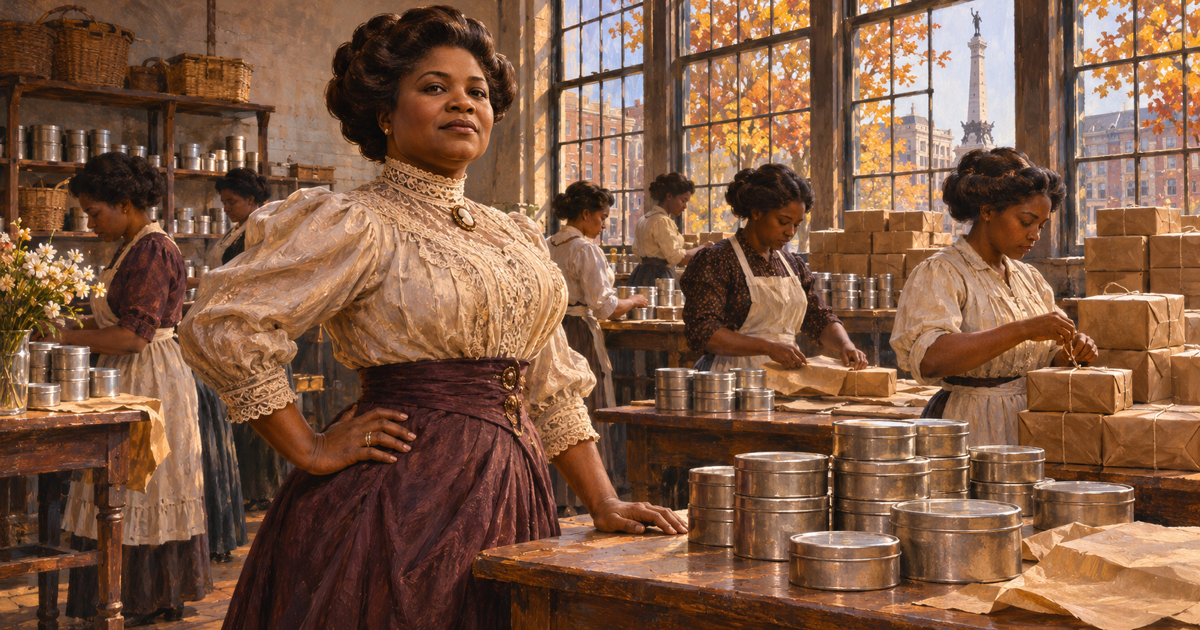
Walker’s business joined several activities that are often separated in accounts of entrepreneurial success. She developed preparations, demonstrated treatments, recruited sellers and established schools. A customer could purchase a tin; a trainee could learn a service; an agent could carry the company into a neighborhood its founder would never visit. Understanding those connections explains more than treating her fortune as the inevitable reward for discovering a remarkable formula.
Her achievement also requires a distinction between opportunity and equality. Selling hair preparations did not remove the restrictions facing Black women in employment, housing or public life. It created another way to earn within those restrictions. Walker’s commercial importance lay partly in recognizing that the women whom many employers confined to household labor could become skilled practitioners, repeat purchasers and local business operators.
A laundress entered an existing beauty business
Walker was born Sarah Breedlove on December 23, 1867, in Delta, Louisiana, to parents who had been enslaved before the Civil War. Orphaned as a child, married at 14 and widowed while still young, she eventually moved to St. Louis, where her brothers worked as barbers. She supported herself through laundry work while raising her daughter. These details appear in the biographical essay by A’Lelia Bundles, her great-great-granddaughter and official biographer.
Laundry work matters to this history as an occupation, not merely as an opening scene in a success story. Walker knew what it meant to exchange physical labor for income while carrying responsibility for a child. Her later recruitment of women doing similar work addressed a practical employment problem. A beauty business offered a different relationship between skill, customers and earnings, even though it still demanded labor and exposed its operator to commercial risk.
Her route into that business began with an existing entrepreneur. Annie Turnbo Malone had developed hair-care products and a sales organization before Walker established her own company. Walker used Malone’s preparations and worked as her sales agent. In 1905 she moved to Denver selling Malone’s products. The Smithsonian’s Walker collection introduction identifies this employment directly, placing apprenticeship and competition inside a story frequently reduced to solitary invention.
That sequence changes the business lesson. Walker did not have to invent the idea that Black women would buy specialized hair products, nor did she create direct selling from nothing. She entered a trade in which another Black woman had already demonstrated demand. Her task was to establish a distinct business capable of acquiring customers, teaching its methods and supplying its sellers consistently.
The distinction also restores Malone to the history without turning the two women into characters in a simple rivalry. A former agent can learn from an established company and later compete with it. Recognizing that relationship gives a more credible account of industry formation than claiming that an entire commercial category sprang from one founder’s inspiration.
The product came with a method
Walker had experienced scalp trouble and hair loss herself. After experimenting with preparations, she sold products under the Madam C. J. Walker name, adopted after her marriage to Charles Joseph Walker in 1906. Her personal experience gave the business a specific starting point: she understood the distress associated with the problem she was asking customers to address. It did not, by itself, establish the effectiveness of every claim made in period advertising.
The company’s offering extended beyond its best-known preparation, Wonderful Hair Grower. The Library of Congress describes the Walker System as a combination of shampoo, pomade, brushing and the application of iron combs. Its account also identifies a factory, salon, beauty school and laboratory at the Indianapolis headquarters. The business sold products within a taught routine rather than relying entirely on a purchase made from an advertisement.
Commercially, a method gives a seller more to explain than a container and a price. Demonstration can show a customer what to do, while instruction can give a practitioner a service to offer. For Walker, those activities linked consumption to training. The same preparations that left the factory could appear in a treatment, a lesson or a subsequent order.
This does not justify describing every Walker preparation as a medical breakthrough. Historical product names and promotional language belong to their period; they are not modern clinical evidence. The stronger documented claim concerns the organization around the products: Walker taught a recognizable system and made training part of the company’s expansion.
Nor did she invent the straightening comb or chemical permanent treatments. Bundles explicitly corrects both misconceptions. That correction makes the history more useful. Walker’s achievement did not require ownership of every tool used by a beauty practitioner. It required bringing preparations, instruction, salesmanship and a recognizable identity into a business customers and agents could understand.
A school could extend the founder’s reach
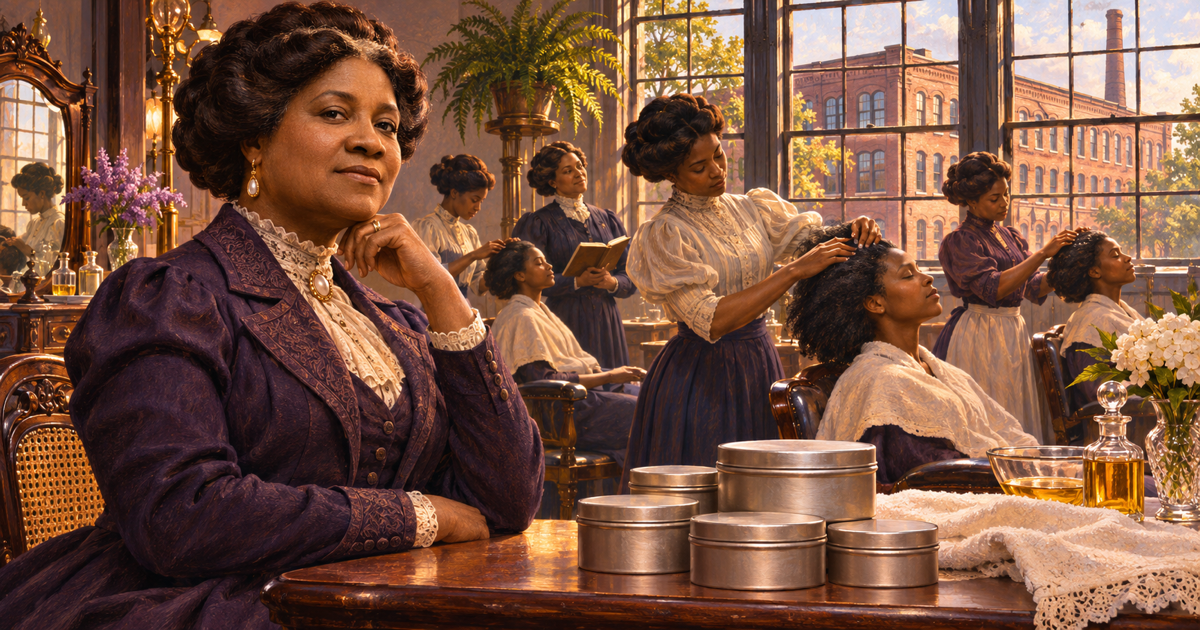
In 1908 Walker established Lelia College in Pittsburgh to train hair culturists. Her daughter helped run the expanding operation. The Smithsonian’s account of Malone and Walker places beauty schools alongside products and employment as central features of their enterprises. Instruction was part of how these businesses reproduced their services beyond the founder’s immediate presence.
A founder demonstrating treatments personally faces an obvious limit: she can be in only one place at a time. A school offers a way around that constraint by preparing other people to perform and explain the work. It also introduces a new problem. The company’s reputation begins to depend on practitioners whose daily decisions the founder cannot directly supervise.
Training therefore had a commercial purpose beyond recruitment. A product associated with a method needs people who can carry out that method credibly. Teaching gives the company an opportunity to establish expectations before a practitioner meets paying customers. It cannot guarantee consistent results, but it makes consistency an organizational task rather than a matter of individual improvisation.
The practitioner, meanwhile, needed something different from what the manufacturer needed. Walker’s company needed distribution and demand for its preparations. A woman opening a beauty business needed customers willing to pay for her time and skill. Those interests could support each other, but they were not identical. Selling agents and service providers should not be treated simply as additional factory employees.
That distinction is essential when assessing the social promise of the enterprise. An opportunity to operate a business is not a guaranteed wage. Earnings depend on local demand, expenses and the ability to retain customers. Walker expanded the available routes into paid work; the existence of her network alone cannot establish that every participant prospered equally.
Indianapolis supplied the machinery of expansion
Walker moved her headquarters to Indianapolis in 1910. The National Park Service’s business history emphasizes the city’s railway connections and substantial Black community. It describes a factory, salon and training school, as well as agents learning to establish home beauty businesses and keep records. The location served both the movement of goods and the development of a local organization.
This was a different requirement from choosing a city for its prestige. A mail-order manufacturer needed to get preparations to purchasers. A training operation needed accessible premises and people who could administer instruction. A founder traveling to promote the business needed others to keep the operation functioning while she was away. Indianapolis brought these needs together in a working headquarters.
The resulting structure combined a central manufacturing operation with dispersed selling. Central production gave the company a common source of goods. Local agents supplied personal contact with customers. Schools connected the two by teaching practitioners how to use the preparations. Each activity depended on the others: recruitment without supply would disappoint agents, while production without effective selling would leave goods unsold.
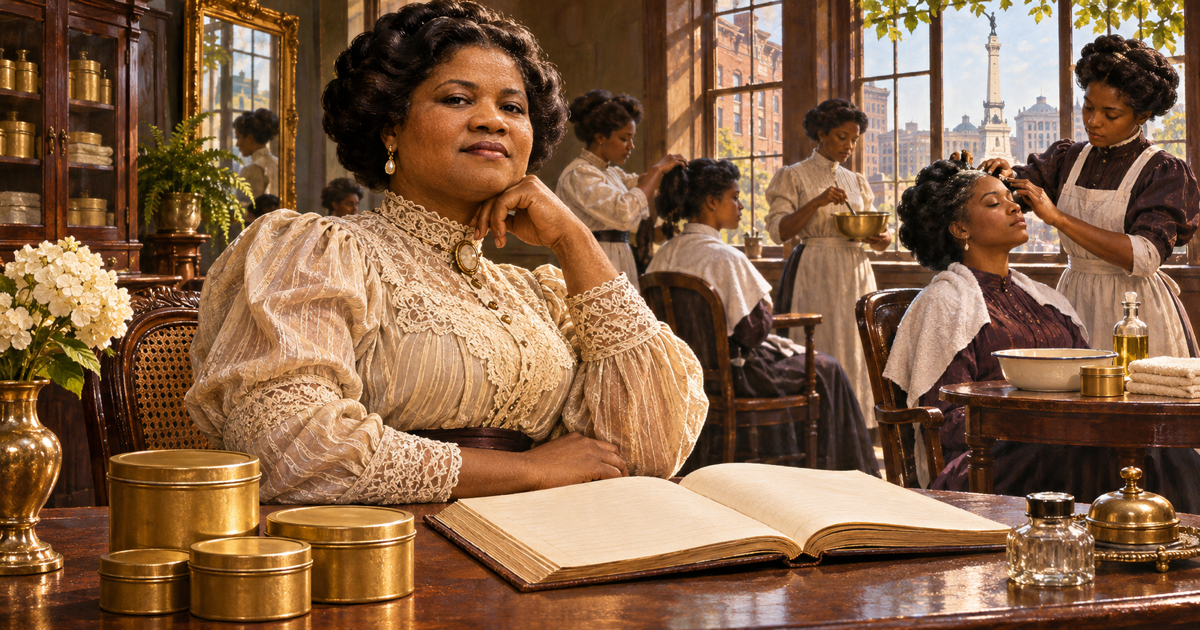
Business records belonged inside that structure. A treatment might attract a customer, but orders, payments and correspondence determined whether the commercial relationship could continue. The emphasis on teaching recordkeeping is therefore a revealing detail. Walker’s organization was preparing women to conduct transactions and manage a business, alongside teaching the visible work of hair care.
The scale of the network should still be described carefully. Historical accounts give different totals for agents and workers, sometimes covering different dates or categories. The secure conclusion is that Walker developed a national organization numbering in the thousands. A precise headcount means little unless the reader knows whether it includes active agents, trainees, employees or everyone associated with the company over time.
Distance required managers, correspondence and authority
Walker’s daughter, later known as A’Lelia, took responsibility for operations in Pittsburgh and then for the New York school and salon. Walker herself moved to New York in 1916 while retaining oversight of the company. Daily work in Indianapolis rested with attorney and general manager Freeman B. Ransom and factory forewoman Alice Kelly. Bundles’s biography identifies both managers and makes clear that the founder continued working after her relocation.
The arrangement exposes a less theatrical part of entrepreneurial growth. A company can outgrow the founder’s ability to inspect every shipment or settle every question in person. Expansion then requires authority to pass to other people. The founder’s contribution changes: maintaining direction becomes inseparable from selecting managers and sustaining communication with them.
Ransom and Kelly performed different kinds of work, and both mattered. Legal and administrative competence could not substitute for supervision of production. Factory knowledge could not replace the handling of company affairs. Treating the enterprise as the achievement of one energetic personality hides the division of responsibility that allowed her to keep traveling and promoting it.
The surviving archive offers evidence of that continuing involvement. The Indiana Historical Society describes letters Walker sent to Ransom from her travels, along with extensive company records. Those materials point toward a founder governing through correspondence, rather than withdrawing once she acquired a more comfortable residence. Distance altered the means of supervision; it did not automatically end it.
Her wealth warrants similar care. Walker is widely remembered as a self-made millionaire, and the Smithsonian uses that description. The Indiana Historical Society’s guide also records her own denial of millionaire status in 1918 and distinguishes the value of business ownership and property from simpler claims about fortune. Those accounts counsel against treating a familiar label as a precise statement of cash available at a particular date.
The important commercial fact survives that uncertainty. Walker owned a substantial manufacturing and distribution business and accumulated property from earnings generated in an industry she had entered as an agent. Her significance does not depend on attaching an unsupported valuation to every stage of that ascent.
Sales organization became civic organization
Walker encouraged agents to form clubs, and their 1917 convention in Philadelphia combined recognition of business achievement with an appeal for political action. Bundles describes her involvement in the campaign against lynching and her response to the killings of Black residents in East St. Louis that year. The network that circulated preparations also connected women who could meet, organize and act beyond individual transactions.
This connection was particularly consequential in a segregated economy. A business association could provide relationships that a woman working alone might struggle to establish. Meetings created occasions to exchange information and identify shared concerns. That did not turn a cosmetics company into a substitute for political rights, but it gave some of its participants an additional institution through which to exercise a public voice.
Walker’s giving also connected commercial earnings to established Black institutions. Bundles records a $1,000 contribution to the Indianapolis Black YMCA building fund shortly after Walker settled in the city, as well as a later $5,000 contribution to the NAACP’s anti-lynching work. These were specific uses of wealth, directed toward organizations with purposes beyond selling her preparations.
The relationship between business and civic activity should not be flattened into an advertising strategy. A donation can establish standing, but it can also finance work the donor considers necessary. Walker’s documented political involvement supports taking her commitments seriously. The historical question is what she funded and encouraged, rather than whether every act can be translated into a sales benefit.
She died on May 25, 1919. The Walker Building in Indianapolis, completed in 1927 after her death, combined company headquarters with commercial and cultural functions, according to the National Park Service. Its later completion matters: it belongs to the continuation of the enterprise by others, rather than to a list of projects she personally saw through to opening.
Walker’s business history is ultimately a history of connected occupations. Manufacturing supplied agents; schools prepared practitioners; treatments brought products into customers’ routines; managers kept the organization operating while its founder traveled. For women whose employment choices were sharply restricted, that structure offered a route into commerce. Its lasting significance rests on those concrete arrangements as much as on the wealth of the woman whose name appeared on the tins.
Frequently asked questions
What did Madam C. J. Walker sell?
She sold hair and scalp preparations, including Wonderful Hair Grower, within a business that also provided beauty training and treatments.
Did Madam C. J. Walker invent the straightening comb?
No. Her official biographer explicitly rejects that claim. Her achievement centered on products, training, manufacturing and distribution.
Why did Walker choose Indianapolis?
Its railway connections, industrial capacity and established Black community supported her manufacturing, mail-order and training operations.
💡 Key Insights
- ▸ Walker learned the trade as an agent for Annie Turnbo Malone.
- ▸ Training connected product sales with paid beauty services.
- ▸ Rail connections and delegated management supported expansion.
- ▸ Agent associations also provided a setting for civic action.
Sources
- Indiana Historical Society — Madam C. J. Walker Papers ↗
- A’Lelia Bundles — About Madam C. J. Walker ↗
- Smithsonian Transcription Center — Madam C. J. Walker Collection ↗
- Library of Congress — The Beauty Entrepreneur: Madam C. J. Walker ↗
- Smithsonian — Annie Malone and Madam C. J. Walker ↗
- National Park Service — Two American Entrepreneurs ↗