Madam C.J. Walker Sold Hair Treatments and Trained Her Own Sales Force
Madam C.J. Walker built a hair-care business by combining products, practical training and direct sales, then used its proceeds to support Black institutions.
View all stories about this mogul
In the 1910 United States census, Sarah Walker and her husband Charles were living in Indianapolis with the same occupation: manufacturer. Their industry was recorded as “hair goods.” Ten years earlier, census takers had found her in St. Louis under the name Sarah Davis. The records document a change that the familiar millionaire label can obscure: before Madam C.J. Walker became a monument to individual achievement, she built an organization capable of making, teaching and selling a repeatable service. The National Archives traces both census entries.
The jar of hair preparation was only one part of that organization. Walker also needed women who could demonstrate treatments, customers who would return, instruction that could travel beyond her own hands, and a manufacturing base that could fill orders. Her commercial achievement lay in connecting those activities. Examining those connections explains more than treating her fortune as the inevitable reward for a good formula.
Sarah Breedlove entered a trade that already existed
Walker was born Sarah Breedlove on December 23, 1867, near Delta, Louisiana. Her parents, Owen and Minerva, had been enslaved. Orphaned as a child, she later worked as a laundress in St. Louis while raising her daughter, Lelia. Her older brothers were barbers. Hair care was therefore both a personal concern and a trade she could observe through people close to her.
During the 1890s, Breedlove experienced hair loss and sought remedies. She eventually sold products for Annie Turnbo Malone, an established Black beauty entrepreneur. In 1905 she moved to Denver; in 1906 she married Charles Joseph Walker and adopted the business identity Madam C.J. Walker. The Smithsonian’s collection introduction places her employment with Malone before the development of her separate business.
That sequence matters. Walker did not discover a population with no previous suppliers, and she did not originate Black women’s commercial hair care. She entered an existing trade with experience of its customers and selling methods. Calling her an isolated inventor erases the commercial environment in which she learned, including another Black woman’s substantial business.
Her experience as a customer offered a different advantage from a patent or an exclusive distribution agreement. She could discuss a problem she had encountered herself. But personal experience could introduce a treatment only once. A durable business required other people to explain and deliver it without the founder standing beside them.
There is also a limit to what the product’s name establishes. Wonderful Hair Grower was a commercial claim, not the result of a modern clinical trial. A business history can document its sale and promotion without endorsing every therapeutic promise. Walker’s biographer A’Lelia Bundles also explicitly rejects the persistent claim that she invented the straightening comb or chemical perms. Bundles’s biographical essay separates those myths from her documented work.
The distinction changes the case study. The question is less whether Walker possessed a unique object than whether she assembled a useful commercial system around treatments and preparations. Her subsequent decisions—traveling demonstrations, a school, a factory and an agent network—point toward the second explanation.
A school made the service easier to reproduce
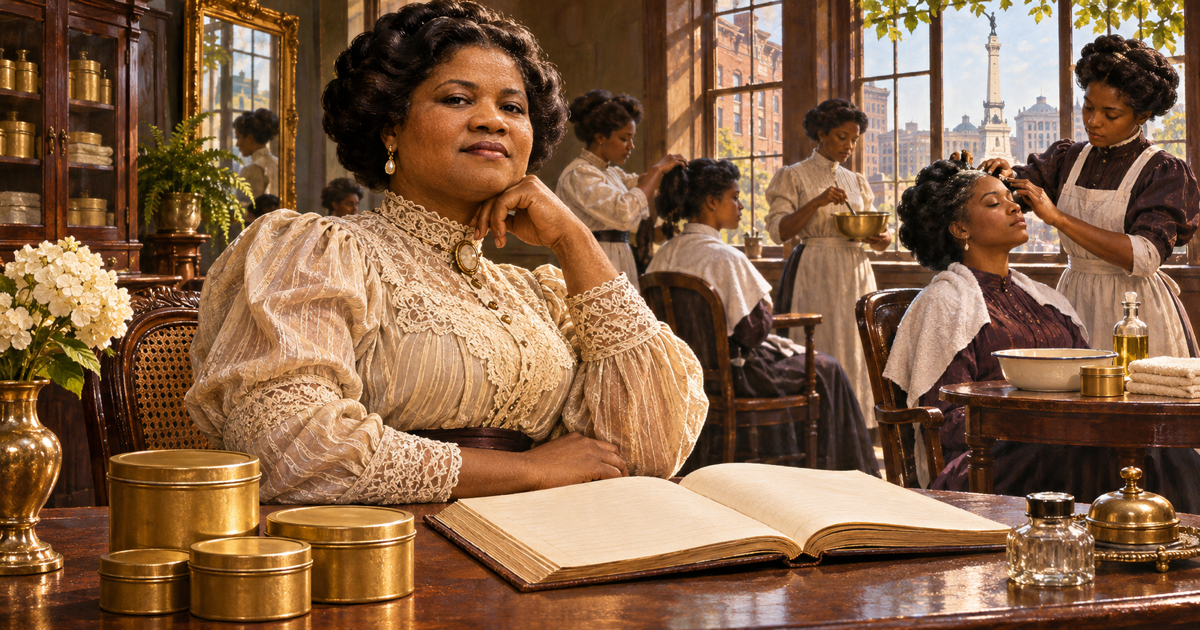
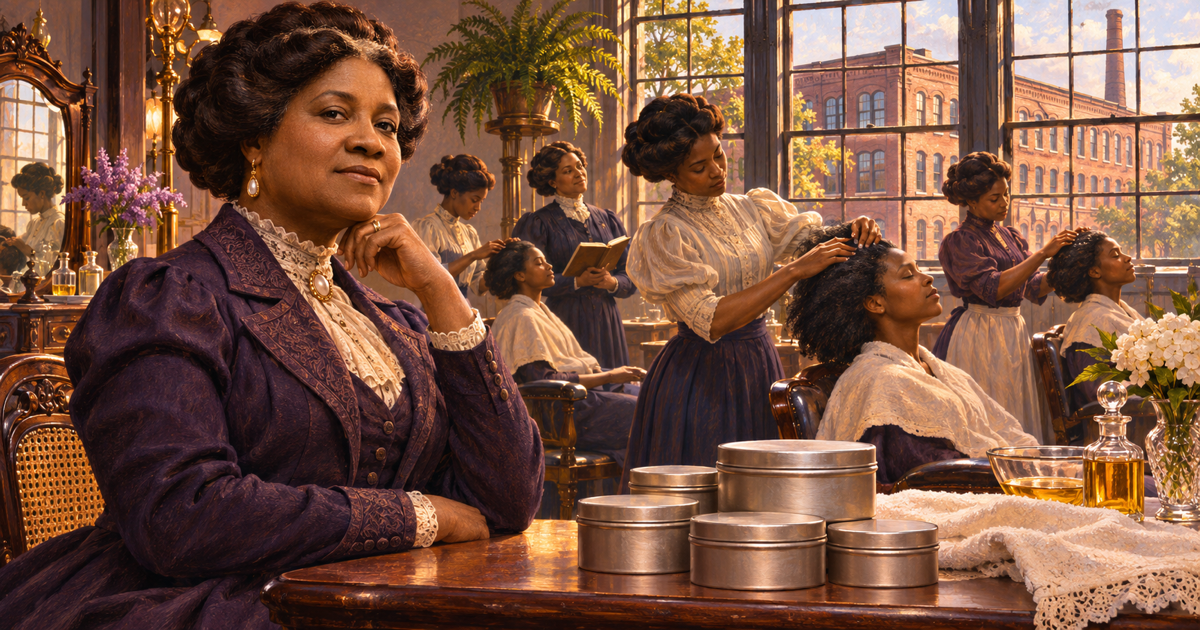
Walker promoted her preparations through personal selling and demonstrations. In 1908 she established Lelia College in Pittsburgh, naming it for her daughter. The school trained women as hair culturists. Rather than relying exclusively on buyers reading instructions attached to a product, she developed a way to teach representatives how to use and sell the treatments.
The surviving material makes that teaching function tangible. The Smithsonian’s Walker collection includes a beauty-school textbook, a Lelia College diploma, an authorized-agent sign, advertising material and product containers. These are different kinds of business equipment: instructions for the operator, evidence of training, identification for the premises, promotion for customers and packaging for the merchandise. The collection presents them together.
Taken together, those objects suggest why a school belonged inside a beauty-products business. A preparation can leave a factory in consistent condition while the customer’s experience varies with the person applying it. Instruction addresses that second problem. It gives the company a means of influencing the service after the merchandise has left its premises.
A diploma also makes training visible. It cannot prove that every graduate performed equally well, but it gives an operator something more specific to present than a personal assertion of skill. An authorized-agent sign serves a related purpose: it connects a local seller to a recognizable organization. Both devices help a distant manufacturer appear in a neighborhood where the founder may never visit.
This arrangement offered a route to expansion that differed from opening a company-owned shop on every street. Trained operators could work locally while obtaining products associated with Walker’s name. The company could increase its reach through instruction and supply rather than through a matching increase in centrally managed retail premises.
That is an interpretation of the structure, not a surviving calculation of its financial returns. The available artifacts do not disclose a uniform cost of acquiring an agent, a standard rate of customer retention or the profitability of every school. They do, however, show that Walker invested in reproducing knowledge as well as manufacturing goods. The distinction is essential to understanding what she was building.
Indianapolis connected production with distribution
Walker moved her headquarters to Indianapolis in 1910. The city offered railway connections and an established Black community. She developed a factory, a salon and another training school there. The National Park Service identifies the city’s access to eight major railway systems as an advantage for a business that used mail order. Its historical account links the location to both transport and community.
Those were complementary assets. Rail connections helped merchandise move between the production base and distant buyers. A local commercial community provided a setting in which a salon, school and manufacturing operation could function together. Choosing headquarters was therefore a decision about the movement of goods and the availability of relationships, rather than simply a move to a larger city.
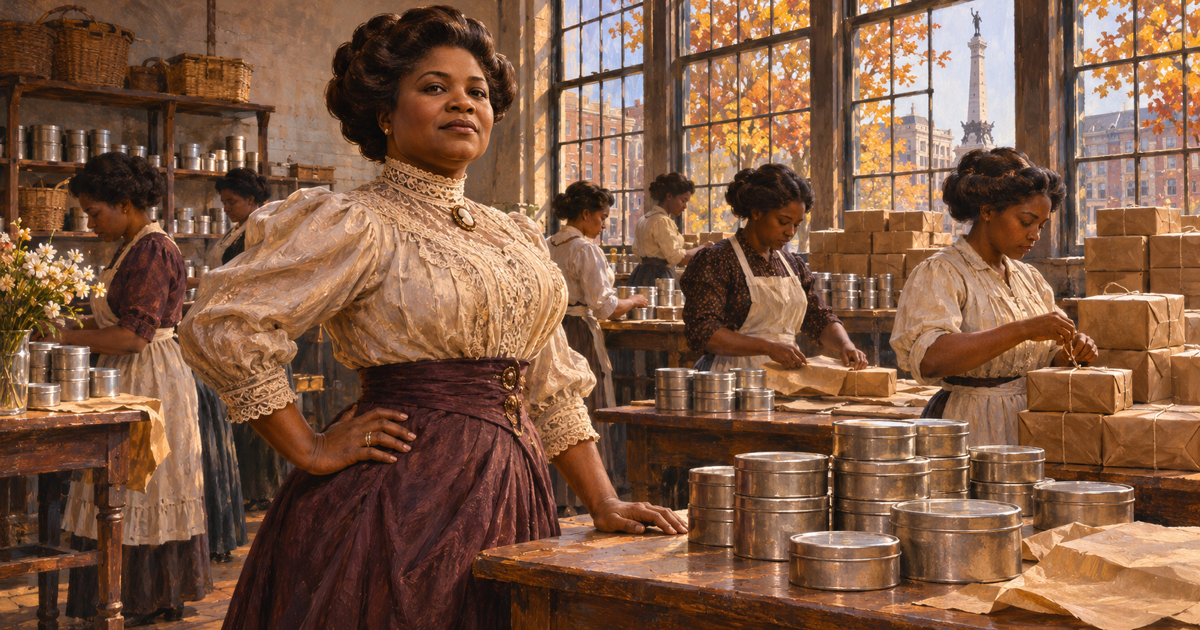
Putting several activities near one another also gave the business a practical organizational shape. Manufacturing supplied the preparations. The salon delivered treatments. The school taught operators. Each activity addressed a different requirement of the same customer proposition. None could substitute entirely for the others: more factory output would not automatically produce more competent operators.
The arrangement exposes a constraint that celebratory accounts often overlook. Recruiting sellers creates an obligation to supply them. Training operators creates an expectation that the branded goods they need will be available. Expansion can therefore increase pressure on a manufacturer before it produces dependable profit. Walker’s manufacturing base belonged to the growth mechanism, not merely to the scenery of her success.
In 1916 she moved her residence to New York while the Indianapolis operation continued under attorney and general manager F.B. Ransom and factory forewoman Alice Kelly. Walker remained involved in the business. The separation of her residence from production is evidence of delegation: the firm could no longer depend on her physical presence for every routine decision. Bundles identifies Ransom and Kelly’s operational roles.
This was a consequential transition for a business bearing its founder’s name. A brand can remain personal while its administration becomes distributed. The owner must still decide whom to rely on, what information to request and which decisions to retain. Walker’s move does not establish that these arrangements were frictionless. It does establish that the organization had developed beyond a traveling proprietor carrying her own stock.
Agents sold labor as well as preparations
Walker’s representatives performed treatments and other beauty services alongside product sales. The National Park Service describes instruction in operating home beauty shops and keeping business records. The work could encompass scalp treatments, hair styling, manicures and massage. An agent’s relationship with a customer therefore involved skilled labor as well as merchandise. The Park Service describes these operating practices.
That distinction helps explain the appeal of training. If the opportunity had consisted solely of passing a jar from manufacturer to customer, technical instruction would have played a narrower role. A service business required the operator to do something the customer valued. Training could support both the sale of the preparation and the operator’s separate ability to charge for work.
The local operator supplied an asset the factory could not manufacture: repeated personal contact. She could explain a treatment, perform it and see the customer again. From the manufacturer’s perspective, this placed a representative close to demand. From the operator’s perspective, the business name and product supply could support a practice rooted in her own neighborhood.
The opportunity must nevertheless be described carefully. Black women faced severe restrictions on employment, and the Walker organization created professional openings. That does not mean every agent earned the same income or achieved lasting independence. A manufacturer’s success, an operator’s gross receipts and an operator’s income after expenses are three different measures.
Nor should the agents all be counted as factory employees. Historical accounts use varying estimates of the network, and categories such as agents, graduates and workers can overlap or refer to different dates. A large cumulative training figure cannot safely be converted into a simultaneous payroll. Precision requires preserving the distinction between making the goods and running a local practice that sold or used them.
The business model also distributed responsibilities. Headquarters had to support its name and supply its products; operators had to attract customers and perform services. This division could extend the brand’s reach, but it also made the customer’s experience depend on many people. The authorized sign and school diploma helped connect them institutionally. They did not eliminate the ordinary uncertainties of running a small business.
Expansion carried the business beyond its founder’s itinerary
In 1913, A’Lelia helped establish the New York branch in Harlem. Walker also pursued business outside the United States. Her passport application and a ship’s manifest provide unusually concrete evidence of that movement: the National Archives identifies a 1913 application signed Sarah Walker and a record of her return from Cuba in 1914. Its account connects these records to foreign sales.
Such records are valuable because they narrow what can responsibly be said. They establish travel and support the account of overseas commercial activity. They do not, by themselves, establish a profitable international division, a particular foreign revenue total or a permanent branch in every place she visited. Business travel is evidence of an expansion effort; it is not a substitute for accounts showing the result.
The combination of a daughter managing important business activity, professional managers in Indianapolis and operators serving local customers created several layers between Walker and the final sale. This is where the story becomes an organizational history. The founder remained prominent, but different people carried distinct parts of the operation.
The same development helps explain why the company’s records deserve attention alongside portraits of Walker. A passport records where she went. A textbook records what the organization wanted operators to learn. A diploma records an institutional relationship. A container records the identity presented to buyers. Each answers a different question; no one object can establish the whole business.
A source-led account therefore resists turning every decision into proof of exceptional foresight. Indianapolis had identifiable advantages. Training served an identifiable function. Delegation made a geographically dispersed operation possible. Those conclusions are strong enough without inventing private motives, reconstructing undocumented conversations or assigning modern financial metrics to incomplete historical evidence.
Commercial proceeds became civic resources
Walker organized agents into local and state clubs and convened a national gathering in Philadelphia in 1917. The gathering recognized business performance while also encouraging civic activity. The Indiana state government’s historical biography describes the convention as an early national meeting of businesswomen, linking commercial organization with political participation. That connection broadened what membership in the Walker network could mean.
Her philanthropy extended beyond the company. She supported educational and community institutions and contributed to the NAACP’s anti-lynching work. The Smithsonian also records scholarships, support for the preservation of Frederick Douglass’s home and a bequest directing a substantial portion of future company net profits toward charity. Its collection introduction documents these commitments.
There is an economic distinction between giving from accumulated assets and assigning future profits. The first transfers wealth already held. The second makes later charitable receipts depend on the business continuing to generate a surplus. Walker’s arrangement connected institutional support to the company’s future performance, while leaving that support exposed to the ordinary uncertainty of future earnings.
Walker died on May 25, 1919. The Indianapolis building associated with her name opened in 1927, after her death. It housed business activity alongside social and cultural facilities. Her daughter carried the project forward. The Madam Walker Legacy Center’s history treats the building as both a commercial landmark and a community institution.
The dates prevent a misleading image: Walker did not operate her lifetime business from a completed building that opened eight years after she died. The later structure belongs to the history of continuation. It shows how a business name and accumulated resources could be developed by successors into something with uses beyond the original product line.
Walker is widely remembered as a self-made millionaire. The more useful explanation of her achievement is specific: she combined manufactured preparations with taught services, recognizable credentials, local selling and delegated administration. Her fortune rested on those connected activities and on the work of people whose names appeared less often on the packaging.
That account also preserves the limits of the achievement. A successful beauty company did not remove the discrimination its customers and operators faced. It created a particular commercial opening within those conditions, then provided resources Walker could direct toward institutions contesting them. The lasting business lesson lies in that documented sequence, rather than in a promise that determination alone can overcome any obstacle.
Frequently asked questions
What did Madam C.J. Walker sell?
She sold hair-care preparations and developed a training and sales organization around scalp treatments and beauty services.
Did Madam C.J. Walker invent the straightening comb?
No. Her official biographer explicitly rejects that claim; her achievement centered on products, training, manufacturing and distribution.
Why did Walker choose Indianapolis?
Its railway connections and established Black community supported a headquarters combining production, mail-order distribution, a salon and training.
💡 Key Insights
- ▸ Training helped reproduce a service beyond the founder's own demonstrations.
- ▸ Indianapolis connected manufacturing, instruction and distribution.
- ▸ Agents' service income differed from the manufacturer's product revenue.
- ▸ Delegated operations supported expansion and later institutional giving.
Sources
- National Archives: Madam C. J. Walker in census, passport and other federal records ↗
- Smithsonian Transcription Center: Madam C. J. Walker Collection ↗
- A'Lelia Bundles: Madam C.J. Walker biographical essay ↗
- National Park Service: Two American Entrepreneurs ↗
- Indiana Governor History: Madam C.J. Walker ↗
- Madam Walker Legacy Center: Our History ↗