Chester Carlson Shared His Patent Rights and Earned a Xerox Fortune
Chester Carlson made a crude electrostatic image in 1938. His Xerox fortune followed decades of development by a research institute and a photographic-paper maker.
View all stories about this mogul
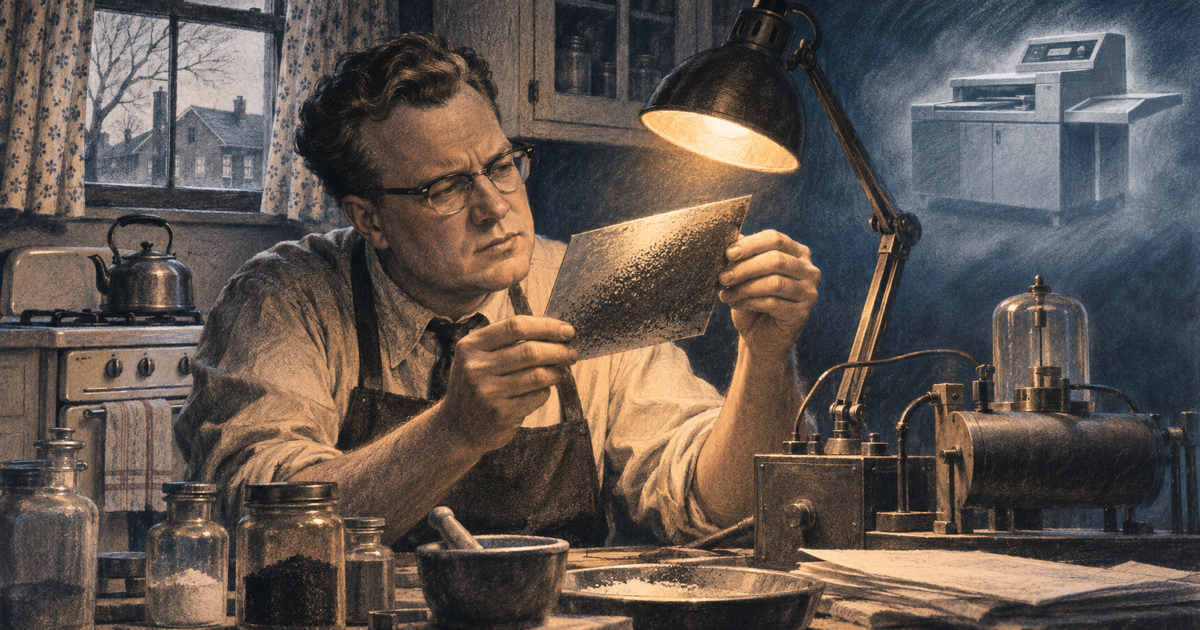
On October 22, 1938, Chester Carlson and his assistant, Otto Kornei, produced a powder image of a date and a place: “10–22–38 ASTORIA.” Their laboratory was a converted kitchen in Queens. The experiment worked. An office machine that made the same process useful to ordinary customers would take another 21 years to reach its public introduction.
That interval is the heart of Carlson’s business history. A successful experiment gave him something to protect and demonstrate, but it did not give him a factory, a service organization or a product an office manager could operate. His eventual fortune depended on getting other institutions to undertake work he could neither finance nor finish alone.
The distinction matters because Carlson is often folded into Xerox’s corporate identity as though he founded a copier manufacturer and steadily enlarged it. He supplied the underlying invention. The commercial organization grew out of Haloid, an existing photographic-paper business in Rochester, New York. The University of Rochester’s history documents their separate paths and eventual partnership.
A copying problem with an expensive workaround
Carlson encountered the need for duplication through patent work. Technical documents needed extra copies, and the available choices imposed costs: photographic reproduction or retyping followed by checking for errors. His opportunity was a particularly awkward kind of office work, in which accurate reproduction mattered as much as readable words.
Consider what retyping a patent specification entails. A fresh typescript can introduce a different number, omit a qualification or alter a reference. Someone must compare the result against the source. The expense therefore includes a second act of reading, with a second opportunity for human error. A reproduction process addresses both the typing and the checking burden.
Carbon paper addressed another part of the problem. It could produce duplicates when the original was typed. It could not supply an additional batch simply because a document already in a file had become useful to more people. That is the practical difference between making planned duplicates and copying something on demand. Carlson’s proposed office machine targeted the latter task.
His solution used electrostatic charge and a material whose electrical conductivity changed under light. Fine powder made the resulting electrical image visible, allowing it to be transferred to another surface. The final sheet did not have to undergo conventional photographic development.
This technical description should not make the business proposition sound inevitable. It identifies a sequence of physical effects. A customer would need a repeatable service: put down a document, obtain a usable copy, and return to work. Between those two descriptions lay most of the cost and difficulty of commercialization.
Carlson’s choice of problem also explains why a blurred demonstration mattered. The aim was never to improve the appearance of a handwritten date for its own sake. The experiment tested whether information on one surface could direct the placement of powder on another. If that relationship could be controlled, the content of the document would become incidental to the copying operation.
A patent could travel where Carlson could not
The institutional turning point came in 1944, when Battelle Memorial Institute committed $10,000 to Carlson’s invention in exchange for 60 percent of future royalties, according to the Rochester account. That arrangement gave the project research backing while leaving Carlson with an interest in its eventual use.
The percentages describe a trade in future proceeds for present capacity. A larger share of a process that remained confined to demonstrations would not necessarily have been worth more than a smaller share of a process other people could develop. This is an economic interpretation of the agreement, rather than evidence that Carlson could predict its eventual value.
The agreement also separated invention from manufacture. Battelle could investigate materials and methods without requiring Carlson immediately to become an industrial employer. A patent interest allowed knowledge and rights to move between institutions. It created a way to participate in a future product without owning every organization required to produce it.
That did not eliminate the search for a commercial partner. Laboratory development could establish that a process was promising while leaving unanswered who would manufacture the equipment, sell it and absorb the losses if customers stayed away. Each additional participant needed a reason to commit resources on terms that made sense for its own business.
Haloid entered through a license effective January 1, 1947. Xerox’s corporate history records that Haloid had earned $101,000 on sales of $6.75 million in 1946. Those figures put its commitment in perspective: it was taking on an uncertain development project with a modest profit base. They do not measure the project’s entire eventual cost. Xerox’s account describes both the license and the resources behind it.
For Carlson, the important result was that the experiment now had an industrial route forward. For Haloid, the license was the start of an obligation rather than the purchase of a finished answer. Rights could make development commercially worthwhile, but they could not substitute for development itself.
The photographic-paper maker needed another business
Haloid’s interest becomes clearer when viewed from its existing trade. It manufactured photographic paper in a city dominated by Eastman Kodak. Joseph Wilson, the executive who committed Haloid to xerography, had a reason to look beyond the continuation of the business he already knew.
An incumbent can regard a new process as an unwelcome diversion when its established products are profitable. A smaller manufacturer facing a powerful competitor can calculate differently. For Wilson, investment in an unfamiliar technology offered a possible route to a more defensible position. That interpretation fits the circumstances without requiring a claim that the outcome was certain.
The fit between Carlson and Haloid was therefore more specific than an inventor finding an enthusiastic backer. Carlson had a copying principle that needed engineering and distribution. Haloid had a commercial organization and an incentive to find a different technical basis for document reproduction. Their limitations were complementary.
Even so, technical difference alone could not create a market. Buyers had no reason to reward Haloid for escaping a competitor’s strengths. They would judge a copier by the work it performed, the demands it placed on staff and the expense of obtaining copies. Wilson’s strategic problem and the customer’s practical problem had to be solved by the same machine.
A licensing agreement could begin that relationship without resolving its hardest questions. Neither the existence of patent rights nor a laboratory demonstration established what a dependable copier would cost to manufacture. Nor did they establish how many offices would use one. The initial commitment exposed Haloid to development costs before either answer was secure.
It would be misleading to treat the transition as Carlson’s uninterrupted march from kitchen experiment to corporate command. Wilson directed the commercial commitment. Researchers and engineers supplied essential development. Carlson’s claim to the history rests on the process and his continued participation, not on having personally performed every executive or technical role.
The first product still asked too much of its operator
The American Society of Mechanical Engineers dates Haloid’s Model A to 1949. Its historical account credits researchers at Battelle and Haloid with solving mechanical engineering problems beyond Carlson’s underlying physics. That division of labor is central: a valid imaging principle still needed machinery capable of carrying it through a useful cycle. ASME’s landmark record follows that progression.
Xerox’s own history describes the early copier as slow and dependent on careful manual operations. It nevertheless found a use in making masters for small printing presses. That application matters because an intermediate product could be useful without yet fulfilling Carlson’s original vision of convenient office copying.
Making a master changes the economics of a cumbersome process. If one carefully prepared sheet enables a subsequent printing run, the operator’s effort is spread across many impressions. The same effort is harder to justify when the desired output is one extra copy for a colleague. A procedure can therefore be commercially tolerable in one workflow and unattractive in another.
This was a limit on the product, rather than proof that the underlying physics lacked value. It also imposed a demanding test on further investment. Haloid needed to distinguish between evidence that xerography could earn money somewhere and evidence that it could become a routine office tool. The two markets placed different requirements on speed, convenience and operator attention.
Automation meant bringing successive operations into a coordinated mechanism. Charging, exposure, powder development, transfer and fixing all had to cooperate. A failure at one stage could spoil the result even if every other stage worked correctly. Improving any individual operation was useful only insofar as the complete cycle became more dependable.
ASME identifies the rotating drum as an important development in the automated microfilm-printing equipment that preceded the office breakthrough. Mechanically, a rotating surface offered a way to move an image-bearing area through successive stages. The business significance was that the process could increasingly be carried by the machine instead of reconstructed by its operator.
The early commercial steps complicate the familiar picture of a single invention suddenly appearing on desks. There was a succession of uses and machines, with different compromises. Commercialization involved discovering where the process could already work while continuing to pay for capabilities it still lacked.
The 914 made ordinary sheets commercially decisive
Haloid Xerox introduced the 914 in 1959. Its designation referred to the ability to copy originals up to nine by fourteen inches. Xerox’s history distinguishes that public introduction from the first customer shipment in March 1960. It reports that 10,000 machines had shipped by the end of 1962.
The dates prevent a common compression of the story. The laboratory result, the early commercial equipment, the public announcement and delivery to customers were separate events. Measuring the development period from the 1938 experiment to the 1959 introduction gives 21 years; measuring to that first shipment gives a little longer.
The 914’s commercial proposition combined automatic operation with output on plain paper. A Smithsonian account emphasizes both the absence of a special-paper requirement and the decision to rent the equipment. Its discussion also identifies patent royalties and Haloid shares as sources of Carlson’s wealth. That account of the machine and its intellectual property connects the inventor’s reward to the commercial arrangements around the product.
Plain paper was a substantial constraint for the engineers and a practical benefit for users. A copy could join an ordinary file, be marked up, or circulate with other office documents. The customer did not have to value the imaging process as a scientific accomplishment. The output fitted an existing way of working.
Renting addressed a different obstacle: acquiring the equipment. It allowed customers to obtain use of the machine without making the same initial commitment as an outright purchase. That distinction helps explain distribution, but rental by itself cannot explain demand. An accessible machine still had to produce copies people wanted often enough to justify keeping it.
The arrangement also made continued use commercially important to the supplier. A manufacturer selling equipment outright receives a purchase price at the transaction. A rental relationship extends the transaction over time. From that structure follows a continuing interest in whether the installed equipment remains useful; this is analysis of the arrangement, not a claim about the terms of every Xerox contract.
The machine’s success transformed the value of earlier commitments. Carlson’s rights, Battelle’s research and Haloid’s engineering were no longer interests in a laboratory possibility. They were connected to equipment reaching customers in substantial numbers. The difference was operational: the sequence demonstrated in Astoria could now be delivered as an office product.
Carlson’s reward reached beyond Xerox shares
Carlson’s position challenges the assumption that an inventor must retain corporate command to receive a large reward. His participation took the form of intellectual property, agreements and stock ownership. Other people directed the organization that manufactured and distributed the machines. The resulting wealth depended on those contributions becoming valuable together.
There is no basis for assigning all the commercial outcome to a single contractual decision. Rights without a useful product would have remained limited assets. Engineering without a route to customers would have remained an expense. Distribution without satisfactory copying would have produced disappointed users. The history supplies a concrete example of those dependencies operating across separate institutions.
Carlson died in 1968. In a centenary tribute, Xerox quoted his daughter Catherine as saying that he had given more than $100 million to charitable organizations during his lifetime. That is an attributed historical estimate, not an independently audited total or a valuation of his estate. Xerox’s 2006 tribute provides the statement.
A more specific institutional record comes from Rochester Institute of Technology. RIT says Carlson visited its campus, belonged to its Nathaniel Rochester Society and left it a substantial bequest; his widow continued supporting the institution. Its Chester F. Carlson Center for Imaging Science page records that connection.
Those gifts add another stage to the economic history. The process first generated a transferable interest, then supported a commercial product, then supplied wealth its inventor could direct elsewhere. Each stage required a different organization. The kitchen experiment established a physical possibility; it did not contain a manufacturer, a distribution system or an educational beneficiary in miniature.
The enduring business twist is that Carlson made his fortune from an invention whose usefulness took decades of other people’s work to realize. He remained economically connected to it while surrendering substantial claims on its future proceeds. The powder image of a date became valuable because institutions agreed to carry it further than its inventor could take it alone.
Frequently asked questions
What did Chester Carlson invent? He invented xerography, an electrostatic copying process that uses a photoconductive surface and powder to reproduce an image.
Did Carlson found Xerox? No. Xerox grew out of Haloid, an existing photographic-paper manufacturer that licensed and developed his process.
When did the Xerox 914 reach customers? It was introduced in 1959; Xerox records the first customer shipment in March 1960.
💡 Key Insights
- ▸ Carlson exchanged a substantial royalty share for research capacity.
- ▸ Haloid supplied the industrial commitment his experiment lacked.
- ▸ Automatic operation and plain-paper output made the process practical.
- ▸ Royalties and shares rewarded Carlson without requiring corporate control.
Sources
- University of Rochester — How Xerox began: Carlson, Wilson, and URochester ↗
- Xerox — The Story of Xerography ↗
- American Society of Mechanical Engineers — Xerography ↗
- Smithsonian Magazine — How Xerox's Intellectual Property Prevented Anyone From Copying Its Copiers ↗
- Xerox — Inventor of Xerography celebrated on 100th birthday ↗
- Rochester Institute of Technology — Chester F. Carlson Center for Imaging Science ↗