Amancio Ortega: The Invisible Man Who Dressed the World
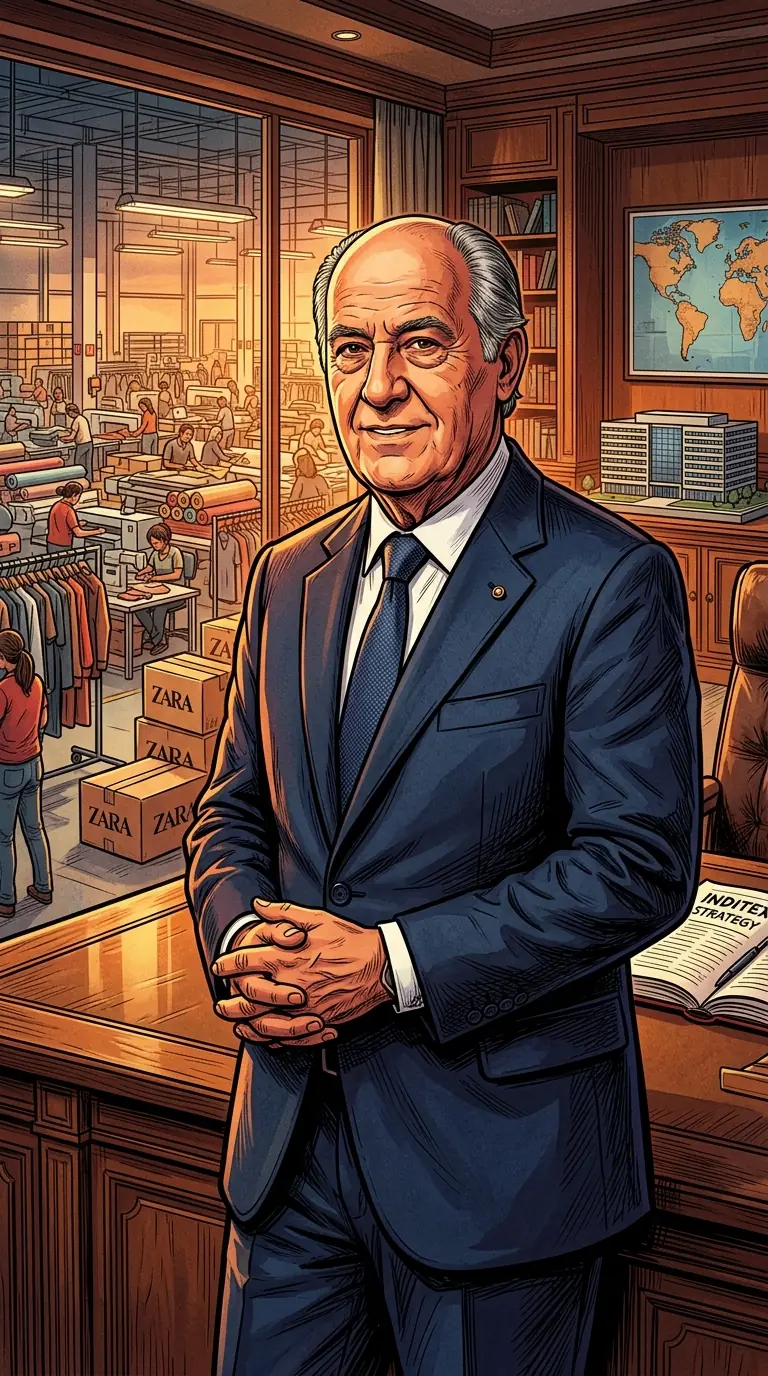
He never gave an interview. He ate lunch with his employees in the company cafeteria. He wore the same outfit every day. And he quietly built Zara into the largest fashion retailer on Earth, amassing a $100 billion fortune while remaining so unknown that his own neighbors didn't recognize him. This is the story of the most successful invisible mogul in history.
View all stories about this mogul
🧵 Chapter 1: The Shirt Maker’s Son
Amancio Ortega Gaona was born on March 28, 1936, in Busdongo de Arbás, a tiny village in León, in the northwest of Spain. His father was a railway worker. His mother was a housewife. The family was poor — not dramatically poor, but consistently, grindingly, unrelentingly poor.
The story that defined Amancio’s childhood — and that he would tell, in the rare moments when he spoke about himself at all — was the day his mother tried to buy food on credit at the local grocery store and was refused. Young Amancio was with her. He watched her face as the shopkeeper said no. He watched her walk home empty-handed.
He was twelve years old. He decided, at that moment, that he would never be poor again.
“That day in the shop, I saw my mother humiliated. I understood something that has stayed with me ever since: money is dignity. Without it, you are at the mercy of others. I never wanted to be at the mercy of others again.”
Amancio dropped out of school at fourteen and got a job as a shop hand at a shirt store in La Coruña — a port city in Galicia, on Spain’s Atlantic coast. The store, called Gala, sold dress shirts to the middle class. Amancio swept floors, organized inventory, made deliveries, and — most importantly — watched.
He watched how customers behaved. What they looked at. What they touched. What they tried on. What they bought. What they left on the rack. He was, without knowing it, conducting the world’s first fast-fashion market research.
He moved to a larger store, La Maja, where he began learning the manufacturing side of the business. He understood, through direct observation, the entire value chain of fashion retail: design, sourcing, manufacturing, distribution, and sales. He understood where the costs were. He understood where the margins were. And he understood where the opportunities were.
By his early twenties, Amancio Ortega knew more about the fashion retail business than most people learn in a lifetime. He just needed the capital to start.
🏭 Chapter 2: The Workshop
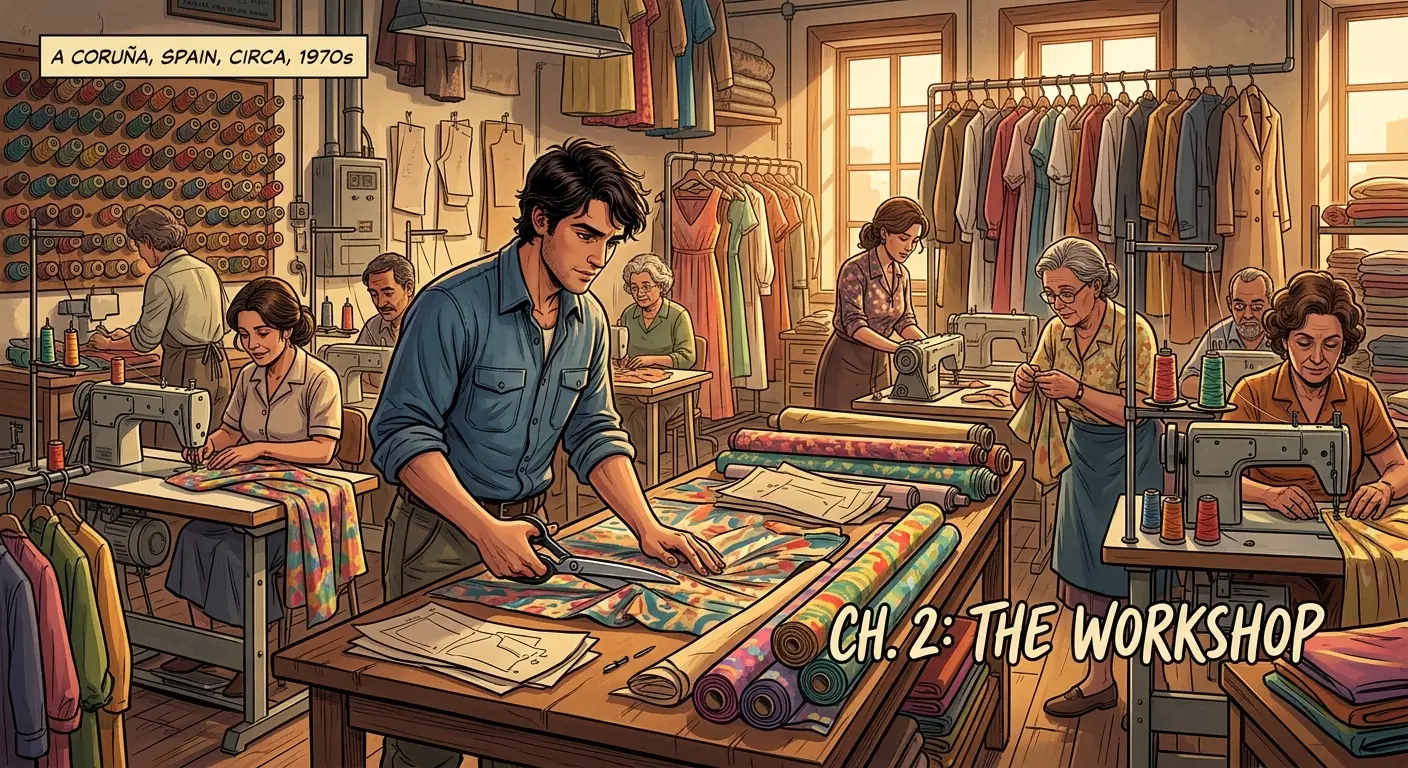
In 1963, Ortega and his then-wife, Rosalía Mera, started a small business making quilted bathrobes. The workshop was in their living room. Rosalía sewed. Amancio sold.
The bathrobes were not glamorous. But they were well-made and, crucially, cheap. Ortega had figured out how to source fabric at low cost and manufacture efficiently in small batches. He sold the bathrobes directly to stores, cutting out the wholesaler and capturing the margin.
The business grew. Ortega expanded from bathrobes to lingerie, to children’s clothes, to women’s fashion. Each product line was characterized by the same formula: good design, decent quality, low price, fast turnaround.
In 1975, Ortega opened his first retail store. He wanted to call it “Zorba” (after the film Zorba the Greek). But there was already a bar nearby with that name, so he rearranged the letters and came up with: Zara.
The first Zara store was on a central street in La Coruña. It sold fashionable clothing at prices that were dramatically lower than the established fashion brands. The store was an immediate success.
“The first Zara store proved something I had always believed: ordinary people want fashionable clothes. They don’t want to wait six months for trends to arrive. They don’t want to pay designer prices. They want fashion, now, at a price they can afford.”
But what made Zara different from every other discount fashion retailer was what happened behind the scenes: the supply chain.
⚡ Chapter 3: The Speed Machine
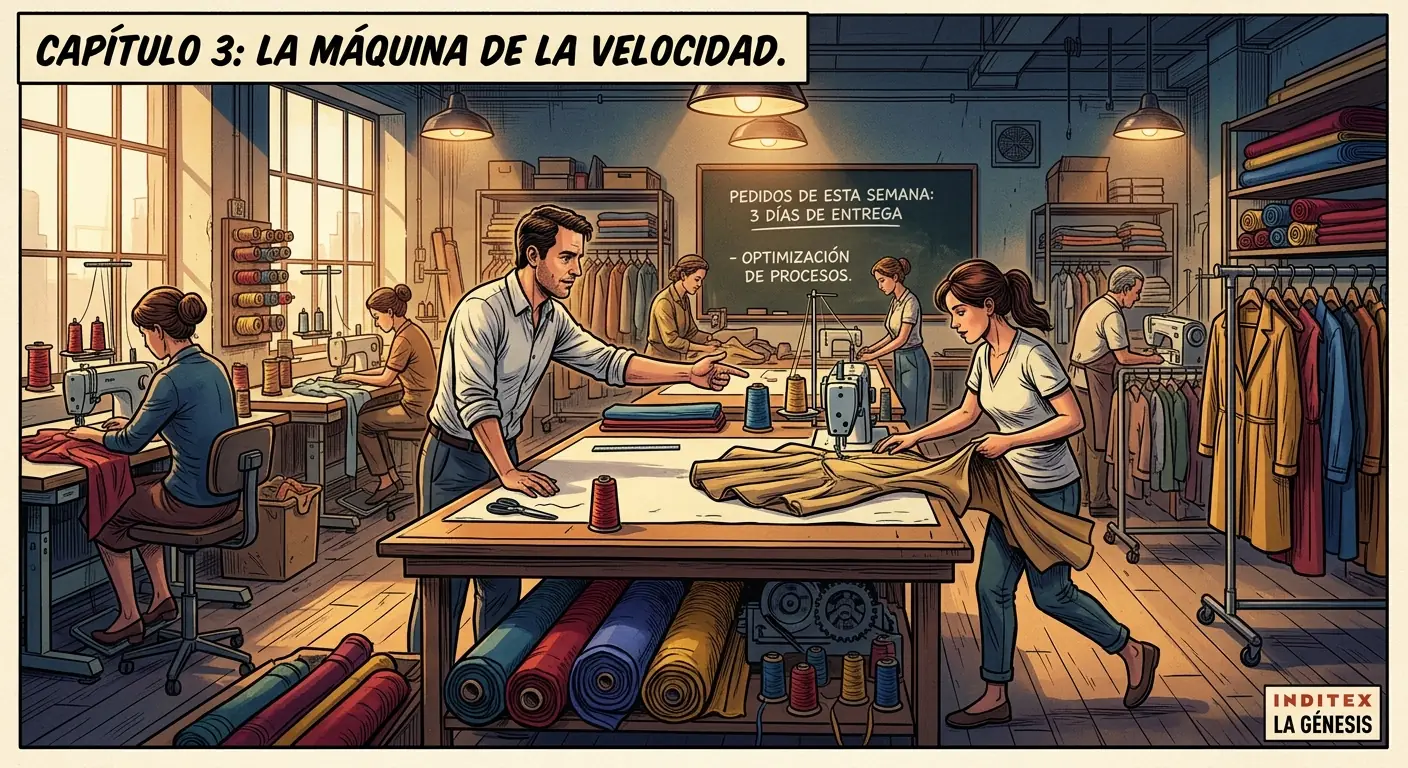
Zara’s supply chain was — and remains — the most sophisticated and fastest in the fashion industry. It is the core reason for Inditex’s dominance, and it is worth understanding in detail because it represents one of the most important business innovations of the past fifty years.
Traditional fashion supply chain:
- Designers create collections 6-9 months before the selling season
- Patterns are sent to factories in Asia (China, Bangladesh, Vietnam)
- Factories produce large batches over several months
- Finished goods are shipped by sea (4-6 weeks)
- Products arrive in stores for the start of the season
- If items don’t sell, they go on clearance at 50-70% off
Zara’s supply chain:
- Designers create items in real-time, based on sales data from stores
- Patterns are sent to factories in Spain, Portugal, and Morocco
- Factories produce small batches in days to weeks
- Finished goods are shipped by truck from Spanish factories to stores worldwide (24-48 hours for Europe, 48-72 hours for other regions)
- New items arrive in stores twice per week
- Items that don’t sell are quickly discontinued; items that sell well are quickly replenished
The speed difference was staggering. Traditional fashion retailers operated on a cycle of 6-9 months. Zara operated on a cycle of 2-3 weeks. This meant:
Zara could respond to trends in real-time. If a celebrity wore a particular style on Monday, Zara could have a similar item in stores within two weeks. Traditional retailers would need six months.
Zara produced less waste. Because items were manufactured in small batches, Zara rarely ended up with mountains of unsold inventory. Items that didn’t sell were discontinued quickly. Items that sold well were replenished immediately.
Zara’s stores always had something new. Customers knew that if they didn’t buy it today, it might not be there next week. This created urgency and frequency — Zara customers visited stores an average of 17 times per year, compared to 3-4 times for traditional fashion retailers.
“Zara’s genius was speed, not design. The designs were often derivative — inspired by (critics would say copied from) high-fashion runway looks. But the ability to go from runway trend to store rack in two weeks was something no competitor could match.”
🌍 Chapter 4: The Global Machine
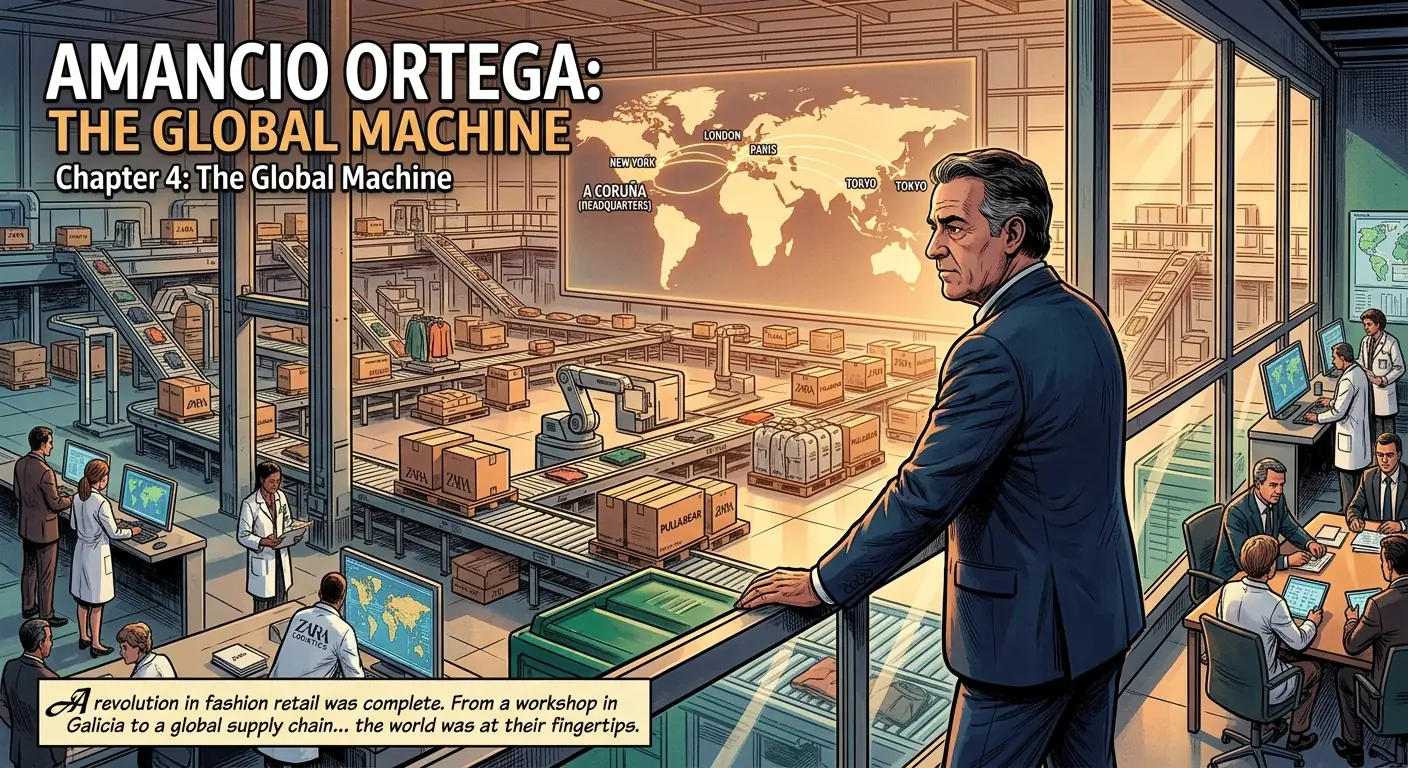
Zara expanded internationally starting in 1988, with a store in Porto, Portugal. The expansion accelerated through the 1990s and 2000s — France, United States, Japan, China, India — until Zara was present in virtually every major market on Earth.
The international expansion was funded internally. Inditex (the parent company, publicly listed in 2001) generated enormous cash flows from its operations, and Ortega reinvested aggressively. There was no private equity. No leveraged buyout. No major debt. Just profits reinvested into growth.
Ortega’s location strategy was counterintuitive: he placed Zara stores on the most expensive retail streets in the world. Fifth Avenue in New York. The Champs-Élysées in Paris. Oxford Street in London. Ginza in Tokyo. These locations were obscenely expensive, but they served as billboards for the brand.
Zara spent almost nothing on advertising — less than 0.3% of revenue, compared to 3-4% for competitors. The stores were the advertising. A Zara store between a Louis Vuitton and a Gucci on the world’s most prestigious shopping street sent a powerful message: we belong here.
“Other fashion companies spent billions on advertising. Ortega spent the same money on real estate. A store on the Champs-Élysées was more effective than any magazine ad — and unlike an ad, it also generated revenue.”
By the 2020s, Inditex operated over 5,600 stores across 8 brands: Zara, Pull&Bear, Massimo Dutti, Bershka, Stradivarius, Oysho, Zara Home, and Uterqüe. Annual revenue exceeded €36 billion ($40 billion). The company employed over 160,000 people.
And Amancio Ortega owned approximately 60% of Inditex, making him one of the richest people on the planet.
👻 Chapter 5: The Ghost Billionaire
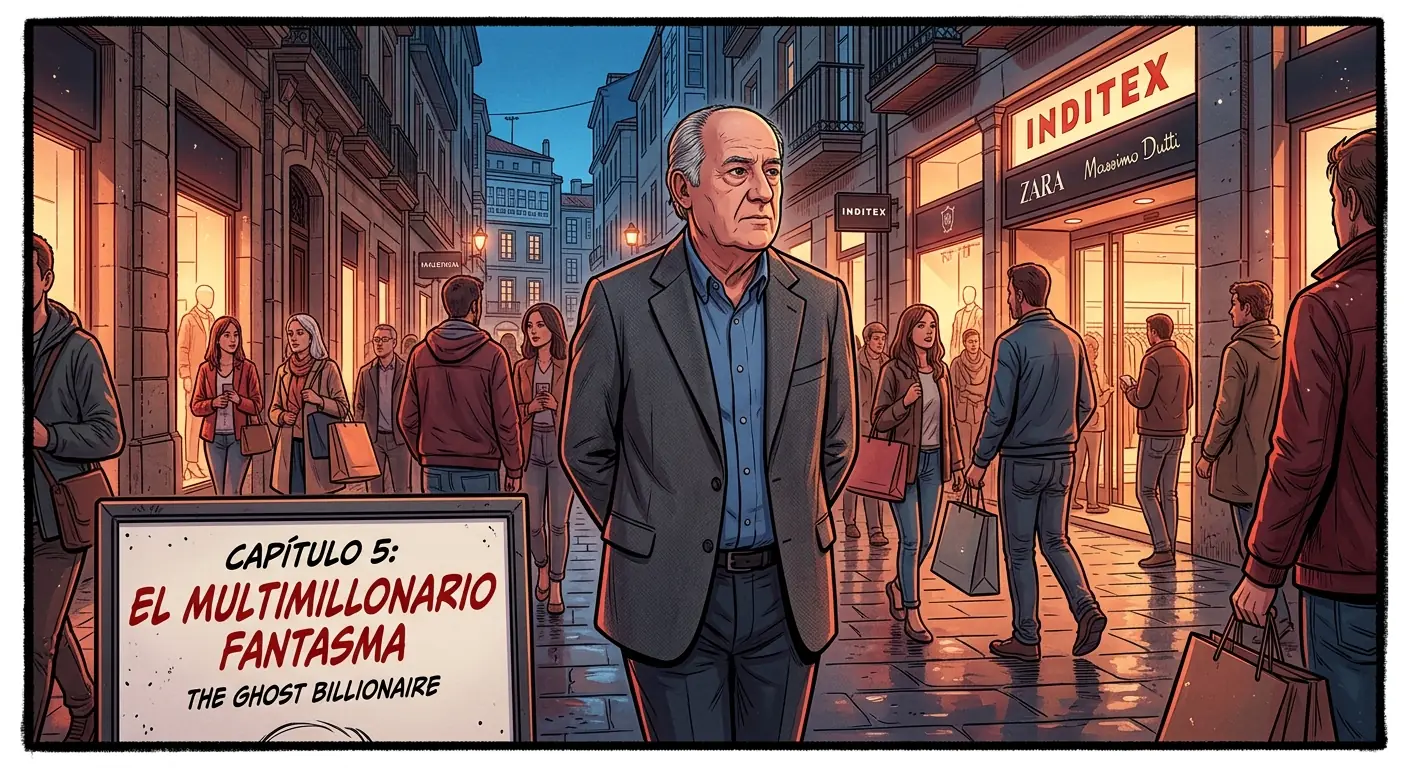
In an age of celebrity CEOs, personal brands, and social media empires, Amancio Ortega was a ghost.
He gave his first (and, for years, only) public interview in 2000 — at the age of 64, when Inditex was preparing for its IPO. He appeared uncomfortable. He spoke quietly. He looked like he wanted to be anywhere else.
After the IPO, he retreated back into anonymity. He declined all interview requests. He made no public speeches. He had no social media presence. He was not photographed voluntarily. Paparazzi who caught him in public captured images of a modest-looking older man in a simple outfit — usually a blue blazer and white shirt — who could have been any anonymous retiree.
His neighbors in La Coruña reportedly didn’t know he was one of the richest people in the world. He ate lunch in the Inditex employee cafeteria, standing in line like everyone else. He drove a modest car. He lived in a relatively simple apartment (though he also owned significant real estate).
“Ortega proved that you don’t need to be famous to be successful. In fact, anonymity might be a competitive advantage. While other CEOs spent time managing their public image, Ortega spent time managing his supply chain. The supply chain made him richer.”
The invisibility was not an accident. It was a deeply held philosophy. Ortega believed that the brand should be famous, not the founder. Drawing attention to himself would distract from Zara. It might also make him a target — for media scrutiny, for political pressure, for kidnapping threats (a real concern for billionaires in Spain, where ETA, the Basque separatist group, had a history of targeting wealthy businessmen).
The result was that Amancio Ortega became the most successful unknown person in the world. A man worth $100 billion who could walk down the street without being recognized.
🏠 Chapter 6: The Real Estate Empire
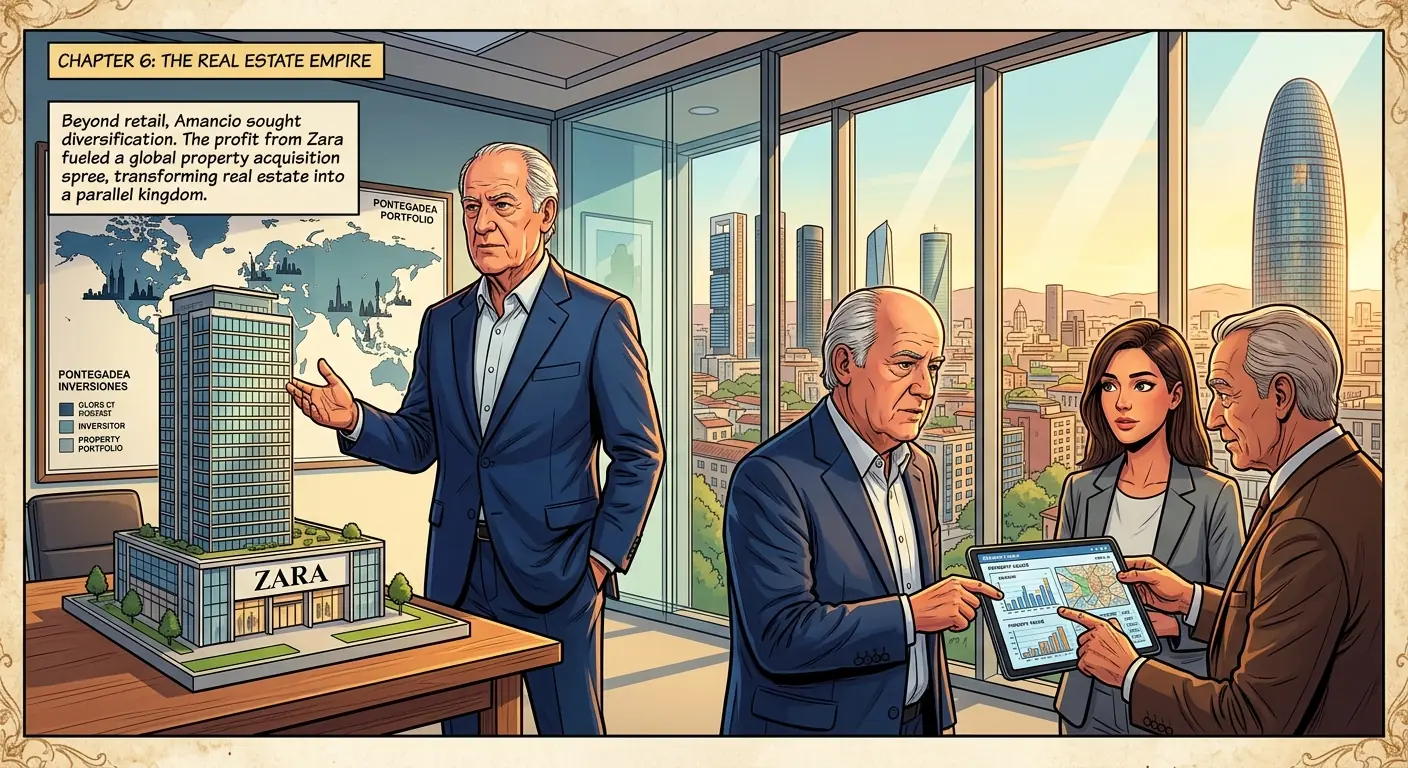
While the world focused on Zara, Ortega was quietly building a second empire: real estate.
Through his investment vehicle, Pontegadea Inversiones, Ortega assembled one of the largest and most prestigious commercial real estate portfolios in the world. The portfolio included:
- Prime office buildings in London, New York, Paris, Madrid, and Barcelona
- Flagship retail spaces on the world’s most expensive shopping streets
- The building that housed Apple’s flagship store on Fifth Avenue in New York
- Major properties in Miami, Chicago, San Francisco, and other major cities
By the mid-2020s, Pontegadea’s real estate portfolio was valued at over $15 billion. The annual rental income exceeded $500 million.
The real estate strategy served multiple purposes. It diversified Ortega’s wealth away from a single company (Inditex). It generated stable, recurring income. And — in a move that was either brilliant or paranoid — it gave Ortega control over some of the retail spaces where Zara and other Inditex brands operated.
“Ortega didn’t just sell clothes from prime retail locations. He bought the buildings. This meant he was both the tenant and the landlord — paying rent to himself. It was the kind of vertical integration that made accountants weep with admiration.”
💑 Chapter 7: The Family

Ortega was married twice. His first wife, Rosalía Mera, was his business partner from the very beginning — sewing bathrobes in their living room, managing production, and co-building the business that would become Inditex. They divorced in 1986 but maintained a business relationship. Mera became one of the wealthiest women in the world in her own right before her death in 2013.
His second wife, Flora Pérez Marcote, was a former Inditex employee. They married in 2001 and had one daughter, Marta Ortega Pérez.
Marta Ortega became the key figure in Inditex’s succession. In 2022, at the age of 37, she was appointed chairwoman of Inditex — the most high-profile role in global fashion retail. The appointment signaled that the Ortega family intended to maintain control of the company for the next generation.
Marta’s style was markedly different from her father’s. While Amancio was invisible, Marta was visible — attending fashion events, giving (rare) interviews, and positioning herself as a modern leader who understood both the heritage and the future of the business.
“The transition from Amancio to Marta represents a generational shift for Inditex. Amancio built the machine in silence. Marta must now run it in a world where silence is no longer an option — where ESG expectations, social media scrutiny, and sustainability demands require a public-facing leader.”
♻️ Chapter 8: The Fast Fashion Reckoning

Zara’s business model — fast fashion at low prices — came under increasing criticism in the 2020s for its environmental impact.
Fast fashion’s fundamental business logic — produce cheap clothes quickly, encourage frequent purchases, and accept that items will be worn a few times and then discarded — was environmentally devastating. The fashion industry was responsible for an estimated 10% of global carbon emissions. Textile waste was a growing crisis. And Zara, as the world’s largest fast-fashion retailer, was the biggest target.
Inditex responded with a comprehensive sustainability strategy. The company pledged that 100% of its cotton would be sustainable by 2025. It invested in recycling technology. It launched clothing collection programs in stores. It set targets for reducing water usage, energy consumption, and waste.
Critics argued these measures were insufficient — that the fundamental fast-fashion model of producing billions of garments per year was incompatible with environmental sustainability, regardless of how the cotton was sourced or how many recycling bins were placed in stores.
Inditex countered that its just-in-time production model actually generated less waste than traditional fashion — because it produced in small batches rather than mass-producing items that might not sell.
The debate was unresolved and likely unresolvable. Fast fashion had made fashionable clothing accessible to hundreds of millions of people who couldn’t afford designer prices. That was a genuine democratization of something that had historically been reserved for the wealthy. But it came at an environmental cost that was increasingly difficult to ignore.
🏆 Chapter 9: The Ortega Equation
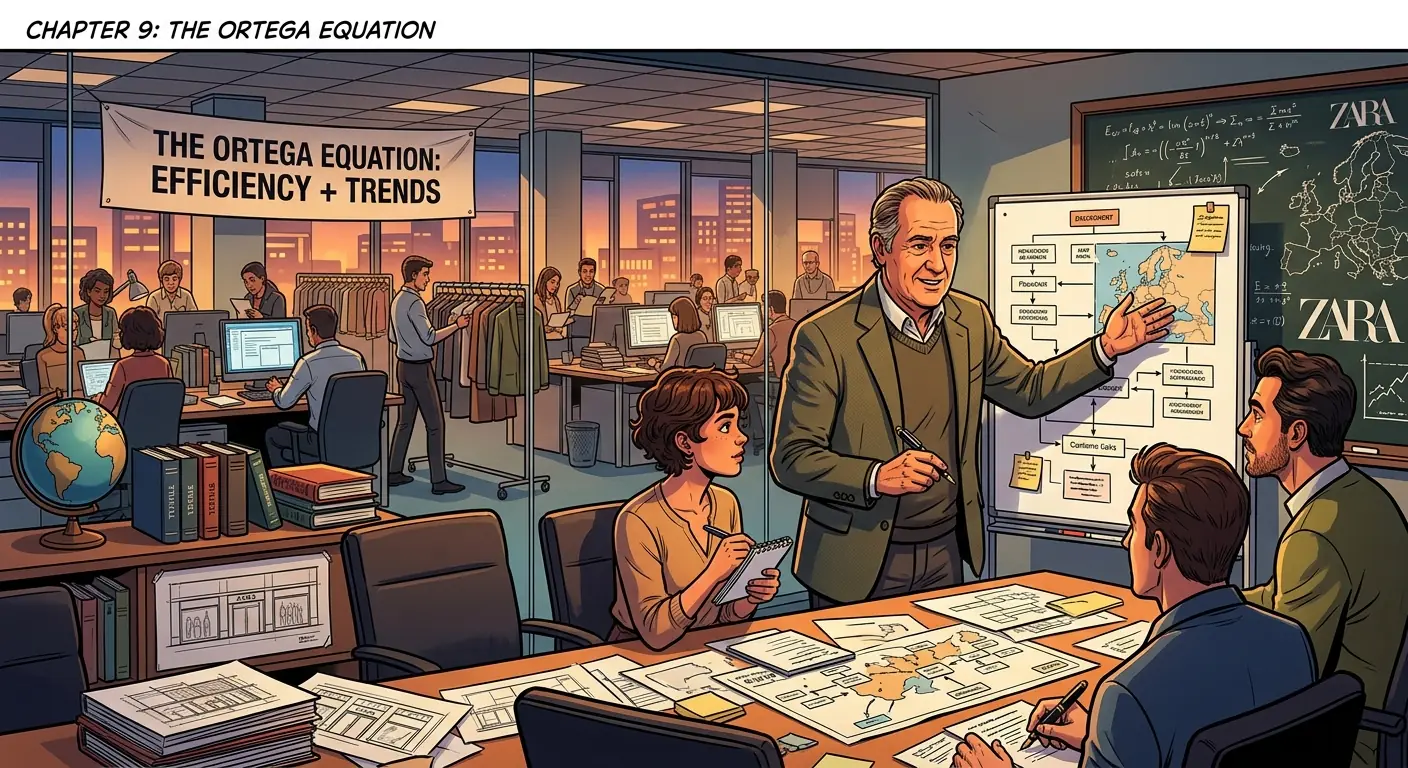
Amancio Ortega turned 90 in 2026. He remained the largest shareholder of Inditex and one of the wealthiest people on Earth, with a net worth that fluctuated around $100 billion depending on Inditex’s stock price.
He was, as always, invisible. No interviews. No speeches. No social media. Just a quiet man in La Coruña, eating in the company cafeteria, walking to work, and watching the empire he built from a bathrobe workshop generate $40 billion in annual revenue.
The Ortega Playbook:
-
Speed is the ultimate competitive advantage. In fashion — and in many other industries — the ability to move faster than competitors is more valuable than the ability to design better, manufacture cheaper, or market more effectively. Zara’s two-week cycle from design to store was its primary moat.
-
Invest in the supply chain, not in marketing. Most fashion companies spent heavily on advertising and lightly on logistics. Ortega did the opposite. The result was a supply chain that enabled everything else.
-
Small batches reduce risk. By producing in small quantities and replenishing quickly, Zara minimized the risk of unsold inventory — the biggest financial drain in the fashion industry.
-
Let the stores do the talking. Prime locations on expensive streets served as brand advertising while also generating revenue. Double duty.
-
Stay invisible. Ortega’s anonymity allowed him to focus on the business without the distraction of celebrity. It also protected his family’s privacy and security.
“Amancio Ortega spoke through his stores, not through his mouth. And his stores — 5,600 of them, in virtually every country on Earth — spoke more eloquently than any interview ever could.”
The shirt maker’s son from León dressed the world. He did it quietly, efficiently, and at a speed that no competitor could match. And he did it without anyone knowing his name.
That might be the most impressive part of all.
Inditex (BME: ITX) is the world’s largest fashion retailer with over 5,600 stores and annual revenue exceeding €36 billion. Amancio Ortega holds approximately 60% of Inditex shares. His daughter Marta Ortega Pérez serves as chairwoman. Ortega’s real estate portfolio, held through Pontegadea Inversiones, is valued at over $15 billion.
👑 Chapter 10: The Succession Question (Late 2000s - 2011)
Even the most reluctant of emperors eventually has to consider the next in line. For Amancio Ortega, a man who famously detested board meetings and the very idea of a corporate hierarchy, the question of succession was less about finding a suitable heir to a throne and more about ensuring his meticulously crafted machine wouldn’t grind to a halt when he finally decided to step away from the daily grind. Which, let’s be honest, he never truly did.
The Handover Dilemma
Ortega, a creature of habit and hands-on involvement, had built Inditex from the ground up, brick by painstaking brick. His presence, though often unseen, was felt in every design decision, every store layout, every supply chain tweak. He was, in essence, the company’s living, breathing algorithm. So, how do you replace that? You don’t, really. Instead, you find someone who can understand the algorithm, maintain its integrity, and perhaps even optimize it for a new era. Ortega himself was known for his resistance to formal structures. He preferred walking around, observing, listening, and making decisions on the fly. This made the idea of a traditional corporate succession plan, with its endless committees and power struggles, almost antithetical to his nature. His greatest fear wasn’t losing control, but that the company’s unique, agile culture—its very soul—would be diluted by corporate bureaucracy. He needed someone who could respect the past while steering towards the future, someone who understood that “speed” wasn’t just a metric, but a religion.
Pablo Isla’s Ascension
The man chosen for this unenviable yet pivotal role was Pablo Isla Álvarez de Tejera. Isla, a lawyer by training, joined Inditex in 2005 as CEO and deputy chairman. Now, if you’re picturing Ortega picking a protégé from within the ranks, a seasoned garmento who’d spent decades on the factory floor, think again. Isla was an outsider, a former co-chairman of Altadis (a tobacco giant) and former director general of the Spanish state-owned bank, Banco Popular. He was, in short, a corporate titan, not a tailor. This was a masterstroke of counter-intuitive genius. Ortega knew his company was built on intuition and speed, but to manage a global empire of Inditex’s scale, it also needed sophisticated financial management, legal acumen, and investor relations expertise – areas where Ortega, the self-taught visionary, wasn’t necessarily the strongest. Isla provided that crucial layer of corporate sophistication without sacrificing the core values. He was, as one analyst put it, the “antidote to chaos,” bringing order to the entrepreneurial whirlwind without stifling its creativity. He worked closely with Ortega for six years, absorbing the Inditex philosophy by osmosis, proving his mettle in expanding the business further into new markets and navigating the burgeoning e-commerce landscape.
A New Era, Same Vision
The formal handover happened in 2011. Ortega, then 75 years old, officially stepped down as chairman of Inditex, handing the reins to Pablo Isla. It was a momentous occasion, yet, in typical Ortega fashion, it was understated. No grand press conferences, no lavish farewell parties. He simply announced it, and then, presumably, went back to his daily routine of visiting stores and observing customer behavior. While he relinquished the official title, it was understood by everyone that Ortega remained the ultimate patriarch, the spiritual guide. He still owned over 59% of Inditex shares at the time, making him the world’s wealthiest fashion retailer and Spain’s richest man. His continued ownership meant his vision, his ethos, was still woven into the very fabric of the company. Isla’s job was not to reinvent Zara, but to amplify its existing strengths, scaling its incredible speed and customer focus to even greater heights. It was a transition that showed not just Ortega’s business acumen, but also his uncanny ability to identify talent and trust his instincts, even when that talent didn’t fit the conventional mold. The invisible man had found his visible steward.
💖 Chapter 11: The Philanthropic Push (2010s - Present)

For a man who built a multi-billion-dollar empire largely in the shadows, Amancio Ortega’s foray into large-scale philanthropy came as a bit of a surprise. It wasn’t the kind of high-profile, celebrity-endorsed giving that dominates headlines. Instead, it was typically Ortega: substantial, focused, and delivered with minimal fanfare, often sparking as much debate as admiration. After decades of being defined by his business prowess and reclusiveness, he began to make his mark on society in a different way, through the Pontegadea Foundation.
The Pontegadea Foundation
Established way back in 2001, the Pontegadea Foundation (named after the small Galician village where Ortega lived) initially operated quietly, focusing on local initiatives in Galicia. It was the philanthropic arm of his investment vehicle, Pontegadea Inversiones, which manages his vast real estate portfolio and Inditex dividends. For years, its activities were relatively low-key, supporting social welfare programs, educational scholarships, and cultural projects within Spain. However, in the mid-2010s, the scale of its giving dramatically increased, particularly in one very specific, and deeply personal, area: healthcare. This sudden surge in highly visible donations naturally led to questions about timing and motivation, moving Ortega from the business pages to the social commentary columns. Was it a genuine desire to give back, or a clever PR move to polish the image of a fast-fashion titan? Perhaps, like most things in life, it was a little bit of both.
Healthcare Heavyweight
The biggest splash came from a series of massive donations aimed at improving public healthcare across Spain. Starting around 2015-2017, the Pontegadea Foundation began donating hundreds of millions of euros for advanced cancer detection and treatment equipment. We’re talking state-of-the-art mammographs, radiotherapy units, and other crucial machinery for public hospitals. By 2017, the foundation had committed €320 million to hospitals across all 17 autonomous communities of Spain, specifically for oncology equipment. Another €280 million followed in 2019, bringing the total close to €600 million for public healthcare infrastructure. This wasn’t pocket change; it was a major change for many underfunded public health systems. The public reaction was, predictably, mixed. While many hailed him as a national hero, others criticized the donations as a form of “philanthro-capitalism” or even a way to avoid higher taxes, arguing that the state should adequately fund public services rather than rely on the largesse of billionaires. Some even saw it as a tacit admission of the social costs of fast fashion, a karmic balancing act. Ortega, as always, remained silent, letting the actions (and the machinery) speak for themselves.
Education and Social Impact
Beyond the headline-grabbing healthcare donations, the Pontegadea Foundation also maintained its commitment to education and social integration. It offers scholarships for Spanish students to study in North America, provides funding for vocational training, and supports various initiatives for vulnerable groups. For example, it has funded projects for people with disabilities and organizations working with children at risk of social exclusion. In 2021, during the COVID-19 pandemic, the foundation also stepped up, providing significant support for medical supplies and social aid efforts. While these efforts rarely garner the same attention as the massive oncology equipment purchases, they reflect a broader commitment to societal well-being. Ortega’s philanthropy, much like his business, is characterized by its practical, results-oriented approach. He’s not funding abstract research or grand theories; he’s buying machines that save lives, providing scholarships that open doors, and funding programs that directly impact communities. It’s a pragmatic generosity, perhaps, but undeniably impactful.
⚖️ Chapter 12: The Ethical Tightrope (2000s - Present)
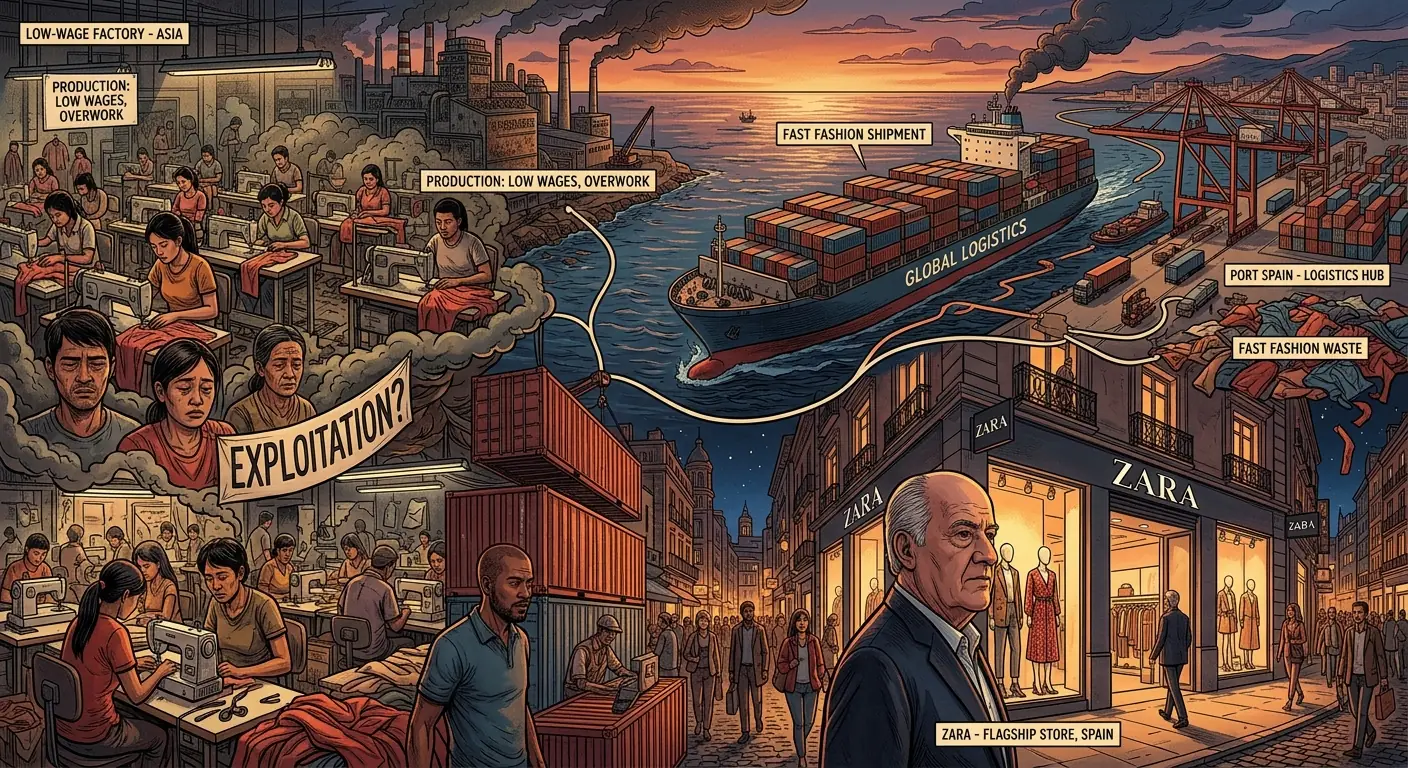
No empire, especially one built on speed and affordability in a globalized world, can escape the thorny thicket of ethical scrutiny. While Amancio Ortega himself remained largely untouched by personal scandal, the colossal shadow of Inditex has, inevitably, fallen into controversial light on several occasions. The fast fashion industry, by its very nature, walks an ethical tightrope, balancing consumer demand for cheap, trendy clothes with the human and environmental costs of rapid production.
Labor Pains
The most persistent accusations leveled against Inditex, and indeed the entire fast fashion sector, revolve around labor practices in its vast global supply chain. Despite Inditex’s famed “proximity sourcing” strategy (keeping much of its manufacturing in Spain, Portugal, and Morocco), a significant portion of production still takes place in countries with lower labor costs, where oversight can be challenging. The most notable scandal broke in 2011, when Brazilian authorities raided several workshops supplying Zara, finding workers, many of them undocumented immigrants from Bolivia and Peru, subjected to conditions that were disturbingly close to “slave labor.” Workers were reportedly toiling up to 16 hours a day for meager wages, living in overcrowded, unsanitary dormitories, and facing exorbitant deductions for food and rent, effectively trapping them in debt. Inditex swiftly responded, taking responsibility and terminating contracts with the offending suppliers, paying fines, and implementing stricter auditing protocols. They committed to increasing inspections and working with NGOs to improve conditions. However, critics argue that such incidents are an inherent risk of the fast fashion model, where relentless pressure for speed and low costs can incentivize corner-cutting down the supply chain. It’s a constant game of whack-a-mole for any global retailer, but Zara’s scale often puts it under the brightest spotlight.
The Environmental Footprint
Beyond human rights, the environmental impact of fast fashion is a growing and undeniable concern. The industry is notoriously resource-intensive, contributing significantly to water pollution (dyeing processes), textile waste (landfills overflowing with discarded clothing), and carbon emissions (global transportation). Inditex, as the world’s largest fashion retailer, is naturally a major contributor to this footprint. Historically, the focus was on speed and profit, with environmental concerns taking a backseat. However, as public awareness and regulatory pressure have grown, Inditex has been compelled to react. They’ve launched ambitious sustainability goals, aiming for 100% sustainable or recycled fabrics by 2030 (a target later accelerated to 2025 for some materials) and zero waste by 2023. They’ve also invested in collection bins for used clothing in stores and launched initiatives to reduce water and energy consumption. But, let’s be real, the fundamental business model of encouraging constant consumption of new trends inherently clashes with deep environmental sustainability. It’s like asking a cheetah to become a vegetarian; it can try, but its instincts are wired differently. The industry is in a race against time, and against itself, to find a truly sustainable path forward.
Taxing Questions
Lastly, Ortega’s immense personal wealth and its management have, at times, drawn scrutiny regarding tax practices. While there have been no direct accusations of illegal tax evasion against Ortega or Inditex, the structure of his personal investment vehicle, Pontegadea Inversiones, which holds his Inditex shares and vast real estate portfolio, has been questioned. Critics, particularly in Spain, have argued that the use of holding companies and international investment structures, while legal, can reduce tax liabilities compared to direct personal income. In 2016, for instance, reports surfaced about Pontegadea’s subsidiaries in low-tax jurisdictions, sparking public debate about the ethics of wealth management for ultra-rich individuals, even if all actions are within the bounds of the law. Ortega, ever the silent billionaire, has never directly addressed these criticisms. His supporters would argue that he has created hundreds of thousands of jobs and contributes significantly to the Spanish economy through taxes paid by Inditex and his personal philanthropy. The debate, however, highlights the complex interplay between legal financial structuring, corporate responsibility, and public perception of fairness in a world grappling with wealth inequality.
🔮 Chapter 13: The Ortega Equation (Present & Future)
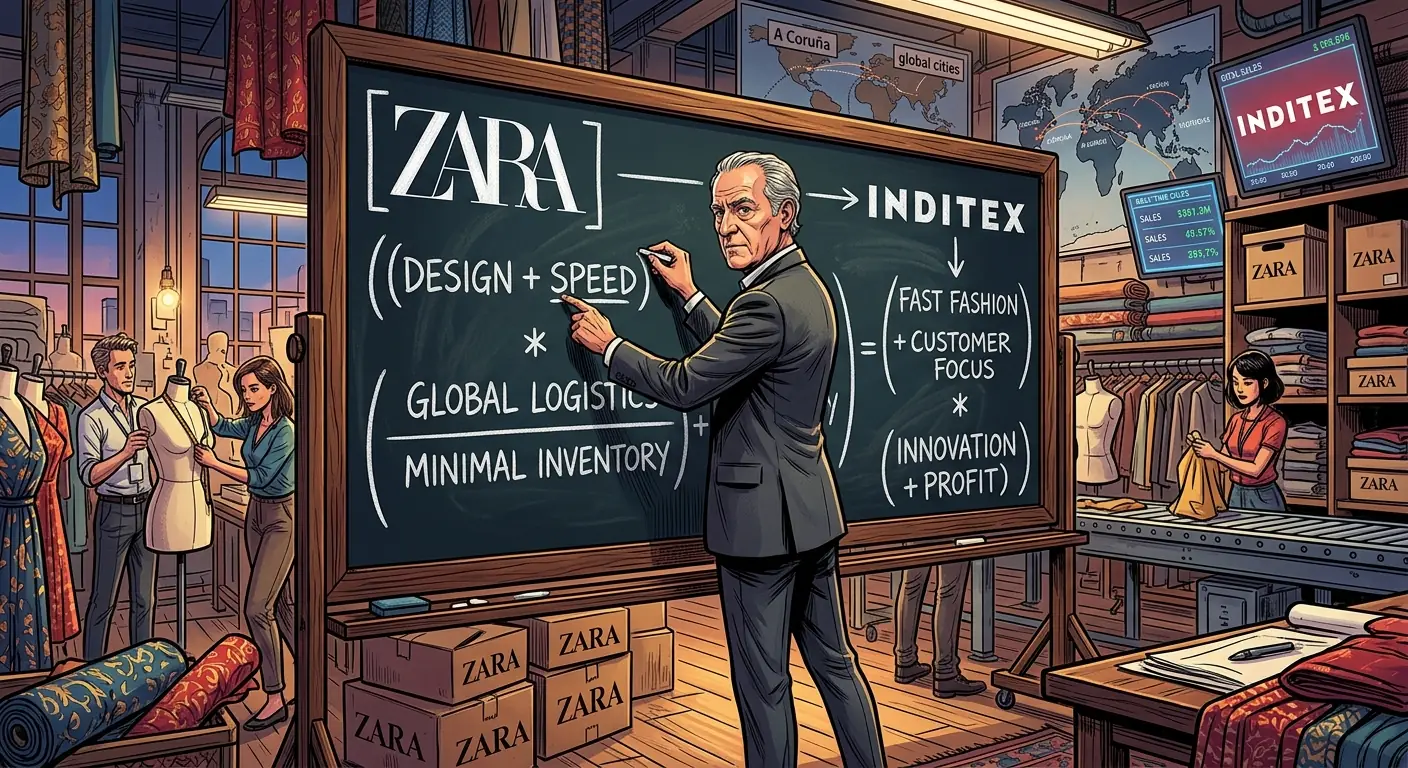
So, what do we make of Amancio Ortega? The man who built an empire, dressed the world, and then vanished into the Galician mist. His story isn’t just a rags-to-riches tale; it’s a masterclass in unconventional business, a testament to instinct, and a blueprint for disrupting an entire industry. His legacy, like his personality, is complex: a blend of revolutionary efficiency, a commitment to product, and an almost pathological aversion to the limelight.
The Ortega Paradox
Ortega is, without doubt, one of the most fascinating figures in modern business history. He’s the anti-CEO, a man who reportedly never had an office, preferred the factory floor to the boardroom, and whose official company portrait only surfaced decades into his career. He epitomizes the “invisible man” persona – rarely granting interviews, shunning public appearances, and letting the product speak for itself. This wasn’t shyness; it was a deliberate strategy to keep the focus on Zara, not on its founder. He understood that his strength lay in observing, not being observed. He was, and remains, a paradox: a global titan who acts like a local shopkeeper, a billionaire who reportedly eats lunch with his employees in the company cafeteria. His success wasn’t built on grand pronouncements or charismatic leadership, but on an almost obsessive focus on the customer, a maniacal dedication to speed, and an uncanny ability to spot talent and trust his gut. He proved that sometimes, the quietest person in the room is the one who’s actually changing the world.
Beyond Fast Fashion
While Ortega stepped down as chairman in 2011, his influence on Inditex is indelible. The company he built continues to evolve, navigating the treacherous waters of a rapidly changing retail landscape. The rise of e-commerce, which Ortega initially resisted but later embraced with gusto, has fundamentally reshaped shopping habits. Inditex has invested heavily in digital transformation, integrating its physical stores with its online platforms to create a seamless “omnichannel” experience. Furthermore, the growing demand for sustainability and ethical production, as discussed in the previous chapter, presents both a challenge and an opportunity. Inditex, under the leadership of Pablo Isla (until 2022) and now Marta Ortega Pérez (Amancio’s daughter), has committed to ambitious sustainability targets, investing in new technologies and materials. The question for Inditex is how to maintain its core “speed machine” advantage while becoming a more responsible corporate citizen. It’s a tightrope walk that will define the next chapter of the company. However, the foundational principle – giving customers what they want, when they want it, at a price they can afford – remains the guiding star, a direct inheritance from Ortega himself.
An Empire Built on Instinct
Amancio Ortega’s legacy is more than just Zara or Inditex; it’s a living testament to the power of intuition, vertical integration, and relentless customer focus. He didn’t invent clothing, but he reinvented how it was made, distributed, and sold. He showed the world that fashion didn’t have to be dictated by distant designers or slow, seasonal cycles. It could be democratic, immediate, and constantly responsive. His “Ortega Equation” for business success might be simplified as: (Customer Observation + Vertical Integration + Lightning Speed) x (Reinvestment + Secrecy) = Global Dominance. He left behind not just a €90 billion (at peak) company but a blueprint for agility and disruption that continues to influence industries far beyond fashion. The lessons from his career – the importance of listening to your customers, the power of controlling your supply chain, and the wisdom of staying humble (or at least out of the spotlight) – are as relevant today as they were when he was sewing bathrobes in his living room. The invisible man may have retreated further into his private life, but his impact on how we dress, and how businesses operate, is as visible as ever.
💡 Key Insights
- ▸ Ortega inverted the traditional fashion supply chain. While competitors designed clothes months in advance, manufactured them cheaply in Asia, and shipped them to stores for a single season, Zara designed in real-time based on what was selling, manufactured close to its stores (in Spain, Portugal, and Morocco), and delivered new items twice a week. Speed replaced forecasting. This meant Zara rarely got stuck with unsold inventory — the bane of the fashion industry — and could respond to trends in weeks instead of months.
- ▸ Ortega's decision to spend almost nothing on advertising — Zara's ad budget was less than 0.3% of revenue versus 3-4% for competitors — was not frugality but strategy. Instead of advertising, Zara invested in prime retail locations on the world's most expensive shopping streets. The stores themselves were the advertising. A Zara store on Fifth Avenue or the Champs-Élysées was a more powerful brand signal than any magazine ad.