Xerox PARC: The Greatest Ideas Ever Stolen
They invented the personal computer, the graphical user interface, the mouse, Ethernet, the laser printer, and object-oriented programming. Then they gave it all away. Xerox PARC is the story of the most innovative laboratory in history — and the corporation that was too blind to realize what it had.
View all stories about this mogul
🏛️ Chapter 1: The Palace of Invention
In 1970, Xerox Corporation was printing money. Literally.
The Xerox 914 copier — the first commercially successful plain-paper photocopier — had transformed the company from a modest photography equipment maker into one of the most profitable corporations in America. The copier was so profitable that Xerox was, for a time, the fastest-growing company in American history. Revenue had grown from $30 million in 1959 to over $1 billion by 1968.
The executives at Xerox’s headquarters in Stamford, Connecticut, looked at the future and saw a problem: the copier market wouldn’t grow forever. They needed to diversify. And in the late 1960s, the future looked digital.
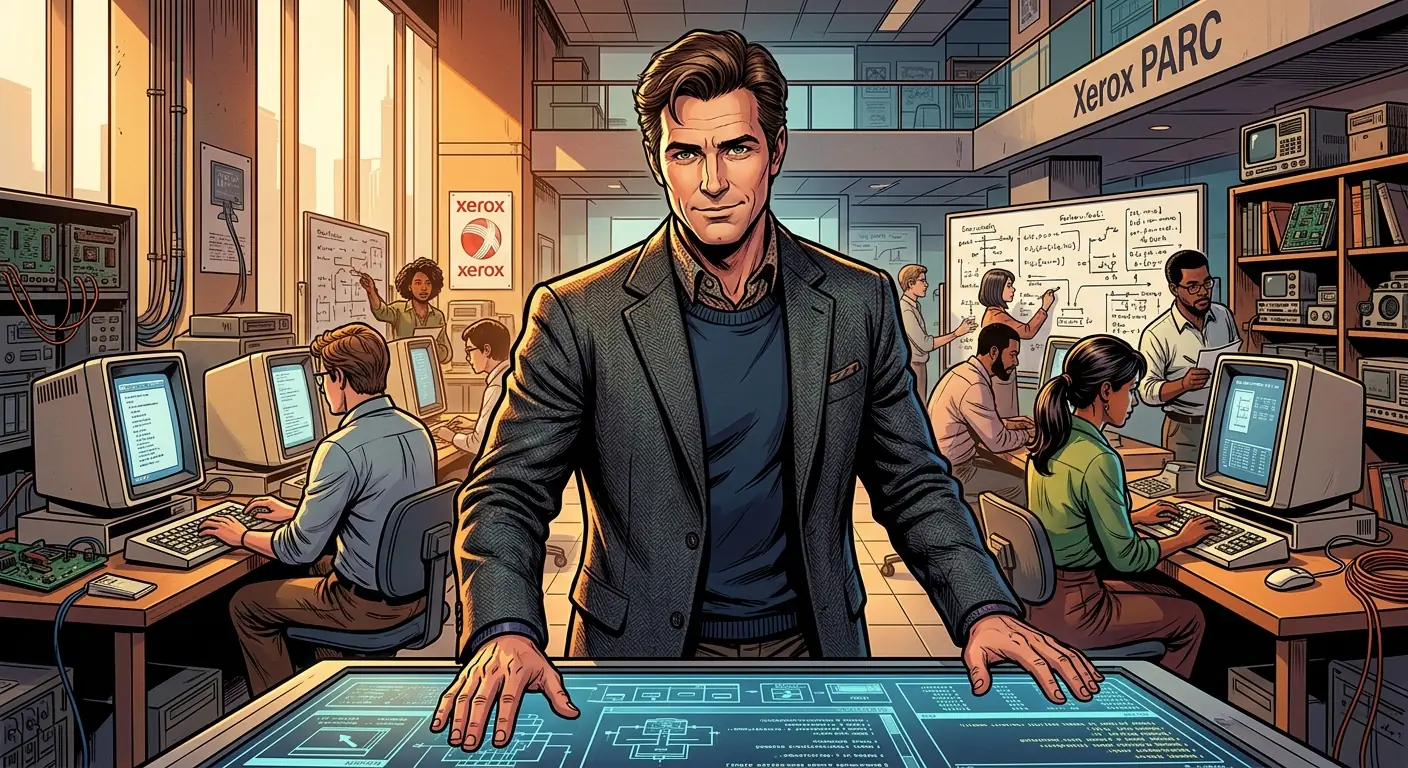
In 1970, Xerox hired a physicist named George Pake to create a new research center. The mission: invent the future of information technology. The location: Palo Alto, California — 3,000 miles from corporate headquarters. The budget: essentially unlimited. The name: Xerox Palo Alto Research Center. PARC.
“Xerox gave PARC a blank check and a blank canvas. The mission was simple and impossibly ambitious: invent the future. What PARC invented was so far ahead of its time that its own parent company couldn’t recognize it.”
Pake assembled a team that reads like a Hall of Fame of computer science. Alan Kay, who would conceptualize the personal computer and object-oriented programming. Bob Metcalfe, who would invent Ethernet. Butler Lampson, who would design the Alto computer. Charles Simonyi, who would later create Microsoft Word and Excel. Larry Tesler, who would invent cut-copy-paste.
These were not incremental thinkers. These were people who believed that the future of computing was not mainframes in air-conditioned rooms — it was personal computers on every desk, connected by networks, operated through graphical interfaces. In 1970, this vision was approximately 15 years ahead of the mainstream.
PARC was designed to be a haven for genius. The researchers were given extraordinary freedom — no deadlines, no product requirements, no management oversight. They were told to think big, experiment freely, and follow their curiosity wherever it led.
And what it led to was nothing less than the invention of modern computing.
💻 Chapter 2: The Alto — The First Personal Computer
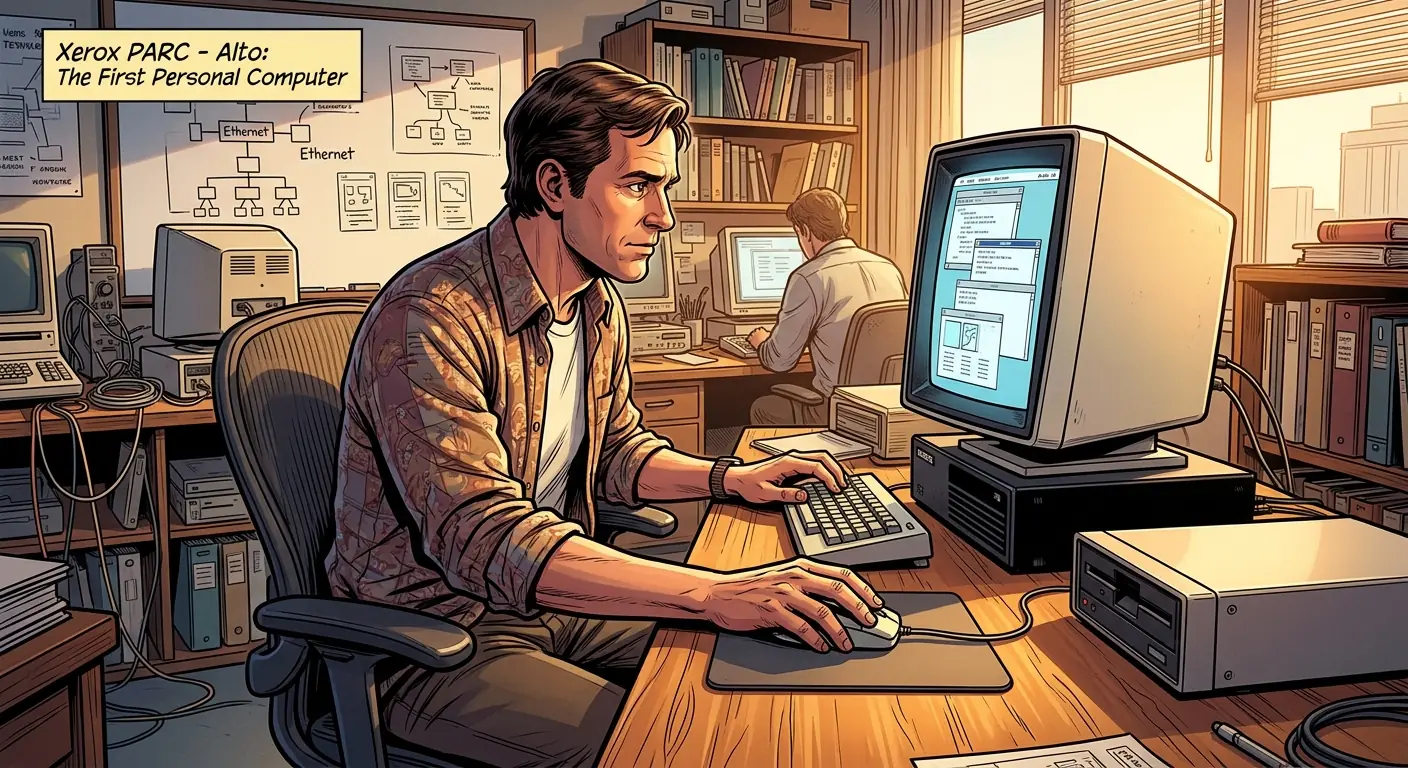
In 1973, PARC researchers completed the Xerox Alto — a machine that, viewed from the perspective of 2026, looks like the blueprint for every personal computer that would follow.
The Alto had:
-
A graphical user interface (GUI) — with windows, icons, menus, and a pointer. You didn’t type commands. You pointed and clicked. In 1973, this was science fiction.
-
A mouse — a pointing device developed by Doug Engelbart at SRI International and refined at PARC. The mouse allowed users to interact with the GUI intuitively.
-
A bitmapped display — a screen where every pixel could be individually controlled, enabling graphics, different fonts, and WYSIWYG (What You See Is What You Get) document display.
-
Ethernet — a local area networking technology invented by Bob Metcalfe at PARC in 1973, which allowed multiple computers to communicate with each other. Metcalfe would later found 3Com and commercialize Ethernet, which became the global standard for computer networking.
-
A laser printer — invented at PARC by Gary Starkweather, which could print exactly what appeared on the screen.
-
An email system — internal to the PARC network, allowing researchers to send messages to each other electronically.
Let’s be clear about what this means. In 1973, PARC had built what was essentially a Macintosh — a windowed, mouse-driven, networked personal computer with email, laser printing, and WYSIWYG document editing.
The Macintosh wouldn’t be released until 1984. Windows wouldn’t ship until 1985. The World Wide Web wouldn’t exist until 1991.
PARC was a decade ahead. At minimum.
“PARC didn’t just invent the personal computer. They invented the personal computer, the network, the printer, the interface, and the software paradigm. They invented an entire ecosystem — the ecosystem that billions of people use every single day — and then they handed it to their competitors.”
Approximately 2,000 Altos were built and used within Xerox and at universities. They were never sold commercially. A machine that could have given Xerox a decade-long head start in personal computing was treated as an internal research curiosity.
🎨 Chapter 3: The GUI and the Mouse
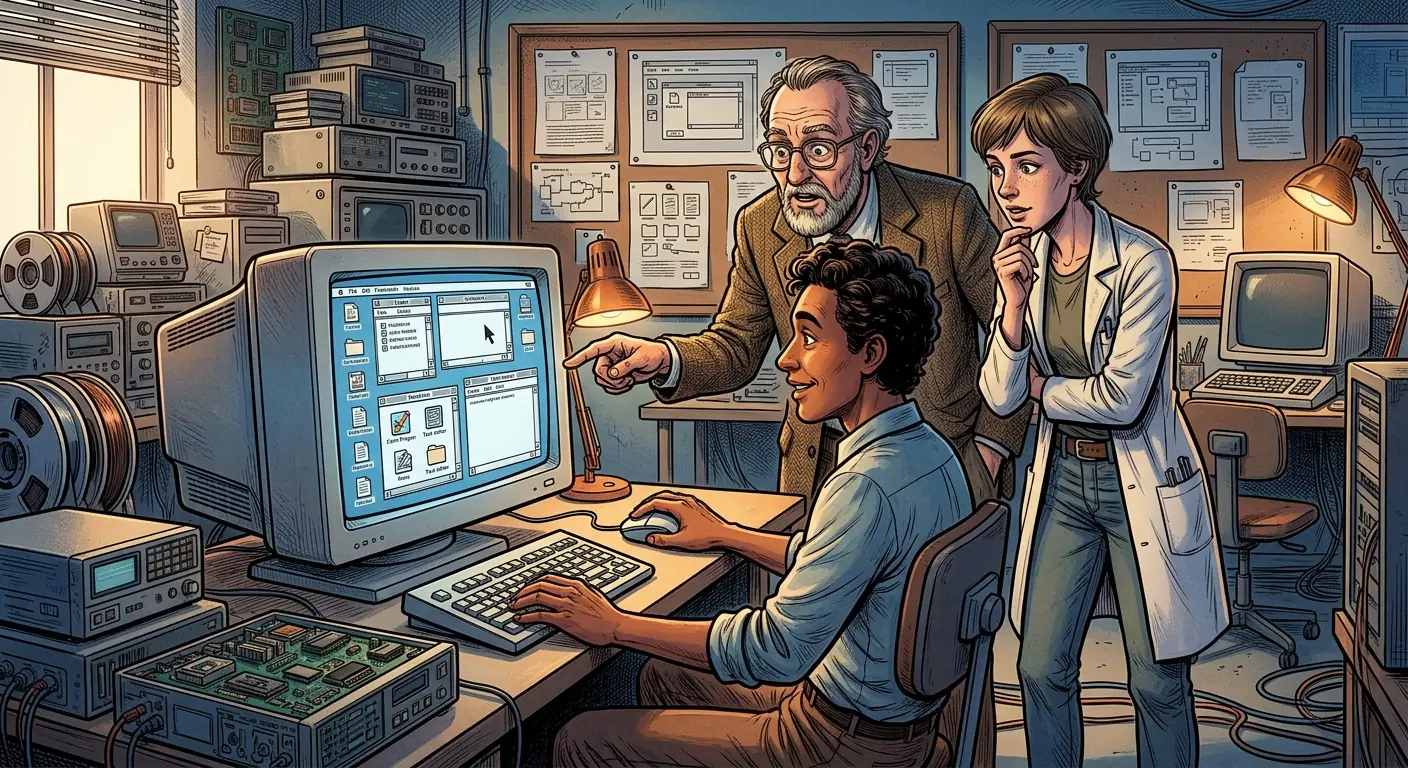
The graphical user interface — the GUI — is arguably the most important human-computer interaction innovation in history. It transformed computers from tools for specialists into tools for everyone.
Before the GUI, interacting with a computer meant typing commands into a text terminal. You had to know the commands. You had to type them correctly. You had to understand the computer’s file structure, its operating system syntax, and its logical organization. Using a computer was a skill — like playing an instrument — that required training and practice.
The GUI changed everything. Instead of typing commands, you pointed at objects on the screen and clicked. Files were represented as icons. Programs ran in windows. Actions were performed through menus. The interface was visual, intuitive, and — critically — learnable by anyone.
Alan Kay, the visionary behind much of PARC’s GUI work, articulated a principle that would define personal computing: the computer should be simple enough for a child to use.
His concept of the “Dynabook” — a portable, personal computer with a graphical interface — was outlined in a 1972 paper. The Dynabook was never built as a single device, but its conceptual DNA is present in every laptop, tablet, and smartphone manufactured in the half-century since.
“Alan Kay imagined a world where every person — every child — had a personal computer that was as easy to use as a book. In 1972, this was a fantasy. In 2026, it’s called an iPad. Kay didn’t just predict the future. He designed it.”
The mouse — the physical interface between the human hand and the GUI — had been invented by Doug Engelbart at the Stanford Research Institute in the 1960s. PARC refined it, integrated it with the GUI, and made it the standard input device for graphical computing.
Engelbart’s original mouse was a wooden block with two metal wheels. PARC’s version was smaller, more ergonomic, and used a rolling ball for smoother movement. The design was so effective that it remained essentially unchanged for 30 years.
🔌 Chapter 4: The Ethernet Revolution
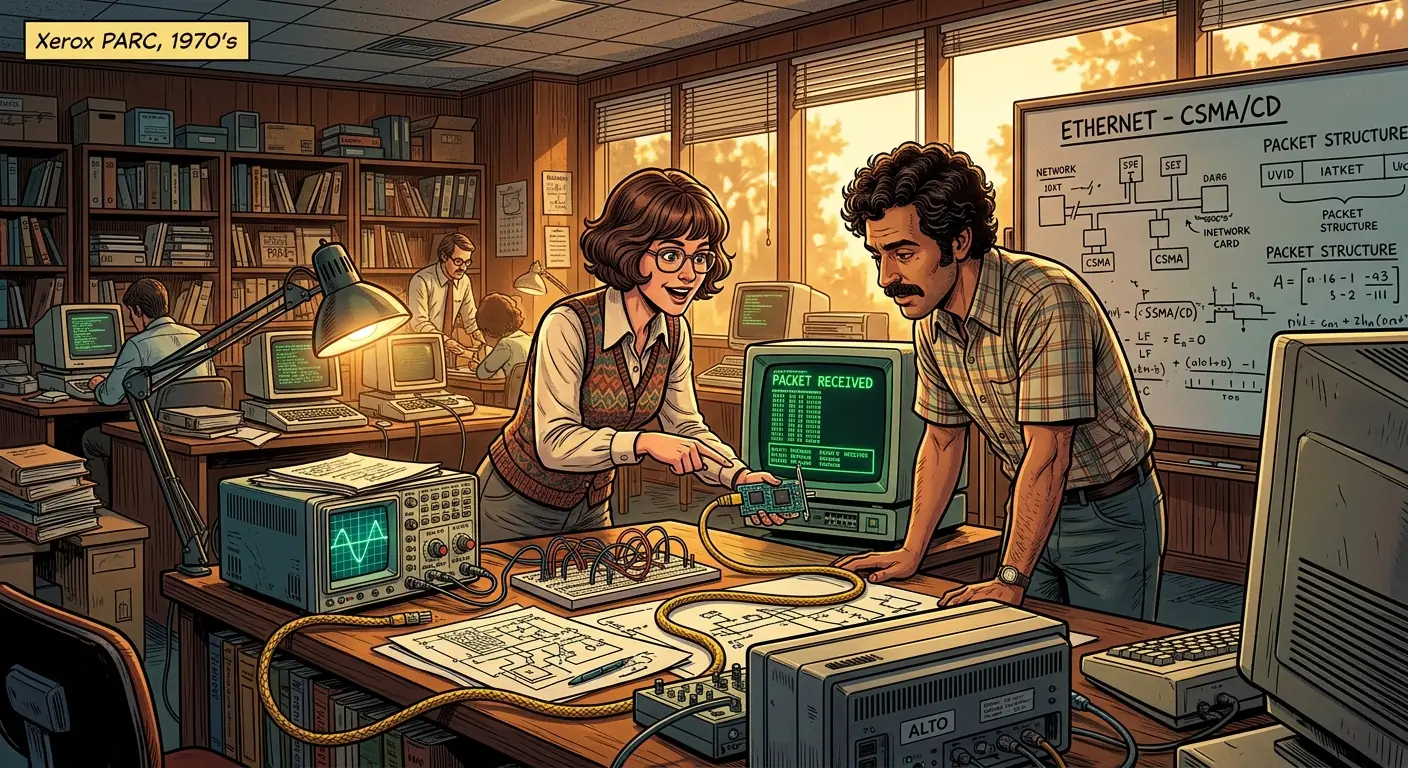
In 1973, Bob Metcalfe — a PARC researcher who had been studying networking protocols — invented Ethernet.
The concept was elegant: connect multiple computers to a shared cable, allow each computer to transmit data as packets, and use a protocol to manage collisions when two computers tried to transmit simultaneously. Metcalfe’s original memo, titled “Alto Ethernet,” described a system that could transmit data at 2.94 megabits per second.
Ethernet allowed the Alto computers at PARC to communicate with each other, share files, and access the laser printer. For the first time, a group of personal computers functioned as a network — a local area network, or LAN.
This was revolutionary. Individual computers were useful. Networked computers were transformative. A network allowed collaboration, resource sharing, and communication in ways that standalone machines couldn’t support.
Metcalfe would later leave PARC, found 3Com, and commercialize Ethernet. The technology became the global standard for local area networking — the backbone of every office network, data center, and internet connection in the world.
By the 2020s, there were billions of Ethernet ports in use worldwide. The technology that Metcalfe sketched on a memo at PARC in 1973 had become the physical foundation of the internet age.
“Metcalfe invented Ethernet at PARC. Xerox didn’t commercialize it. Metcalfe left and did it himself. This pattern — brilliant inventor at PARC, Xerox fails to commercialize, inventor leaves and profits elsewhere — would repeat itself over and over.”
👀 Chapter 5: The Visit That Changed Everything
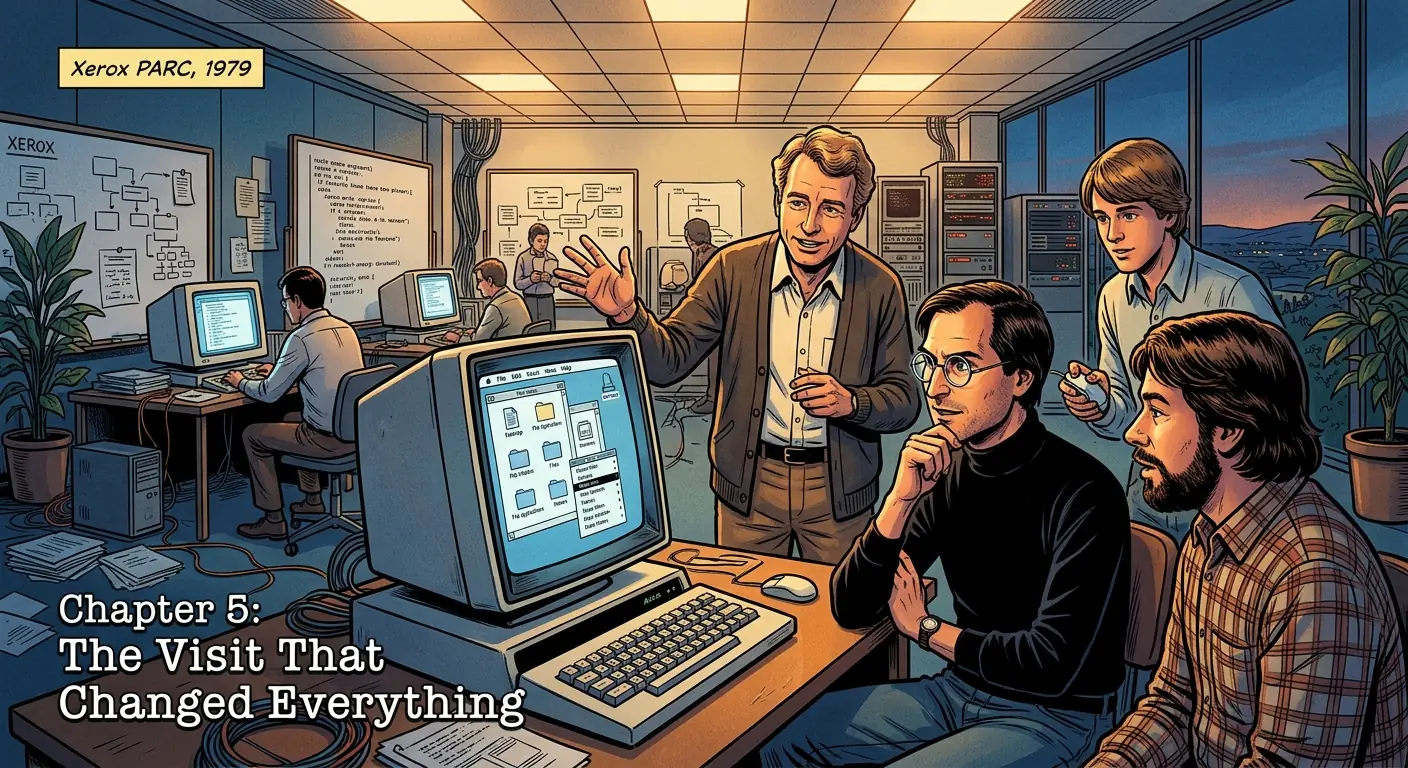
In December 1979, Steve Jobs visited Xerox PARC.
The visit had been arranged as part of a deal: Xerox’s venture capital division had invested $1 million in Apple’s pre-IPO stock. In exchange, Apple received a tour of PARC’s facilities and a demonstration of the Alto.
Jobs brought a team of Apple engineers. They were shown the Alto, the GUI, the mouse, the networked computing environment, and the object-oriented programming system called Smalltalk.
Jobs was stunned. He reportedly became agitated during the demonstration, pacing around the room, gesticulating, and demanding to see more. “Why isn’t Xerox marketing this?” he reportedly asked. “This is the most incredible thing I’ve ever seen.”
“Steve Jobs walked into PARC and saw the future. He didn’t invent the future — PARC did. But he recognized it, which was something Xerox’s own management had failed to do. Jobs’ genius was not creation. It was recognition.”
Jobs returned to Apple and redirected the company’s efforts toward developing a graphical user interface computer. The result, after several years of development (and the commercial failure of the Lisa), was the Macintosh — released in January 1984.
The Macintosh was not a copy of the Alto. Apple’s engineers made significant improvements and innovations: the single-button mouse (PARC’s had three buttons), the menu bar, the desktop metaphor, the trash can, drag-and-drop, and numerous other interface refinements. But the foundational concept — a graphical, mouse-driven personal computer — came directly from what Jobs saw at PARC.
The question of whether Jobs “stole” from Xerox is the subject of endless debate. The facts are:
- Xerox voluntarily showed Apple its technology as part of a business arrangement.
- Apple invested significant engineering resources in improving and refining the GUI concepts.
- Xerox had the opportunity to commercialize its inventions and chose not to.
- The PARC researchers themselves were frustrated that Xerox wasn’t commercializing their work and were, in some cases, eager for someone else to do it.
As Jobs himself said years later: “Xerox could have owned the entire computer industry. They had the technology. They had the money. They had the people. They just didn’t have the vision to see what they had.”
💀 Chapter 6: Why Xerox Couldn’t See
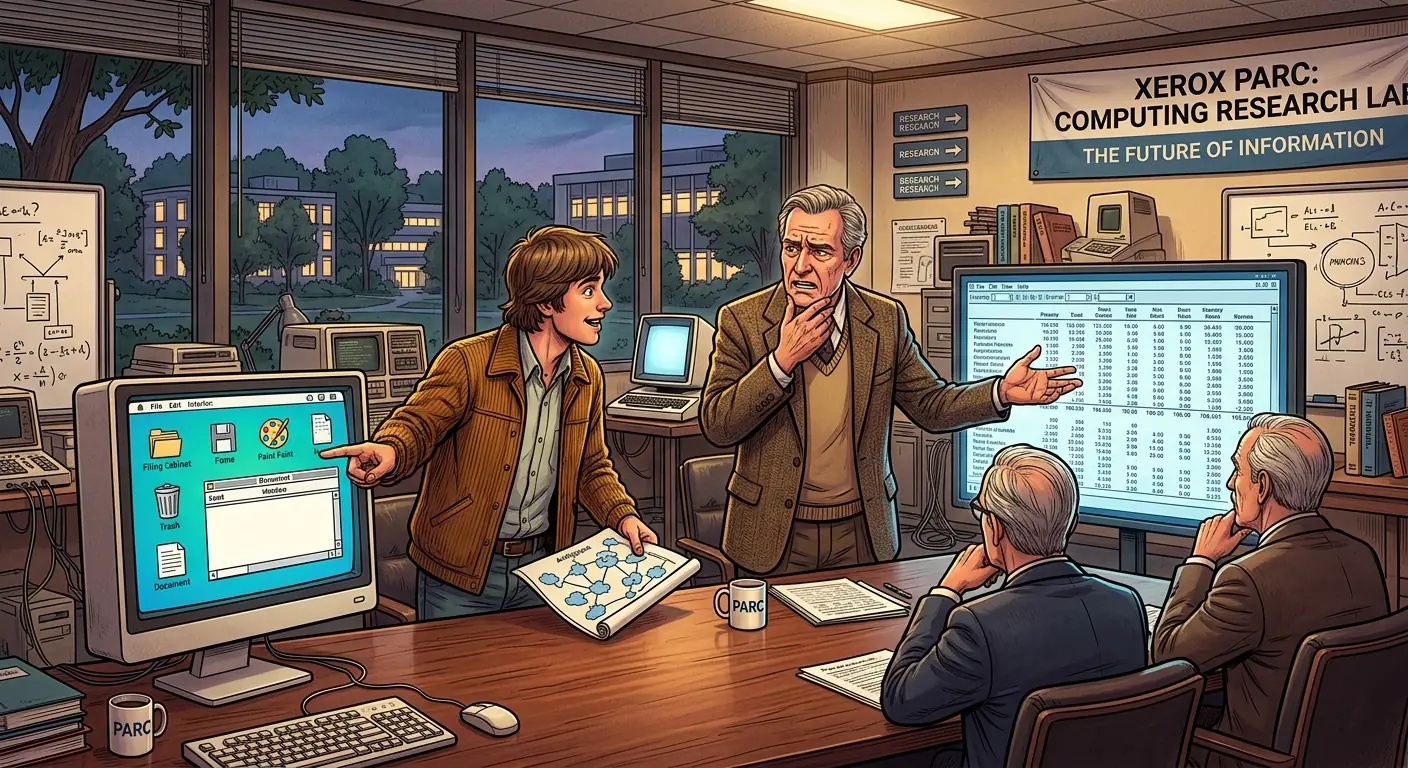
The most fascinating question in the PARC story is not “what did PARC invent?” but “why didn’t Xerox commercialize it?”
The answer is a case study in corporate blindness that is taught in business schools worldwide.
Geographic distance. PARC was in Palo Alto, California. Xerox headquarters was in Stamford, Connecticut — 3,000 miles away. The physical distance created cultural distance. PARC researchers and Xerox executives inhabited different worlds.
Cultural clash. PARC was populated by long-haired, counterculture-adjacent researchers who wore jeans and sandals, challenged authority, and worked according to their own rhythms. Xerox headquarters was populated by suit-wearing, hierarchy-respecting corporate managers who valued process and predictability. The two groups regarded each other with mutual suspicion.
Revenue blindness. Xerox’s copier business was generating billions in revenue with fat margins. The personal computer market, in the mid-1970s, was tiny. Xerox executives couldn’t see why they should invest in a low-margin, uncertain market when the copier market was printing money.
The innovator’s dilemma. This concept — later articulated by Clayton Christensen — describes how successful companies fail to adopt disruptive technologies because the new technologies initially serve smaller, less profitable markets. Xerox was the textbook case. The Alto served a market that didn’t yet exist in any commercially meaningful way. By the time the market materialized, Xerox had lost its lead.
Organizational design. PARC was structured as a pure research lab, not a product development organization. There was no bridge between PARC’s inventions and Xerox’s commercial operations. Researchers invented. Executives commercialized. And the gap between them was a canyon.
“Xerox PARC is the greatest cautionary tale in corporate history. It proves that invention is not enough. You need invention AND commercialization. You need the lab AND the product team. You need the researchers AND the executives. And you need them talking to each other.”
🚪 Chapter 7: The Diaspora
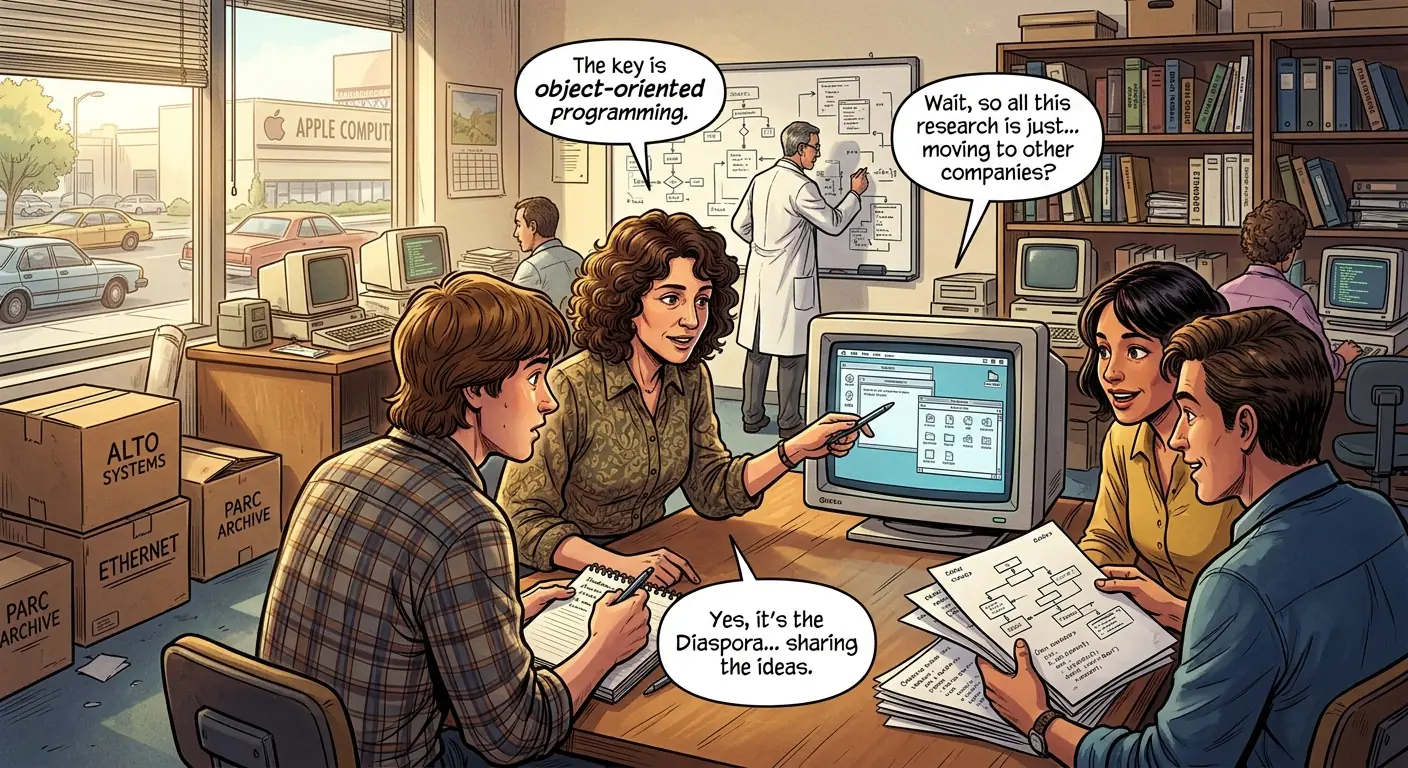
When PARC’s researchers realized that Xerox would never commercialize their inventions, they left. And they took their ideas with them.
Charles Simonyi went to Microsoft, where he led the development of Word and Excel — the applications that would make Microsoft Office the dominant productivity suite in the world.
Bob Metcalfe founded 3Com and commercialized Ethernet.
Larry Tesler went to Apple, where he helped develop the Lisa and Macintosh interfaces. He is credited with inventing the concepts of cut, copy, and paste.
John Warnock and Charles Geschke founded Adobe Systems, commercializing the PostScript page description language that PARC had developed. Adobe would become one of the most important software companies in the world.
Robert Belleville went to Apple and led hardware engineering for the Macintosh.
Alan Kay went to Apple, then Disney, then Hewlett-Packard, continuing to advance the concepts of personal computing and programming that he had pioneered at PARC.
“The PARC diaspora seeded the entire personal computer industry. Apple, Microsoft, Adobe, 3Com — companies that collectively created trillions of dollars in value — were all built, in part, by people who had done their foundational work at PARC and then left because Xerox couldn’t see the value of what they’d created.”
The irony is almost painful. Xerox spent hundreds of millions of dollars funding PARC. The researchers at PARC invented the technologies that would define the personal computer revolution. And then those researchers walked out the door and made other companies rich.
Xerox, meanwhile, continued to sell copiers. The copier business remained profitable for decades. But the personal computer industry that PARC had invented grew to dwarf the copier industry by orders of magnitude.
🖨️ Chapter 8: The Printer Consolation Prize
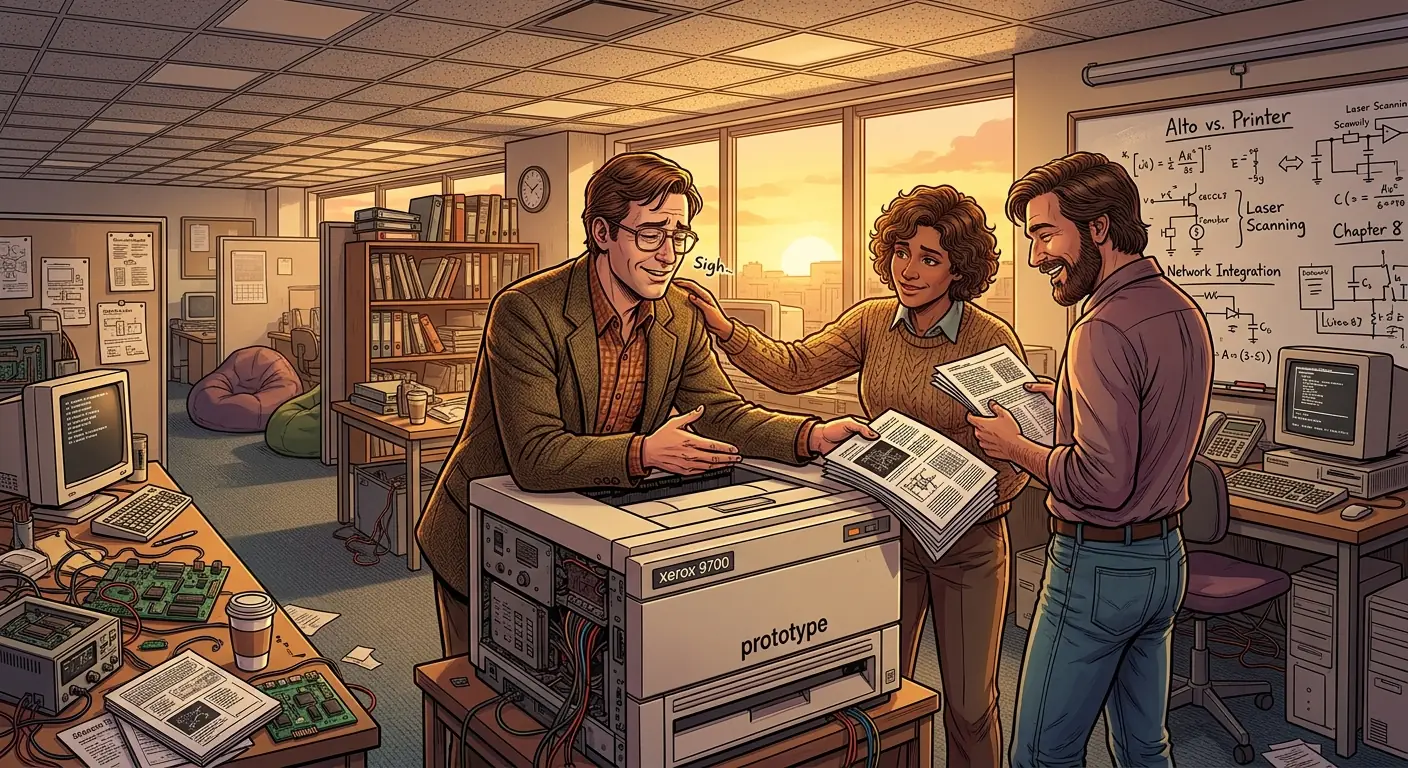
It would be unfair to say that Xerox commercialized nothing from PARC. The laser printer — invented at PARC by Gary Starkweather — was successfully developed into the Xerox 9700, which became a major commercial product.
Laser printing was a natural fit for Xerox’s existing business: it was a printing technology, it served enterprise customers, and it complemented the copier product line. The Xerox 9700 and its successors generated billions in revenue over the following decades.
But the laser printer was, relative to the other PARC inventions, a consolation prize. It was valuable but incremental — an extension of Xerox’s existing business rather than the foundation of a new one.
The GUI, the mouse, the personal computer, Ethernet, object-oriented programming — these were the foundations of a $3 trillion industry. Xerox captured almost none of that value.
“Xerox got the laser printer. Apple got the Macintosh. Microsoft got Windows. Adobe got PostScript. 3Com got Ethernet. Xerox PARC created a feast and served everyone except its own parent company.”
📚 Chapter 9: The Lessons That Echo
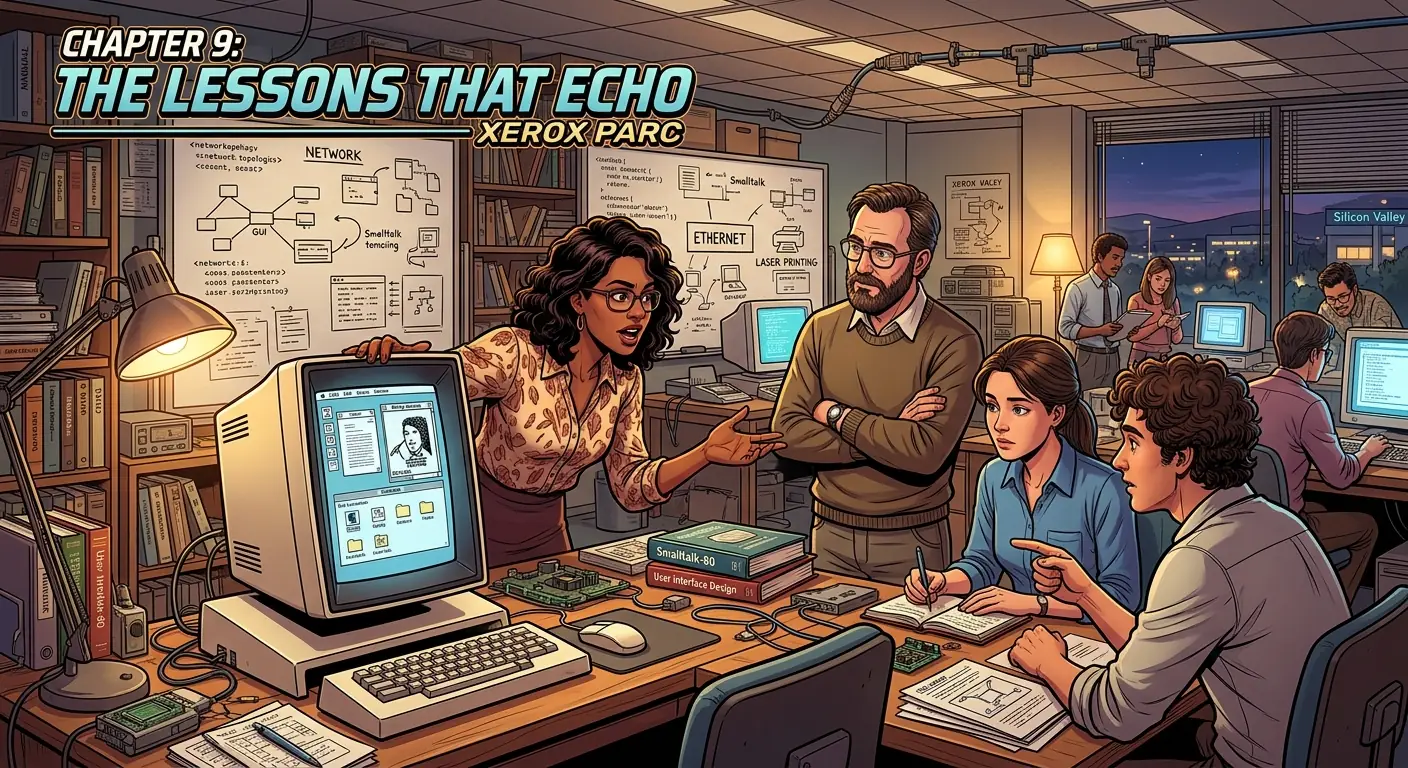
Xerox PARC’s story is over fifty years old, but its lessons have never been more relevant.
In the 2020s, every major technology company was wrestling with the same challenges that Xerox faced: how do you incubate breakthrough research while running a profitable existing business? How do you prevent the cash cow from blinding you to the next paradigm? How do you build the bridge between invention and commercialization?
Google created X (formerly Google X) to incubate moonshot projects. Meta created Reality Labs to develop VR and AR technologies. Apple maintained its legendary secrecy around future products. Each was, in its own way, trying to avoid the Xerox PARC trap.
The PARC Lessons:
-
Invention without commercialization is philanthropy. PARC’s inventions enriched the world — but not Xerox. The gap between creating a breakthrough and profiting from it is where most corporate innovation dies.
-
Keep the lab close to the business. PARC’s 3,000-mile distance from headquarters wasn’t just geographic — it was strategic, cultural, and communicative. The most successful corporate labs are embedded in the business, not isolated from it.
-
The existing business is the enemy of the future business. Xerox’s copier revenue blinded executives to the potential of personal computing. In any organization, the most profitable current business will always receive the most attention — even when the future is somewhere else.
-
People are the technology. When PARC’s researchers left, they took the knowledge, the vision, and the capability with them. Technology can’t be locked in a lab. It lives in people’s heads, and people can walk out the door.
-
Recognizing value is as important as creating it. PARC created enormous value. Xerox failed to recognize it. Steve Jobs walked in and recognized it immediately. The ability to see the potential of a new technology — to connect it to a market need — is a skill that’s as rare and as valuable as the ability to invent.
“Xerox PARC is the story of the greatest inventions ever made by the wrong company. The researchers were brilliant. The technology was revolutionary. The parent company was blind. And the world’s most important innovations went to the people who could see their value — which was everyone except Xerox.”
The mouse under your hand. The windows on your screen. The network connecting your devices. The printer in your office. The fonts in your documents.
All of it came from a research lab in Palo Alto that was funded by a copier company that couldn’t imagine a world beyond copiers.
That is either a tragedy or a comedy. Probably both.
Xerox PARC (now PARC, a Xerox company) continues to operate as a research center. Xerox Corporation had annual revenues of approximately $7 billion as of 2024. Apple, Microsoft, and Adobe — companies that commercialized PARC’s inventions — have a combined market capitalization exceeding $8 trillion.
⭐ Chapter 10: The Star’s Fading Glow (1981-1985)
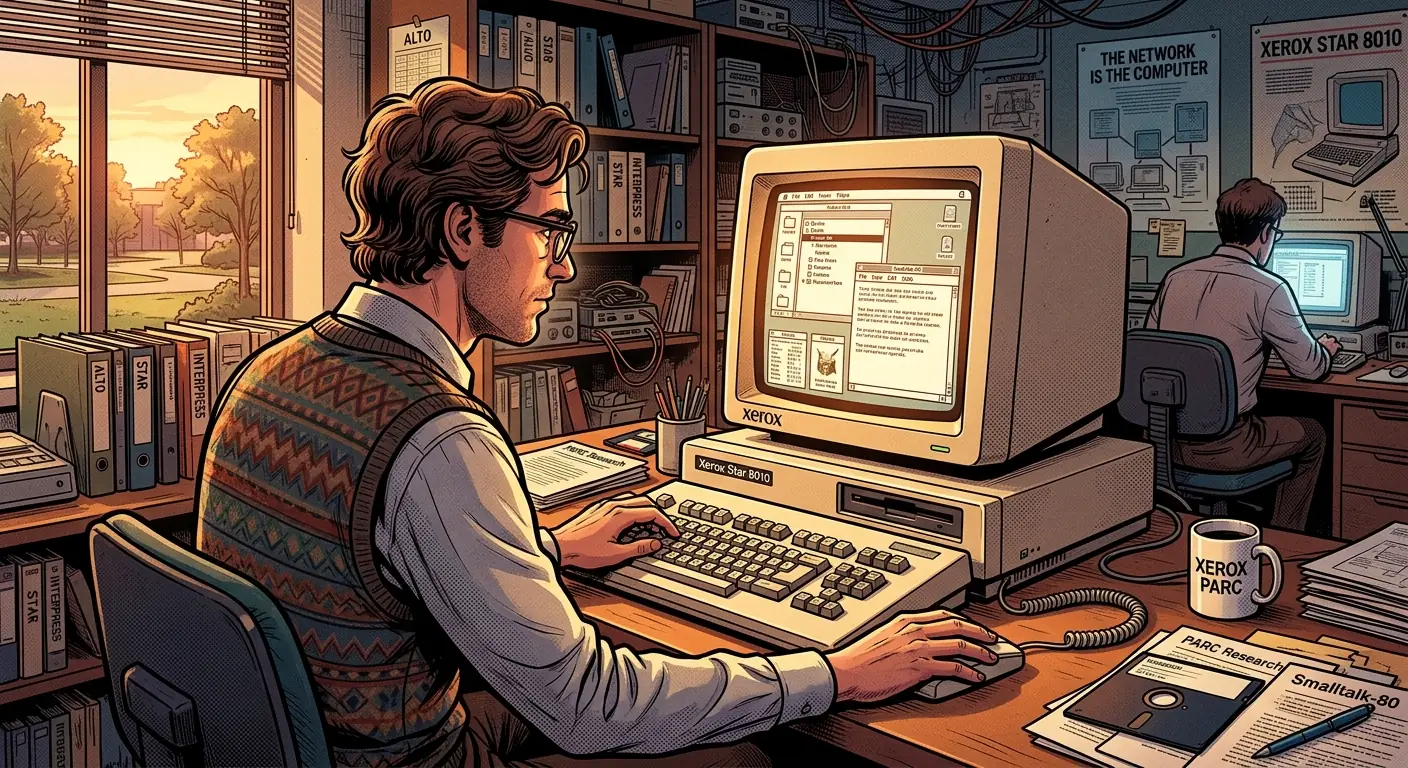
Here’s the thing about watching someone else run off with your brilliant ideas: it stings. But what’s even more excruciating is having the winning lottery ticket in your hand, fumbling it, and then watching someone else pick it up and claim the prize. Xerox wasn’t just a passive victim; they actually tried to commercialize PARC’s inventions. The result? A spectacular, self-inflicted wound known as the Xerox Star 8010 Information System.
The Star’s Grand Vision
Launched in 1981, the Star was Xerox’s magnum opus, a direct descendant of the Alto, designed to bring the GUI, mouse, and networked computing to the office. It was, by all accounts, a marvel of engineering and user experience for its time. Imagine, in an era dominated by green-screen terminals and arcane command-line interfaces, a computer with a bit-mapped display, icons representing documents and applications (even a little trash can!), and WYSIWYG word processing. It had Ethernet built-in, allowing it to connect to other Stars, share files, and print to laser printers – all innovations born at PARC. It even had a “Properties Sheet” concept for object customization that was arguably more sophisticated than anything seen for decades.
The Star wasn’t just a computer; it was a system, intended to be the centerpiece of the paperless office. It was revolutionary, polished, and functionally superior to anything else on the market. It was, in essence, the commercial version of the Alto, a full three years before the Macintosh and four years before Windows 1.0. Xerox had the future in its hands. What could possibly go wrong?
Pricing Itself Out of Orbit
Everything, it turns out, when you decide to price a personal computer like it’s a small, luxurious car. The Xerox Star 8010 wasn’t sold as a standalone unit; it was part of an integrated system, requiring file servers, laser printers, and network cabling. The price for a single workstation, without any of the necessary infrastructure, started at an eye-watering $16,595 (that’s over $55,000 in 2024 dollars). A typical office setup with a few workstations and peripherals could easily run into the hundreds of thousands of dollars.
Now, compare that to the Apple Lisa, which launched in 1983 at $9,995 (and was also considered a commercial flop for being too expensive), or the original Macintosh in 1984 at $2,495. The Star was designed for large corporations, but even they balked. It was perceived not as a personal computer, but as a mini-mainframe, albeit one with a user-friendly face. Xerox’s sales force, accustomed to selling big, expensive copiers on long-term leases, didn’t know how to sell a “personal workstation.” They lacked the vision, the marketing, and the distribution channels to introduce such a paradigm shift to the broader market.
The Echo of Missed Opportunity
The Star’s failure was a crushing blow, not just financially, but to the morale of the PARC researchers who had poured their hearts and souls into it. They had built the future, and their own company had essentially buried it. The Star sold a paltry 1,000 to 2,000 units before being discontinued. Its failure cemented the corporate belief that “personal computers” and “graphical interfaces” were niche, expensive curiosities, not the future of information technology.
This self-inflicted wound was arguably more tragic than the Apple visit. Xerox had the chance to be its own disruptor. It possessed the talent, the technology, and the resources. Yet, trapped by its existing business model and corporate inertia, it created a beautiful, prohibitively expensive museum piece instead of a market-defining product. The Star wasn’t stolen; it was simply left to gather dust, while others would later polish its core ideas into glittering fortunes.
⚖️ Chapter 11: The Patent Puzzle (1970s-1990s)
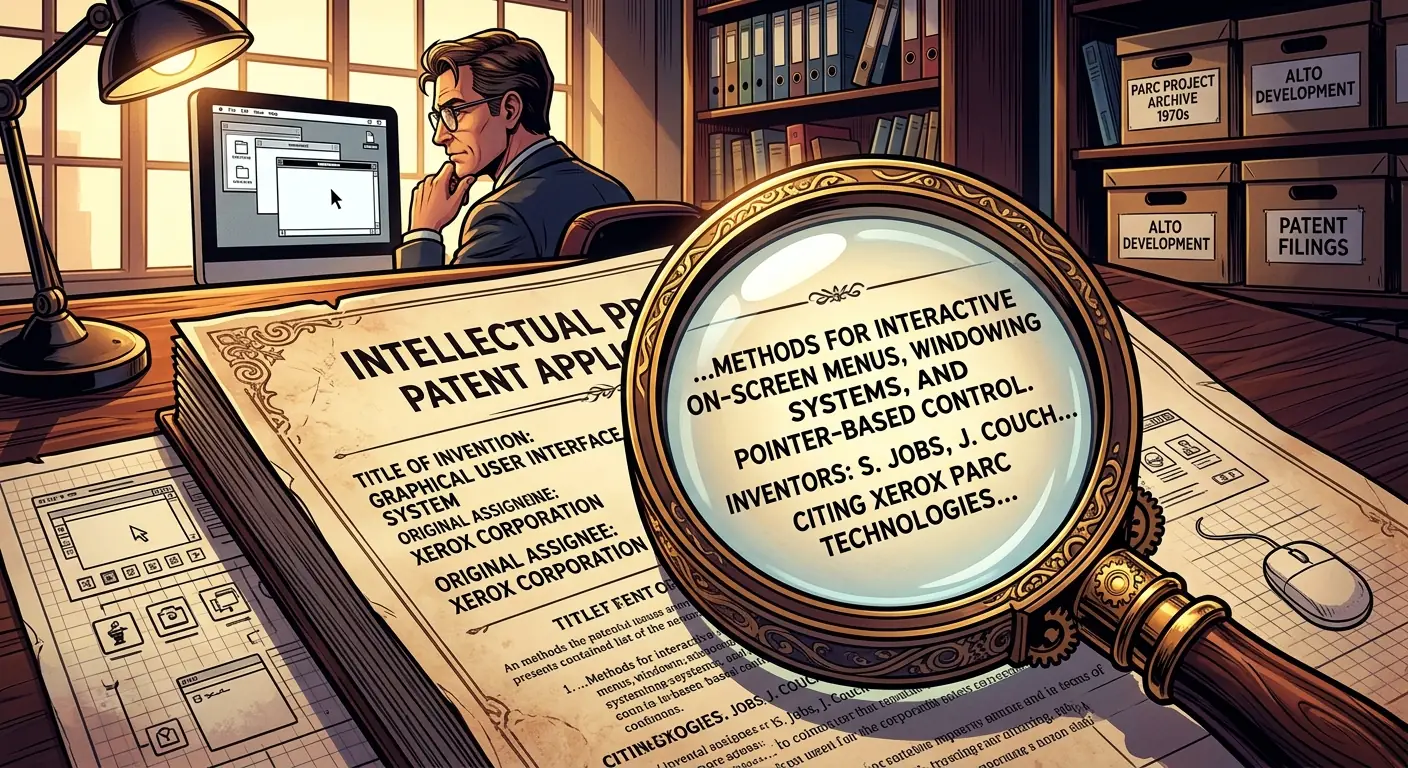
So, if Xerox PARC invented virtually everything we use today – the GUI, the mouse, Ethernet, laser printing, object-oriented programming – why didn’t Xerox just sue everyone who came after them? Why wasn’t Apple, Microsoft, or any other tech giant buried under a mountain of patent infringement lawsuits? The answer is a tangled web of legal ambiguities, corporate myopia, and the sheer difficulty of protecting genuinely revolutionary ideas when the legal landscape hasn’t caught up.
The Unprotected Garden
In the 1970s and early 1980s, the concept of software patents was, to put it mildly, nebulous. The U.S. Patent and Trademark Office (USPTO) was far more comfortable with hardware inventions – tangible machines, circuits, and physical processes. Software, often seen as mere mathematical algorithms or abstract ideas, was considered less patentable. The prevailing wisdom was that software could be protected by copyright (like a book or song), but not patents, which protect functionality and invention. This distinction meant that while the code for the Alto’s GUI might be copyrighted, the idea of a graphical interface with windows and icons was much harder to protect.
Xerox, a company built on hardware patents (the xerographic process itself was a patent goldmine), understood physical invention. They secured patents for the laser printer (Gary Starkweather’s invention in 1971), for specific aspects of Ethernet, and for the physical mouse design. But the revolutionary software that made PARC’s inventions sing – the underlying logic of the GUI, object-oriented programming, cut-copy-paste – was left largely exposed, or protected with patents so broad they were difficult to enforce against specific implementations.
The “Idea” vs. The “Product”
This wasn’t just a legal oversight; it was a cultural one. Xerox’s corporate leadership, focused on the copier business, struggled to see the value in “soft” inventions. They viewed PARC as a blue-sky research lab, not a product factory. The patents they did secure were often specific to their own internal implementations, making them less effective against later, slightly different commercial products. For instance, while Xerox might have patented a specific way to draw a window on a screen, Apple’s implementation, years later, would inevitably be different enough to complicate infringement claims.
“Xerox was a company that understood atoms, not bits. They patented the hell out of the copier, but when it came to the intangible magic of software, they just didn’t get it.” – A common refrain among PARC alumni.
The biggest hurdle was proving that Apple or Microsoft had stolen a patentable invention, rather than just being inspired by an idea. Steve Jobs famously retorted to a question about stealing from Xerox PARC: “Picasso had a saying: ‘Good artists copy, great artists steal.’ And we have always been shameless about stealing great ideas.” While a cheeky response, it highlighted the difficulty for Xerox to prove direct infringement on foundational software concepts. By the time the legal environment for software patents matured in the late 1980s and 1990s, Apple and Microsoft had established their own vast patent portfolios and market dominance, making any late-stage legal challenge from Xerox a Goliath-sized undertaking.
What Could Have Been
Could Xerox have been the Microsoft or Apple of the 1980s? If they had aggressively pursued software patents in the early 70s, or even attempted to license their foundational innovations, the tech landscape might look vastly different. Imagine if every graphical user interface, every mouse-driven interaction, required a royalty payment to Xerox. The company’s fortunes would have been astronomical.
Instead, Xerox mostly watched. The few patent lawsuits they did pursue later (like against Apple for some specific aspects of the Lisa in 1989, which was largely unsuccessful) were too little, too late. The primary focus remained on its core copier business, and the true value of PARC’s software innovations slipped through their fingers, leaving behind a profound “what if” that echoes through Silicon Valley history. The greatest ideas ever stolen weren’t just taken; they were left unguarded, ripe for the picking.
👻 Chapter 12: PARC’s Enduring Ghost (1990s-Present)
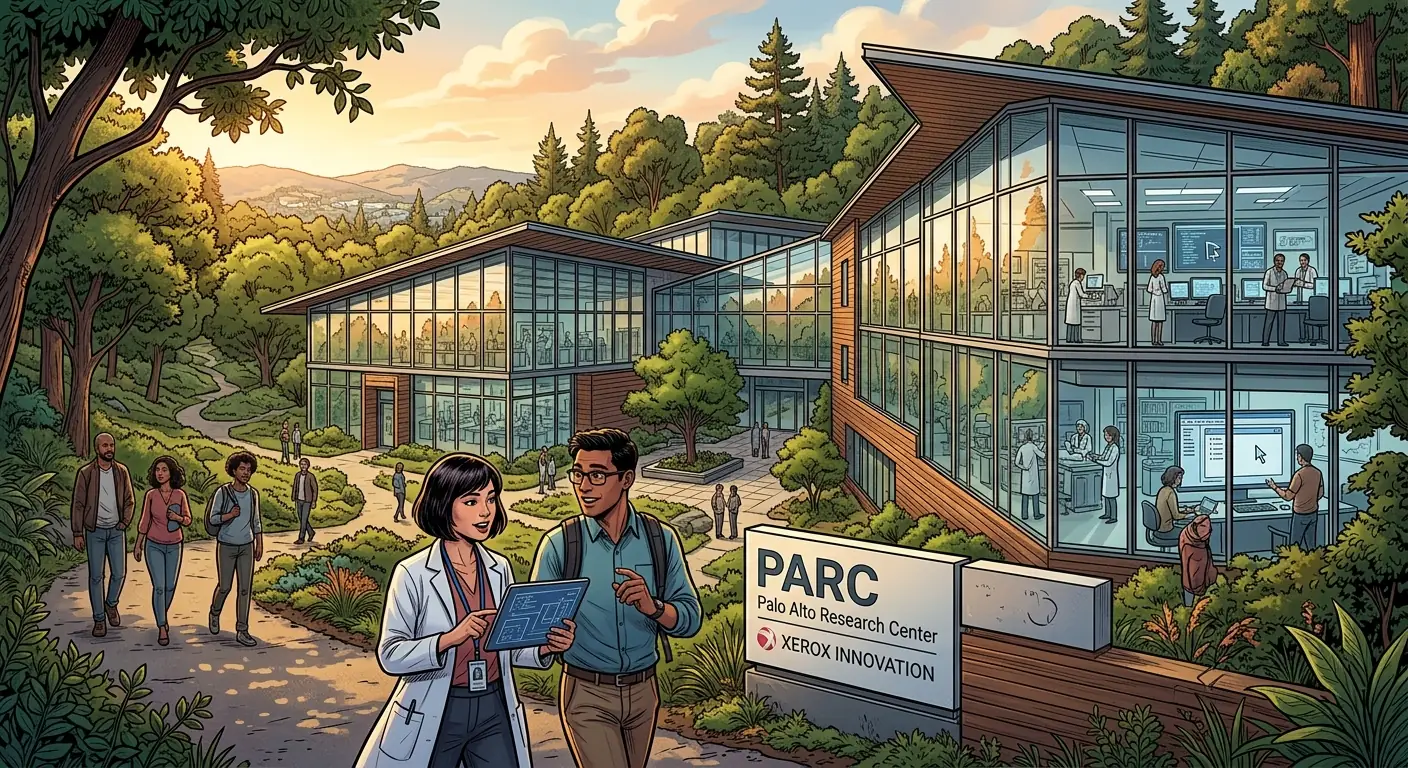
After the tumultuous 1980s, with the Star’s spectacular flop and the diaspora of its brightest minds, one might expect PARC to have simply faded into obscurity, a relic of a bygone era. But like a persistent ghost, PARC endured. It evolved, adapted, and continued to innovate, albeit with a quieter, less revolutionary hum. The institution itself became a testament to the power of sustained research, even when its parent company struggled to capitalize on its breakthroughs.
From Xerox to Independent Entity
The 1990s saw Xerox attempting to redefine its relationship with PARC. There was a renewed effort to more closely align PARC’s research with Xerox’s product lines, a move that often clashed with the “blue-sky” ethos that had defined its golden age. Researchers were encouraged to think about how their work could directly benefit Xerox’s core business, leading to advancements in document management, digital printing, and color science. This shift, while pragmatic, meant fewer grand, foundational leaps and more incremental, applied research.
The biggest structural change came in 2002, when Xerox spun PARC off as a wholly-owned subsidiary named PARC, a Xerox Company. This move was ostensibly to allow PARC to conduct contract research for other companies and to commercialize its technologies more aggressively, without being solely tethered to Xerox’s internal product development cycles. It was an attempt to make PARC a profit center, not just a cost center. This new independence meant PARC could work with competitors, license its IP more broadly, and pursue diverse funding streams. It was a strategic pivot, acknowledging that PARC’s value extended far beyond just Xerox’s copier division.
Modern PARC: Beyond the Copier
Today’s PARC looks very different from the legendary lab of the 1970s, but the spirit of innovation persists. While it no longer invents entire paradigms like the GUI or Ethernet, it continues to push boundaries in areas relevant to the modern information age. Its research portfolio is diverse, spanning:
- Ubiquitous Computing: Think sensors, AI, and data analytics applied to real-world environments.
- Novel Materials and Devices: Developing new materials for electronics, energy, and displays.
- Intelligent Systems: AI, machine learning, and automation for complex decision-making.
- Digital Workplace and Security: Innovations in document processing, information security, and user experience for the modern office.
For instance, PARC has done significant work in areas like printed electronics, developing flexible, low-cost circuits, and AI for explainable decision-making, helping industries understand why an AI makes certain recommendations. They’ve contributed to advancements in solid-state devices, microfluidics, and even sophisticated algorithms for managing energy grids.
In 2021, PARC was acquired by SRI International, another legendary research institute (and the place where Doug Engelbart invented the original mouse!). This acquisition brought PARC full circle, placing it within another non-profit research powerhouse, further emphasizing its role as a hub for advanced R&D rather than a direct product development arm.
A Legacy of Influence
PARC’s current status is a testament to the enduring value of dedicated research. It may not generate the breathless headlines of its youth, but its scientists and engineers continue to contribute to the global pool of knowledge and technology. It’s no longer the “Palace of Invention” for personal computing, but it remains a significant player in areas like AI, materials science, and clean energy.
The ghost of PARC’s past, with its groundbreaking inventions and the bittersweet tale of their dissemination, serves as a constant reminder that innovation is a complex, multi-faceted process. Even when a company fails to monetize its own genius, the genius itself often finds a way to change the world, leaving an indelible mark on the landscape of human progress. PARC, the institution, lives on, a quieter but still potent force in the ongoing quest to invent the future.
💡 Chapter 13: The Innovator’s Dilemma Personified (Timeless Lessons)
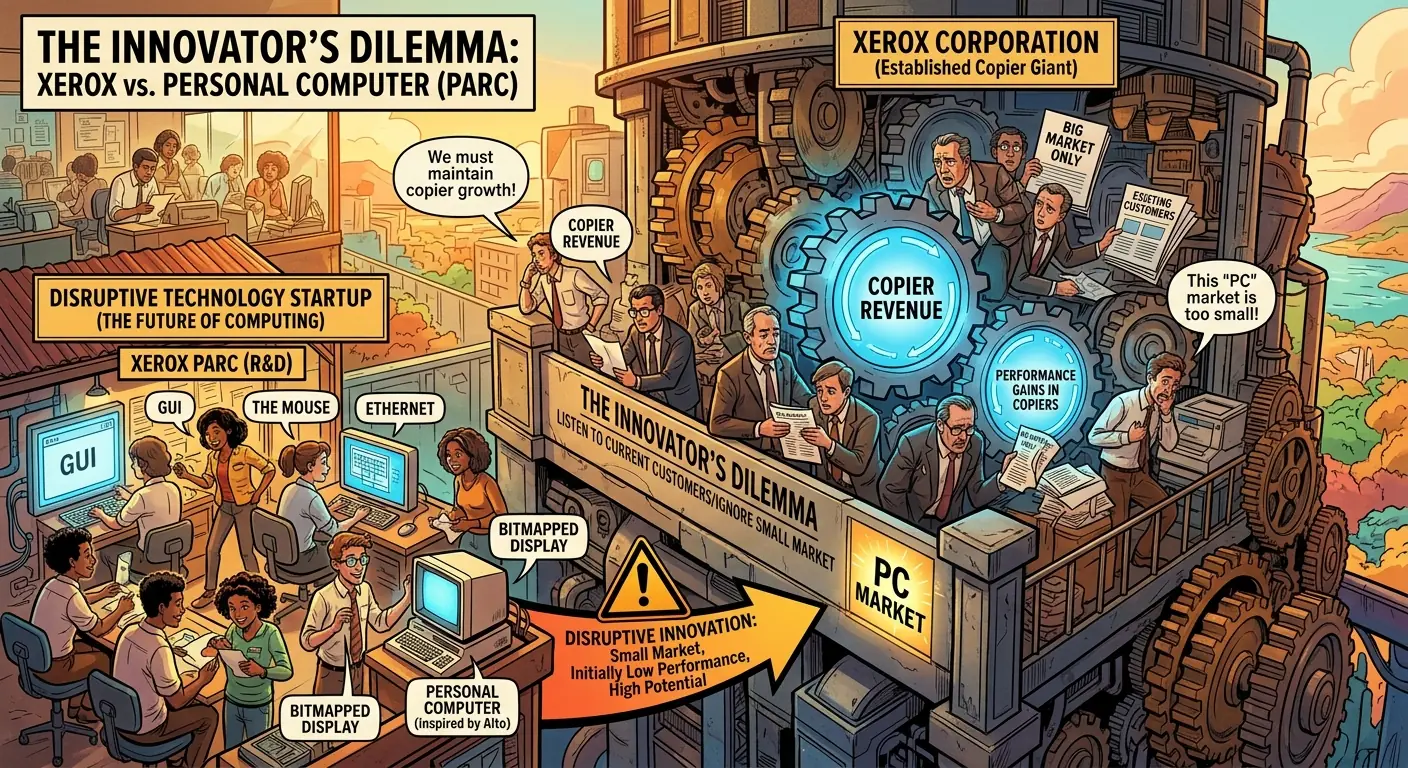
The story of Xerox PARC is often framed as a tragedy of corporate blindness, a cautionary tale of missed opportunities. But it’s more than just a footnote in tech history; it’s a living, breathing case study for one of the most profound business theories of our time: Clayton Christensen’s “Innovator’s Dilemma.” Christensen, a Harvard Business School professor, argued that successful companies often fail not because they’re poorly managed, but precisely because they listen to their customers and invest in established technologies, making them inherently bad at embracing disruptive innovations. Xerox PARC is the textbook example.
The Curse of Core Competence
Xerox in the 1970s was a titan, printing money with its photocopiers. Its customers, primarily large corporations, wanted faster, cheaper, more reliable copiers. They didn’t ask for personal computers, graphical interfaces, or networked workstations. Why would they? These technologies were unproven, expensive, and didn’t fit into their existing workflows. For Xerox, investing heavily in these nascent technologies, which promised lower margins and uncertain markets, would have seemed irrational from a traditional business perspective.
“The reason why great companies fail is that they do everything right. They listen to their customers, they invest in new technologies, they improve their products, but they refuse to invest in new markets that are too small to satisfy their growth needs.” – Clayton Christensen.
This is the core of the dilemma. Xerox’s “core competence” was analog document reproduction. Its sales force, its manufacturing, its entire corporate culture was geared towards this. The innovations bubbling up at PARC were disruptive – they weren’t improvements to existing products; they were entirely new paradigms that would eventually make the core business obsolete. To embrace PARC’s vision would have meant cannibalizing their immensely profitable copier business, a move few rational executives would make. It would have required a complete re-imagining of Xerox’s identity, something corporate behemoths are notoriously bad at.
The Value Network Trap
Xerox was trapped by its “value network.” Its investors demanded steady returns from the copier market. Its customers reinforced the need for better copiers. Its internal processes and management structures were optimized for this existing business. PARC’s personal computing vision existed outside this value network, a rogue planet in Xerox’s well-ordered solar system. When PARC developed the Star workstation, it priced it for the large corporate market that Xerox understood – a market that simply wasn’t ready for individual, networked workstations at that price point. They tried to fit a square peg (personal computing) into a round hole (high-margin, corporate office equipment).
Meanwhile, companies like Apple, with no existing value network to protect, could embrace the “low-end disruption.” They built cheaper, less powerful, but still revolutionary personal computers that initially appealed to hobbyists and small businesses – markets too insignificant for Xerox to bother with. These smaller markets were where the disruptive technology could mature and eventually move upstream, ultimately consuming the very market Xerox protected so fiercely.
The Uncomfortable Truths of Disruption
The lessons from Xerox PARC are timeless and brutal. They remind us that:
- Innovation can be a double-edged sword: Sometimes your greatest inventions can lead to your downfall if you can’t, or won’t, commercialize them properly.
- Market focus can be blinding: Listening too closely to your existing customers can make you deaf to the whispers of future markets.
- Corporate culture is king: Even with unlimited resources and unparalleled genius, a rigid corporate culture can stifle even the most brilliant innovations.
- Disruption rarely starts at the top: Revolutionary change often begins in niche, seemingly unprofitable markets before sweeping through the mainstream.
Xerox PARC didn’t just invent modern computing; it provided the perfect, painful illustration of why dominant companies often struggle to adapt to paradigm shifts. It’s a testament to human ingenuity, but also to human inertia. The ideas weren’t just stolen; in many ways, they were abandoned, left for others to nurture into the digital world we inhabit today, a world that Xerox itself had the foresight to invent, but not the courage to fully embrace.
💡 Key Insights
- ▸ Xerox PARC's failure was not a failure of innovation — it was a failure of organizational design. The researchers at PARC were brilliant. The corporate headquarters in Connecticut couldn't understand what PARC had built, couldn't see how it connected to the copier business, and couldn't integrate breakthrough technology into their existing product lines. The lesson: innovation without organizational alignment is just expensive research. The bridge between invention and commercialization is the hardest thing to build in a corporation.
- ▸ Steve Jobs' visit to PARC in 1979 is often framed as 'Jobs stole from Xerox.' The reality is more nuanced: Xerox gave Jobs a tour in exchange for the right to invest in Apple's pre-IPO stock. They essentially traded the future of computing for a modest financial return. Xerox PARC's tragedy is that it invented the future and then watched others profit from it — not because the ideas were stolen, but because Xerox's leadership couldn't recognize their value.