The Rise and Fall of Adam Neumann: How WeWork's $47B Valuation Collapsed
He convinced the world that shared office space was a tech revolution. Then reality caught up — and one of the greatest corporate implosions in history began.

View all stories about this mogul
A guy who rented desks convinced Wall Street he was building the next Google, rode that narrative to a $47 billion valuation, and when the whole thing cratered, he walked away with a reported $1.7 billion. His employees — the ones who’d taken pay cuts because they believed in the “mission” — got their keycards deactivated and, according to multiple accounts, learned they were laid off from news reports. This is, in our editorial opinion, one of the most staggering wealth transfers in modern business history, and the wildest part is that it might not even have been intentional.
WeWork was a real estate company that dressed up as a tech startup, led by a barefoot, tequila-swigging, surfboard-carrying CEO who, according to reporting in Billion Dollar Loser and The Cult of We, once filled a $60 million private jet with so much marijuana smoke that the flight crew reportedly refused to fly it home. His wife reportedly had people fired for having “bad energy.” He trademarked the word “We” through a personal holding company and charged his own startup $5.9 million to use it, according to the company’s S-1 filing. And the smartest investors on Earth just kept writing checks.
This is that story. Buckle up.
🇮🇱 Chapter 1: The Kibbutz Kid — Origins of a Salesman (1979–2008)

Adam Neumann was born on April 25, 1979, in Israel, into a childhood that was basically a masterclass in instability. Parents divorced young. Bounced around. Spent time on a kibbutz — one of Israel’s communal living experiments where everyone shares everything and private ownership is basically a swear word. Years later, Neumann would tell investors that WeWork was his attempt to recreate the kibbutz for the modern professional world. Beautiful origin story. Whether it was genuinely foundational or reverse-engineered to sell the narrative is anyone’s guess — but the man knew his audience.
A Restless Youth
Neumann was not what you’d call a scholar. Dyslexic, bored by classrooms, allergic to sitting still. What he had instead of academic talent was something arguably more valuable: the ability to walk into any room and make every single person in it believe whatever he wanted them to believe. People who knew him as a teenager have described someone with an almost unsettling gift for persuasion. Six-foot-five, good-looking, radiating a kind of manic confidence that either made you want to follow him or run the other direction. Most people followed.
He served in the Israeli Navy — mandatory service — and then did what ambitious young Israelis do: he moved to New York City to get rich.
New York and the Baby Clothes Failure
Neumann landed in New York in his early twenties with almost no money and barely functional English. He enrolled at Baruch College but was way more interested in hustling than homework. His first business venture? Krawlers — a line of baby clothes with built-in knee pads. For crawling babies. Because apparently babies were just out there destroying their knees and nobody had noticed.
The product bombed. But Neumann learned the only lesson he’d ever really need: the product doesn’t matter nearly as much as the story. A baby knee pad is just a baby knee pad. But “a movement to protect the next generation”? That gets you a meeting with investors.

Meeting Miguel McKelvey
Then came the meet-cute. Neumann crossed paths with Miguel McKelvey, a trained architect from Oregon who was basically his opposite in every conceivable way. McKelvey was quiet, methodical, thoughtful — the kind of guy who measures twice and cuts once. Neumann was the kind of guy who didn’t measure at all, just started cutting, and somehow the thing still held together. For a while.
McKelvey had helped create a co-working space called Green Desk in their Brooklyn building — an eco-friendly shared office concept. It was working. People wanted flexible, community-oriented space. The two looked at each other and had the same thought: what if we scale this thing?
They sold their stake in Green Desk and poured the money into a new venture. They called it WeWork. And for a while, it was legitimately great.
🏢 Chapter 2: The Birth of WeWork — Selling a Revolution (2010–2014)
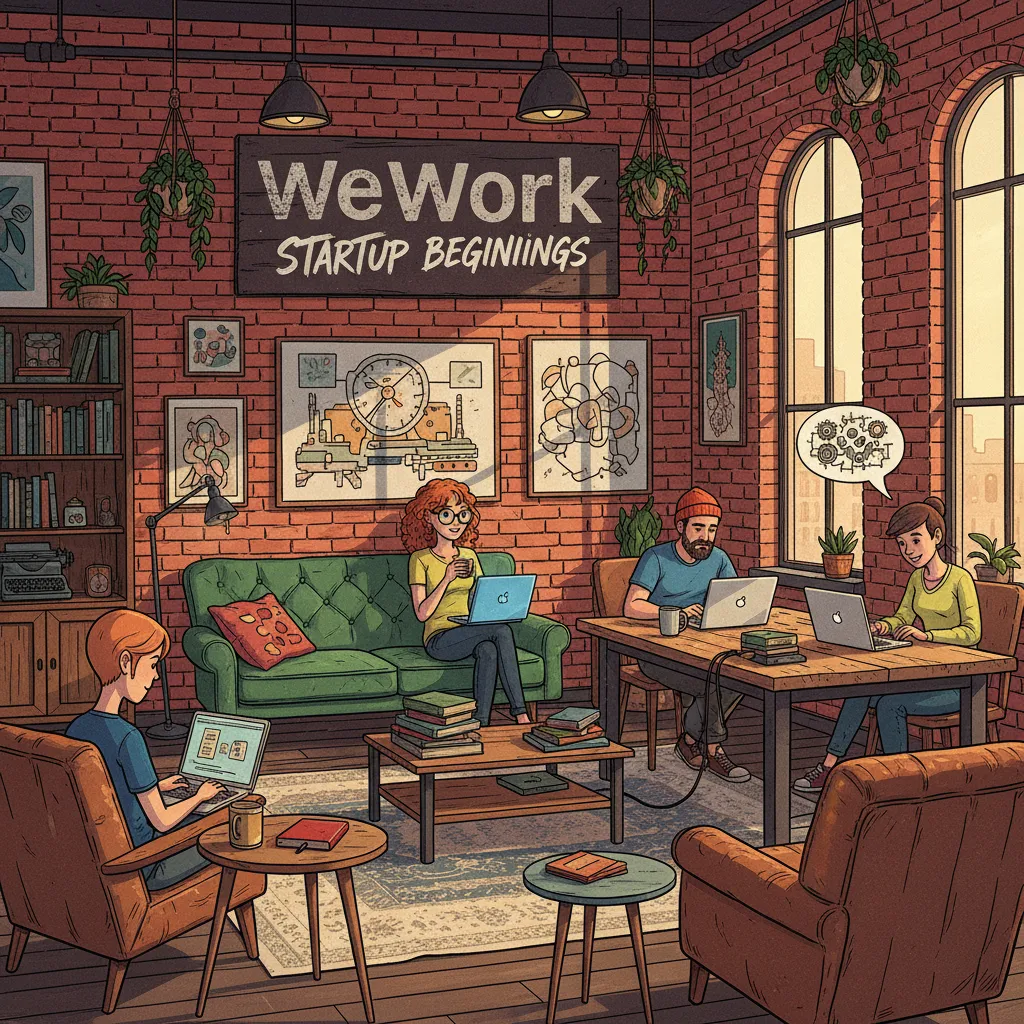
WeWork opened its first location in 2010 at 154 Grand Street in SoHo, Manhattan. The concept was dead simple: lease entire floors or buildings, gut-renovate them into Instagram-worthy shared workspaces with beer on tap and good coffee, then rent desks and private offices to freelancers, startups, and small companies at a hefty markup.
Here’s the thing nobody wanted to say out loud: this was a real estate company. The business model was identical to Regus (now IWG), which had been doing the exact same thing since 1989. Lease long, sublease short, pocket the spread. Your grandpa could explain it.
But Adam Neumann did not sell WeWork as a real estate company. That would get you a real estate valuation — boring, low multiples, yawn. He sold it as a technology company. A community company. A consciousness company. And that audacious, arguably delusional reframing is what made WeWork worth $47 billion on paper and absolutely nothing in reality.
The Pitch
Neumann’s pitch to investors was something people describe less like a business presentation and more like a tent revival. He would stride into rooms barefoot — actually barefoot, shoes nowhere in sight — hair flowing past his shoulders, radiating the energy of a surf instructor who’d just discovered capitalism. Hardened venture capitalists who’d spent decades saying no to founders found themselves reaching for their checkbooks before he finished talking.
“We are here in order to change the world,” he’d say, without even a hint of irony. “We’re not just renting desks. We’re elevating the world’s consciousness.”
Members weren’t tenants — they were a “community.” Offices weren’t offices — they were “spaces for creation.” The company didn’t have a business model — it had a “mission.” And if you squinted hard enough and turned your head sideways and had maybe two glasses of wine, you could almost see it.
The Early Growth
The formula worked. Young professionals and startups flocked to WeWork locations. Credit where it’s due: McKelvey’s architectural background meant the spaces were genuinely beautiful. Exposed brick, natural light, craft beer on tap, community events that felt more like house parties. For a generation of workers who’d rather chew glass than sit in a beige cubicle under fluorescent lights, WeWork was a revelation.
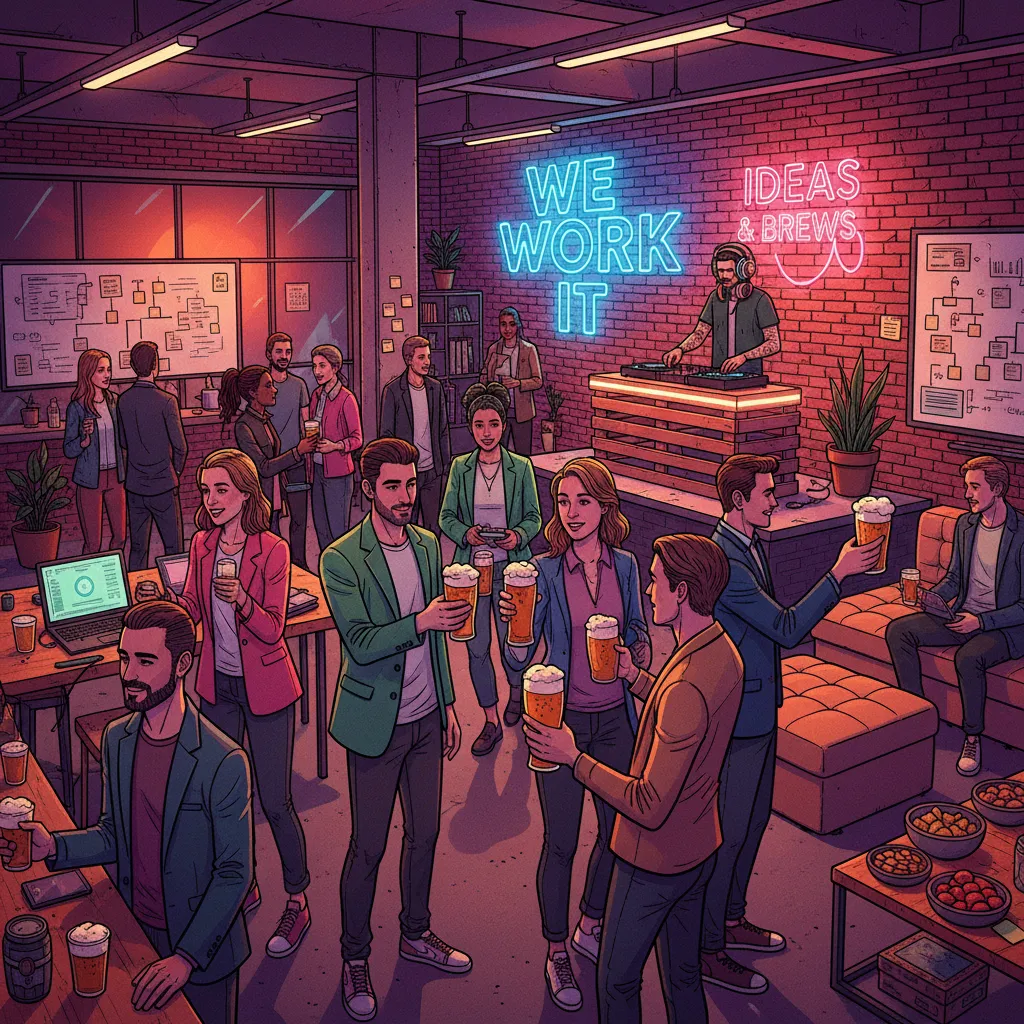
WeWork expanded fast. New York. San Francisco. LA. London. By 2014, the company had a handful of locations and a $5 billion valuation. VCs were in a bidding war to throw money at it.
The numbers, of course, told a completely different story. Each new location required massive upfront capital — lease deposits, renovations, furniture, staff. Revenue trickled in slowly as desks filled up. The unit economics were somewhere between “questionable” and “actively suicidal.” But this was the mid-2010s. Interest rates were on the floor. “Growth at all costs” wasn’t just a strategy — it was a religion. Nobody was asking whether the business made money. They were asking about the vision.
The Culture of Excess
From Day 1, WeWork’s internal culture was less “tech startup” and more “Burning Man with a P&L statement.” Neumann set the tone, and the tone was frat party meets spiritual retreat meets your friend’s wedding that got way out of hand.
Company events — called “Summer Camps” — featured live music from the Chainsmokers and Florence and the Machine, open bars that raged until sunrise, and Neumann himself leading thousands of employees in chants like some kind of co-working cult leader. Everyone was mandatory-fun-having their faces off.
Tequila was the unofficial sacrament. According to multiple former employees quoted in Billion Dollar Loser and The Cult of We, it flowed freely at headquarters, and former employees have described meetings where shots were poured at 2 PM on a Tuesday. One former employee recalled Neumann walking into a meeting, slapping a bottle of Don Julio 1942 on the table, and announcing that nobody was leaving until it was empty. Imagine your CEO doing that. Now imagine the company losing $2 billion a year while he does it.
The surf thing was real too. Neumann was an avid surfer, and there are multiple published accounts of him hitting Rockaway Beach before board meetings — reportedly rolling into discussions about billion-dollar financing rounds with wet hair and sand in his ears. It’s the kind of detail a screenwriter would delete for being too on-the-nose, except it actually happened.
💰 Chapter 3: Masayoshi Son and the Money Firehose (2016–2018)

Every heist movie has a moment where things go from “ambitious” to “completely unhinged.” For WeWork, that moment has a name: Masayoshi Son.
Son, the founder and CEO of SoftBank, is one of the most aggressive investors in the history of money. His $100 billion Vision Fund — backed largely by Saudi Arabia’s sovereign wealth — was the largest technology investment vehicle ever assembled. Son’s investment philosophy was elegant in its recklessness: find visionaries, firehose them with more cash than they could possibly spend, and let them conquer their markets.
The 12-Minute Bet
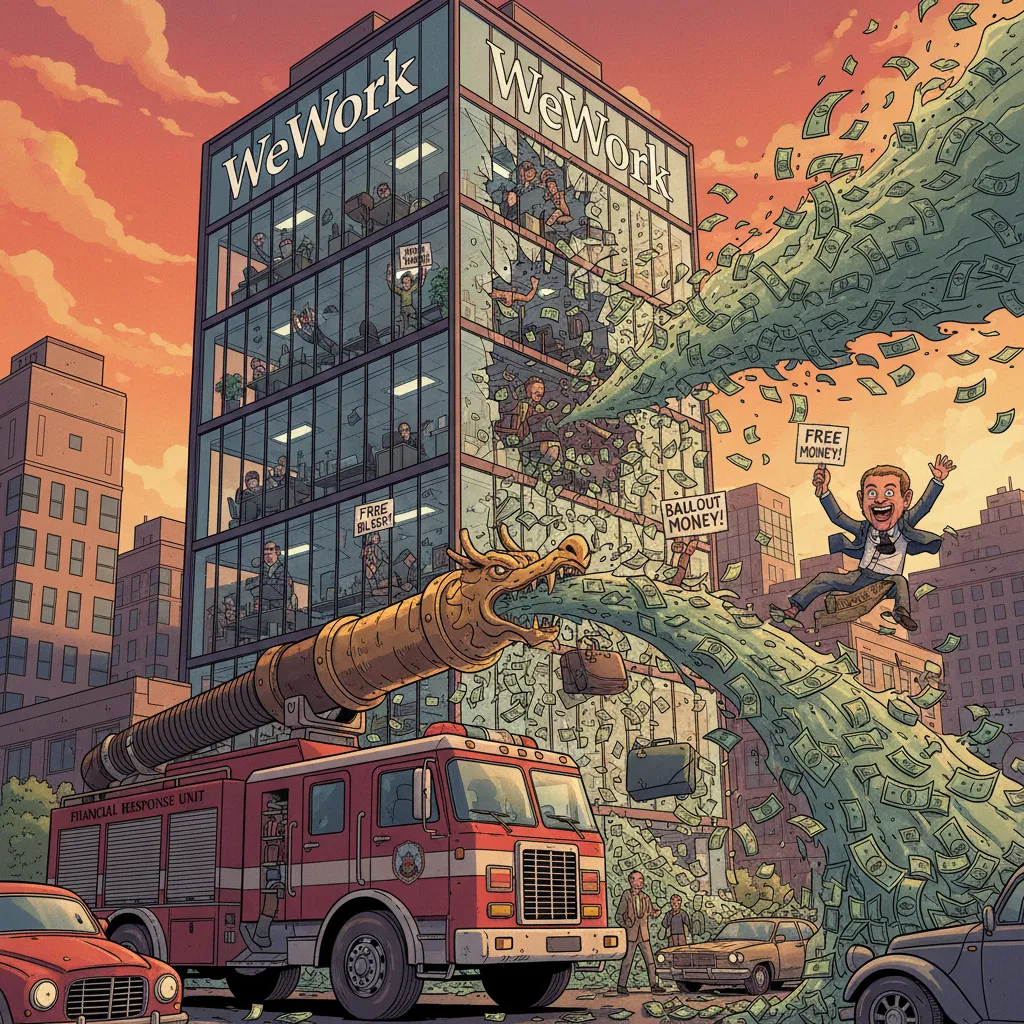
In January 2017, Son visited WeWork’s headquarters. Neumann gave him a quick tour. The two climbed into the back of Son’s car. Son pulled out his iPad, scratched out a valuation on the screen, and committed $4.4 billion to WeWork.
The entire thing took twelve minutes. From car door to handshake. Twelve minutes.
For context, you probably spend longer deciding what to order at Chipotle. Masayoshi Son spent twelve minutes deciding to bet $4.4 billion on a guy who rented desks.
Son’s logic was that Neumann reminded him of Jack Ma — the charismatic founder of Alibaba, where a $20 million SoftBank bet turned into over $100 billion. Son figured he’d found another Jack Ma. But here’s the inconvenient truth: Jack Ma built a platform with network effects, near-zero marginal costs, and insane operating leverage. Neumann built a company that lost money on every single desk it rented. Slight difference.
“In a Fight, Being Crazy Is an Advantage”
Son didn’t just write a check. He poured gasoline on the fire. According to Reeves Wiedeman’s book Billion Dollar Loser, Son asked Neumann: “In a fight, who wins — the smart guy or the crazy guy?” Neumann answered, “The crazy guy.” Son replied: “You’re right. But you’re not crazy enough.”
Read that again. The most aggressive investor in tech history looked at a guy who was already spending money like it was on fire and said: be crazier. It’s like handing a toddler a flamethrower and telling him to dream bigger.
Neumann was happy to oblige.
The Spending Binge
With SoftBank’s billions burning a hole in the balance sheet, WeWork went on a spending spree that would make a drunken sailor blush. The company was opening new locations at a rate of roughly one per day. It expanded into dozens of countries. It started acquiring companies seemingly at random — a coding bootcamp (Flatiron School), a social networking app (Meetup), and — this is real — a wave pool company (Wavegarden). Neumann reportedly explored buying the naming rights to entire neighborhoods. Just casually trying to purchase the concept of a neighborhood.
The crown jewel of the excess was the corporate jet. WeWork leased a $60 million Gulfstream G650 for Neumann’s personal use. He used it to bounce between WeWork locations, surf destinations, and whatever else struck his fancy. But the jet’s most memorable moment, according to reporting by the Wall Street Journal and detailed in The Cult of We, came on a flight from New York to Israel, when Neumann and his entourage reportedly smoked so much marijuana on board that the flight crew found a substantial stash stuffed into the couch cushions after landing. The crew reportedly refused to fly the plane back. Let that visual really settle in: the CEO of a $47 billion company allegedly got so high on his own private jet that the pilots staged a labor action.
👑 Chapter 4: The Kingdom of We — Peak Neumann (2018–2019)
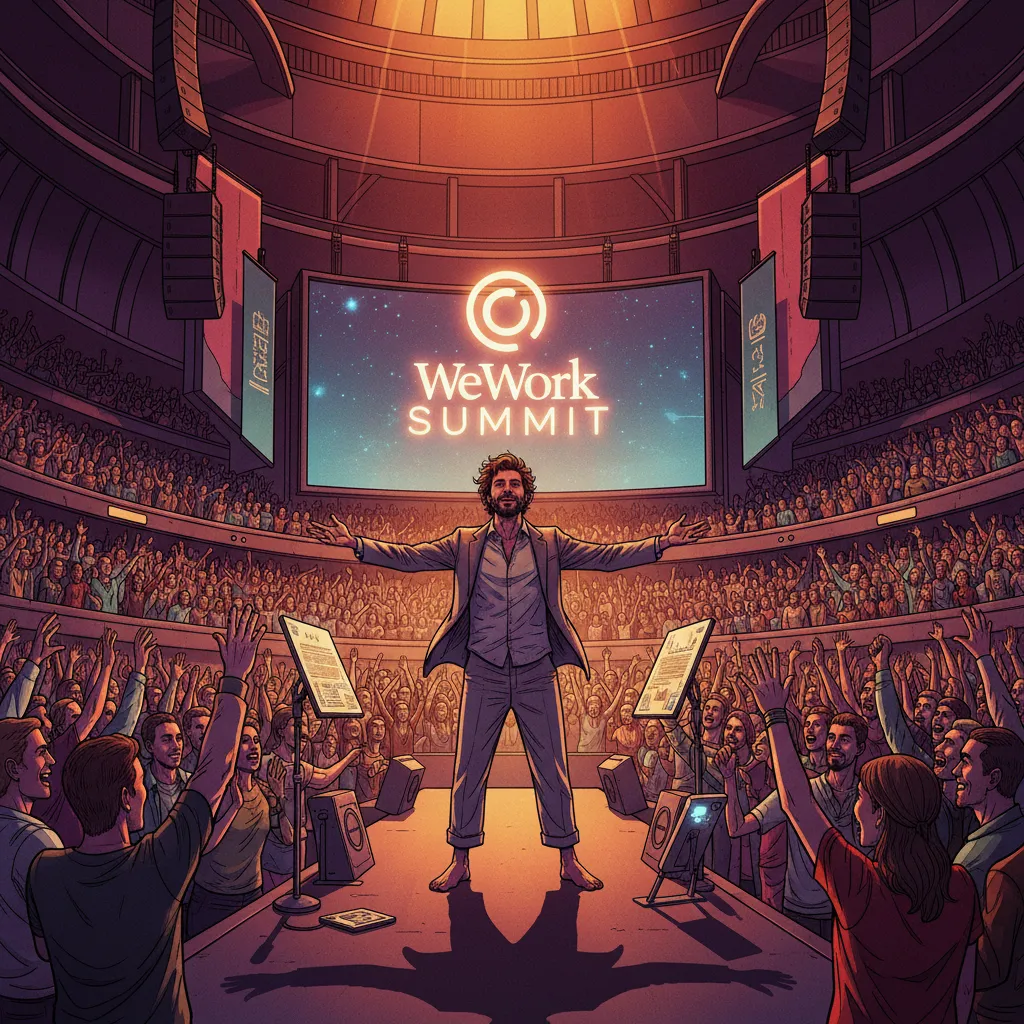
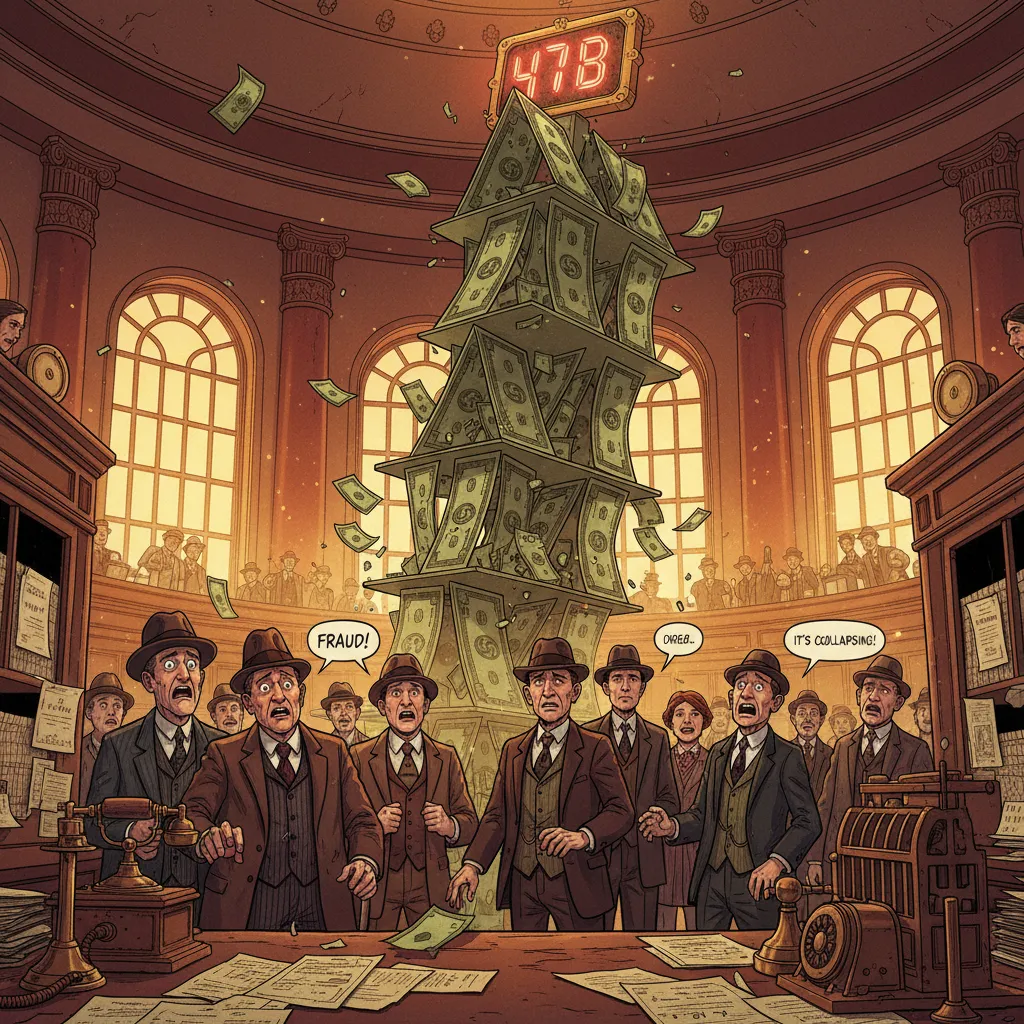
By 2018, WeWork was valued at $47 billion. Forty-seven billion dollars. For a company that subleased office space. That valuation made WeWork worth more than ten of the twelve largest publicly traded real estate companies in the United States. Combined. It was worth more than Ford, more than Delta Airlines, more than Marriott — all companies that had the audacity to actually make money.
Neumann, reportedly intoxicated by validation and tequila in roughly equal measure, had — according to former employees and board members — stopped operating like a CEO and started operating like a tech-mogul-philosopher-king who answered to no one and nothing.
WeGrow, WeLive, and the We Universe
The empire expanded in every direction, whether it made sense or not. WeLive: co-living apartments. WeGrow: a private school. Rise by We: a gym. Neumann’s vision was total immersion — WeWork for your office, WeLive for your home, WeGrow for your kids, Rise by We for your body. A person could theoretically live their entire life inside a Neumann-controlled ecosystem, from birth to death, never touching the outside world. Which is either a utopian vision or the setup for a horror movie, depending on your perspective.
Neumann’s wife, Rebekah Paltrow Neumann — yes, a cousin of that Paltrow — installed herself as CEO of WeGrow and declared the school would “unleash every human’s superpowers.” The tuition was $42,000 a year. For a school run by a company that couldn’t turn a profit renting desks.

Rebekah’s role at WeWork was a constant source of internal chaos. She held the title of chief brand and impact officer, which gave her vague authority over basically everything. According to multiple former employees quoted in published accounts, she fired people on the spot based on vibes. Literal vibes. She reportedly had an employee removed within seconds of meeting them because she detected “bad energy.” Not poor performance. Not misconduct. Bad energy. Imagine going home and explaining to your partner that you lost your job because the CEO’s wife didn’t like your aura.
And then there’s the trademark deal. The word “We” became so central to the brand that Neumann trademarked it — not through the company, but through a personal holding company — and then turned around and charged WeWork $5.9 million to license back the right to use the word “We,” as disclosed in WeWork’s S-1 filing. From its own co-founder. He literally sold a two-letter word back to his own company for $5.9 million. When the deal became public, the outrage was immediate and universal. Neumann returned the money, but the damage was done. Everyone could see exactly what kind of operation this was.
The Self-Dealing Problem
The trademark deal was just the appetizer. According to WeWork’s own S-1 filing and subsequent reporting, Neumann had been using his position to enrich himself in ways that would raise serious governance red flags at any public company:
- He personally bought buildings and then leased them back to WeWork. The company was paying rent to its own CEO. Read that sentence again.
- He’d taken out hundreds of millions in personal loans secured against his WeWork stock — effectively cashing out while everyone else held worthless paper.
- His voting structure gave him supermajority control, meaning the board couldn’t overrule him on virtually anything.
- His employment contract specified that if he died or became incapacitated, his wife Rebekah would help choose his successor. The succession plan for a $47 billion company was “ask my wife.”
The board — populated by early investors who were either dazzled, compromised, or terrified — did absolutely nothing. They sat there like passengers on the Titanic complimenting the orchestra.
The $47 Billion Fantasy
At $47 billion, WeWork was the most valuable startup in the United States after Uber. But that number existed in a hermetically sealed fantasy world. SoftBank had set the valuation in a private transaction. No public market. No skeptical analysts. No short sellers. As long as each funding round came in higher than the last — and as long as Son kept writing checks — the number could be anything they wanted.
Going public would change everything. Because in a public market, the spreadsheets have to match the story. And WeWork’s spreadsheets were a horror show.
📉 Chapter 5: The S-1 — Six Weeks of Destruction (August–September 2019)
In August 2019, WeWork — now pompously rebranded as “The We Company” — filed its S-1 with the SEC. This is the document every company has to file before going public. It’s supposed to be your debut. Your moment. Your chance to show Wall Street what you’re made of.
WeWork’s S-1 showed Wall Street exactly what WeWork was made of, and Wall Street laughed until it cried.
The Document That Launched a Thousand Memes
The S-1 opened — and I swear this is real — not with financial data, not with business strategy, but with a dedication:
“We dedicate this to the energy of we — greater than any one of us but inside each of us.”
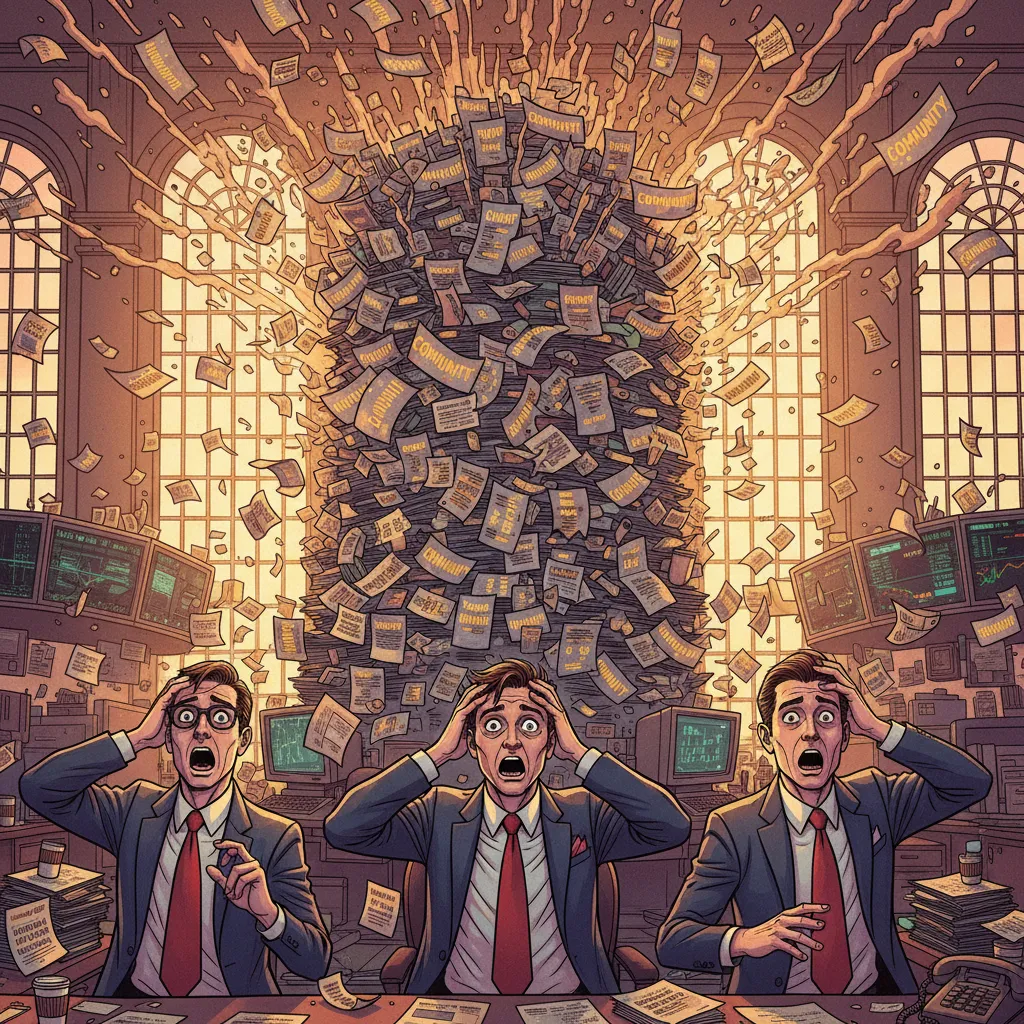
Wall Street analysts, people who spend their days reading dense legal filings about depreciation schedules and tax liabilities, stared at this sentence like a dog hearing a strange noise. The document used the word “community” over 150 times. It featured long philosophical riffs about “elevating the world’s consciousness.” Neumann was described not as a CEO but as someone so cosmically important that his departure was listed as a risk factor alongside global economic downturns and natural disasters. Adam Neumann, right up there with earthquakes and recessions. No ego problem here.
The Numbers Behind the Curtain
But the real devastation was in the financials, which read like a confession:
- Revenue in 2018: $1.8 billion
- Net loss in 2018: $1.9 billion (they lost more than they made — the company literally had a negative profit margin on total revenue)
- Long-term lease obligations: $47.2 billion in rent commitments over the next 15+ years
- Cash on hand: about $2.5 billion, enough for maybe 12-18 months at current burn rate
The business model, stripped of all the consciousness-elevating poetry, was this: WeWork signed 10-to-15-year leases at fixed rates and rented space to members on month-to-month or one-year deals. If a recession hit, members could vanish overnight. WeWork couldn’t. The entire company was a massive, leveraged bet that the economy would never, ever contract. It was a bet against recessions. In America. Where recessions happen like clockwork.
“Community Adjusted EBITDA”
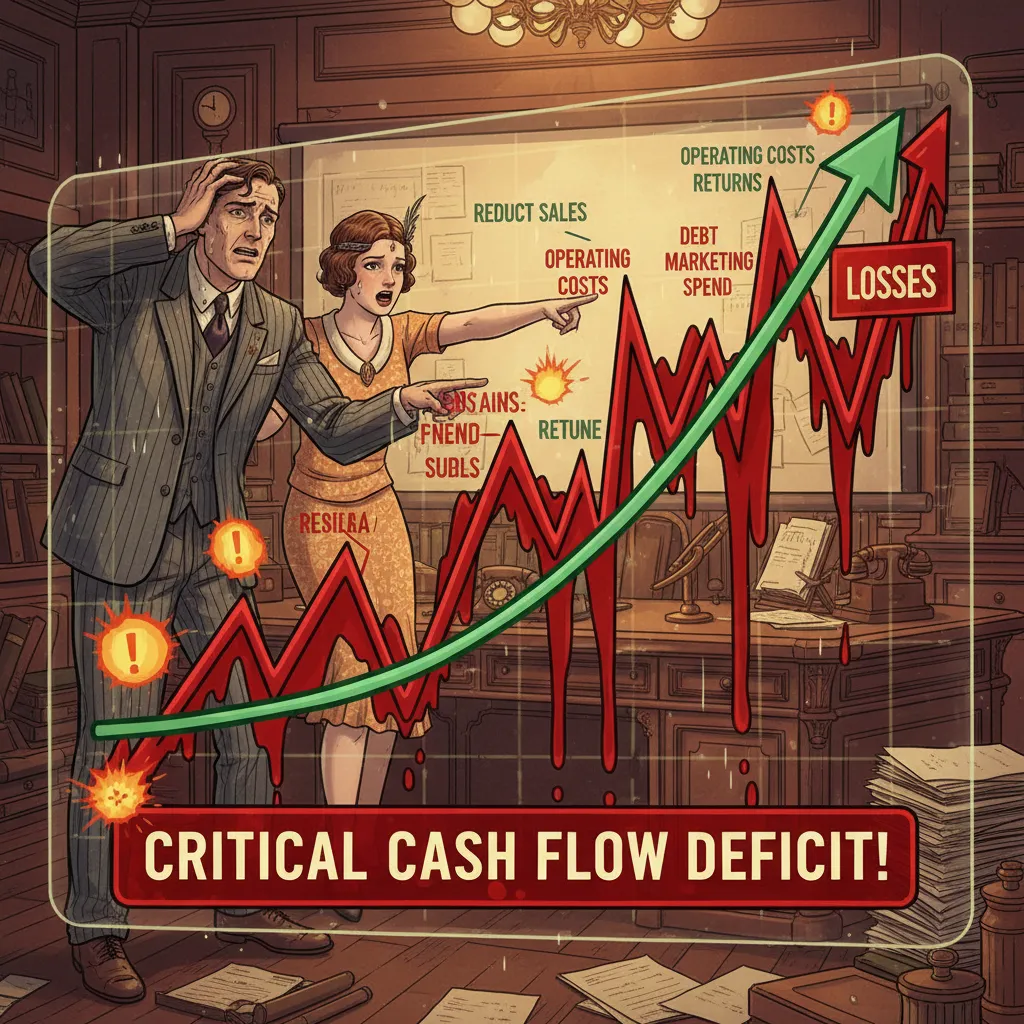
And now we arrive at the single greatest piece of financial fiction since Enron. WeWork invented its own profitability metric: “Community Adjusted EBITDA.”
Normal EBITDA — Earnings Before Interest, Taxes, Depreciation, and Amortization — is already a generous way to measure how a company is doing. It strips out a bunch of real expenses to make you look better. WeWork’s version went further. It stripped out additional major expenses, including the cost of building and designing new locations. You know — the core activity of the business. It’s like a restaurant calculating its profitability after excluding the cost of food.
By WeWork’s own custom math, things looked great. By every accounting standard that has existed since the invention of accounting, the company was lighting money on fire in a dumpster.
The reaction was immediate and savage. NYU professor Scott Galloway called WeWork “WeWTF.” Bloomberg’s Matt Levine wrote devastatingly funny dissections. Twitter was absolutely merciless. “Community Adjusted EBITDA” became the punchline of the decade — a shorthand for corporate BS so brazen it loops back around to being almost admirable.
The Valuation Collapse
Within days of the S-1 dropping, the $47 billion target valuation was dead on arrival. Banks started suggesting $20 billion. Then $15 billion. Then $10 billion. Each revision landed like another punch to a fighter who was already on the canvas.
In six weeks, WeWork lost roughly 80% of its perceived value. Not because of a market crash. Not because of a competitor. Not because of a pandemic. Just because people finally read the numbers. That’s it. The emperor walked out with no clothes, and for the first time, somebody pointed.
The IPO Is Pulled
On September 30, 2019, WeWork officially killed the IPO. The investor roadshow — where executives pitch Wall Street in a series of fancy dinners and presentations — had been a bloodbath. Institutional investors asked basic questions about profitability, and Neumann responded with motivational poetry about consciousness. These are people who manage pension funds. They didn’t want their consciousness elevated. They wanted to see a profit.
The most valuable startup in America had been exposed as a money-incinerating real estate company wearing a tech costume. And the guy who built the illusion was about to learn that you can’t “elevate consciousness” your way out of a balance sheet.
🚪 Chapter 6: The Ouster — How Neumann Lost His Kingdom (September–October 2019)

With the IPO dead and buried, WeWork’s board — the same board that had spent years nodding along like dashboard bobbleheads to every insane decision Neumann made — suddenly discovered it had a spine. Better late than never, guys.
The Final Days
Now that the spell was broken, reporters and analysts went digging, and what they found was a greatest-hits album of corporate governance failures:
- Neumann had installed a personal sauna in his office. A sauna. At work. In a company losing $2 billion a year.
- WeWork had reportedly purchased properties at above-market rates from entities connected to — wait for it — Neumann himself.
- The company had seriously explored buying a wave pool company to build surfing amenities in WeWork buildings, because the CEO liked surfing.
- Former employees have described a culture where Neumann’s inner circle was untouchable and where questioning the leader was reportedly treated as disloyalty.
The board, led by SoftBank’s representatives who were watching their billions evaporate in real time, finally told Neumann to leave. On September 24, 2019, Adam Neumann resigned as CEO. He was replaced by two co-CEOs — Artie Minson and Sebastian Gunningham — because apparently the thinking was, “One person can’t clean up this mess, let’s try two.”
The Golden Parachute
Now here’s where the story goes from tragic to infuriating. SoftBank, desperate to stabilize WeWork and protect what was left of its investment, negotiated an exit package for the man who had just destroyed $40 billion in value. The package included:
- A $185 million “consulting fee” (for what consulting, exactly, remains unclear)
- $500 million in credit to repay his personal loans
- SoftBank’s purchase of roughly $1 billion in Neumann’s WeWork shares
Total haul: approximately $1.7 billion.

One point seven billion dollars. For the guy who presided over the company’s implosion. The man who, according to the company’s own filings and extensive reporting, personally enriched himself through self-dealing while the business hemorrhaged cash, who fostered a corporate culture where, by numerous accounts, tequila shots and “energy checks” replaced financial discipline, who spent company money on private jets and wave pool companies — that man walked away richer than 99.999% of humans who have ever lived.
Meanwhile, the employees got nothing. Thousands of WeWork workers had accepted below-market salaries because they believed in the mission and trusted that their stock options would make them whole someday. Those options were now worth less than the paper they were printed on. Many of these people had relocated for WeWork, turned down offers from stable companies, uprooted their families — all because a charismatic guy in bare feet told them they were changing the world.
The layoffs that followed were handled with a cruelty that bordered on performance art. According to multiple former employees quoted in news reports, some learned they’d been laid off from news coverage before the company bothered to tell them. Others reportedly showed up to work and found their keycards deactivated. No meaningful severance. No apology. Just silence from a company that had spent years preaching about “community.”
Adam Neumann got $1.7 billion. His employees got a deactivated keycard and a lesson about capitalism.
💀 Chapter 7: The Aftermath — Bankruptcy and Beyond (2019–2023)

With Neumann gone, the “adults” took over. But the patient was already on life support, and the damage was structural, deep, and in many ways terminal.
The Rescue Attempt
SoftBank pumped an additional $5 billion into WeWork to keep the lights on. The new leadership did what Neumann never had the discipline to do: they cut costs, laid off roughly 2,400 employees (about 20% of the workforce), and started dismantling Neumann’s empire of vanity projects. WeGrow — the $42,000-a-year school for superpowered children — shut down. WeLive got scaled back. The Gulfstream was returned (presumably after a very thorough cleaning). The wave pool dreams died quietly.
Sandeep Mathrani, a veteran real estate executive, was brought in as CEO in February 2020. He was everything Neumann wasn’t: experienced, measured, allergic to spiritual pronouncements about consciousness, and capable of reading a balance sheet without having a vision quest. He was the designated adult.
COVID-19: The Worst Possible Timing
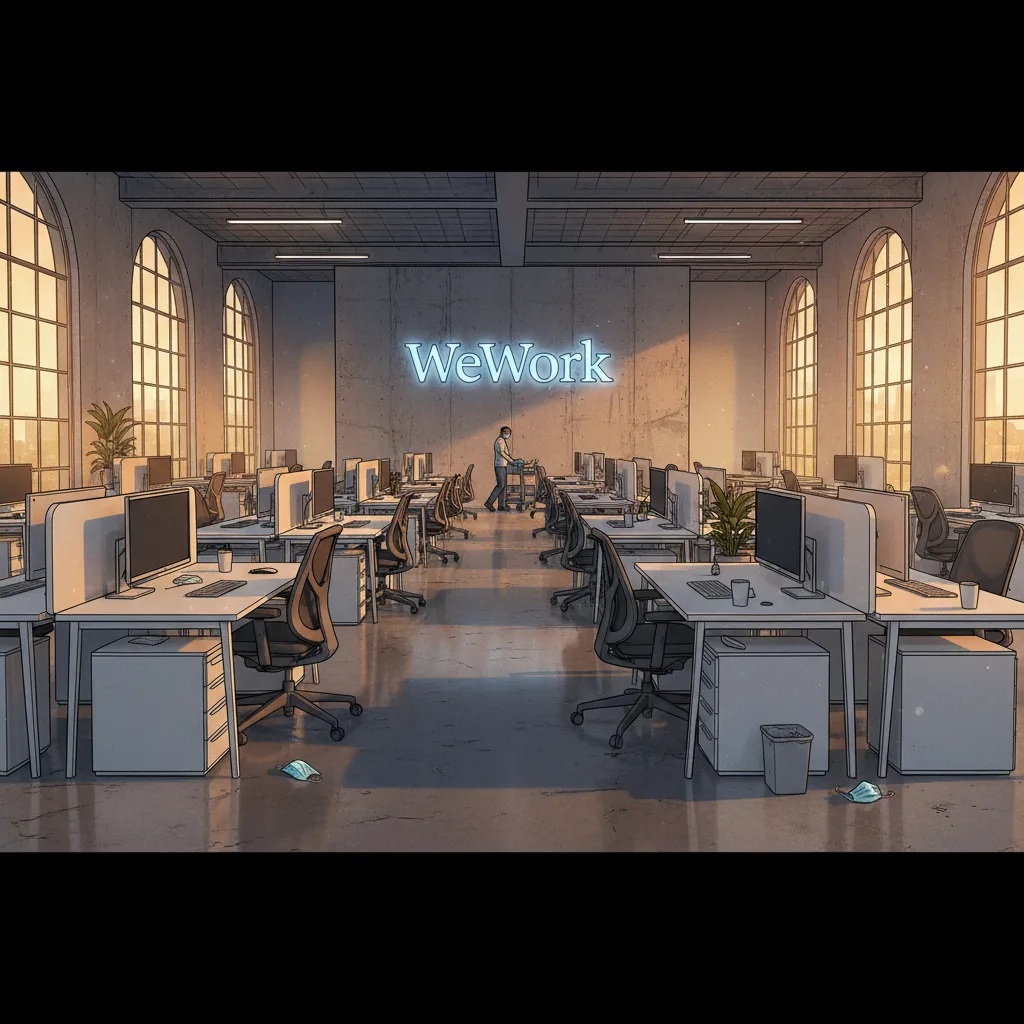
Because the universe has a sense of humor, the COVID-19 pandemic hit just weeks after Mathrani took over. Every office in the world emptied overnight. The entire premise of WeWork — that people wanted to gather in shared spaces to work — wasn’t just questionable anymore. It was literally a public health hazard.
Occupancy rates cratered. Revenue fell off a cliff. The company, already drowning in billions of dollars of debt from its expansion binge, now had the added joy of paying rent on hundreds of half-empty buildings during a global lockdown. It was like watching someone who’s already drowning get hit by a wave.
The SPAC and the Final Chapter
WeWork eventually limped its way to a public listing in October 2021 through a SPAC merger — which is basically the side door you use when the front door of a traditional IPO has been slammed in your face. The implied valuation was about $9 billion. So: $47 billion to $9 billion in two years. Nearly $40 billion in perceived value, just gone. Poof. Like it never existed. Because it didn’t.
Even at this beaten-down valuation, the numbers still didn’t work. WeWork kept losing money. The stock, which opened around $10, began a slow, grinding death march. By mid-2023, it was trading below a dollar. A single share of the company that was once valued higher than Ford Motor Company was now worth less than a pack of gum.
On November 6, 2023, WeWork filed for Chapter 11 bankruptcy. $47 billion to zero. It was one of the largest startup collapses in American history — a flaming wreck so spectacular it’s practically a tourist attraction.
The filing listed $15 billion in assets and $18.6 billion in liabilities. WeWork would keep some locations running during restructuring, but the dream — the consciousness-elevating, world-changing, community-building, tequila-fueled dream — was dead. And somewhere, Adam Neumann was still a billionaire.
🔄 Chapter 8: The Comeback Kid — Flow and the Audacity of Adam Neumann (2022–Present)

Most people, having presided over the destruction of $47 billion in value, having cost thousands of people their jobs and savings, having been publicly humiliated in front of the entire financial world — most people would take the $1.7 billion, buy a very nice island, and never show their face again.
Adam Neumann is not most people. Adam Neumann is built different. And by “different,” I mean he has the kind of audacity that scientists should probably study.
Flow
In August 2022 — while WeWork was still alive and staggering toward its eventual bankruptcy — it was announced that Neumann had raised $350 million from Andreessen Horowitz (a16z) for a new startup called Flow. The focus? Residential real estate. Specifically, “reinventing the apartment living experience with community-oriented amenities and a technology platform.”
If this sounds familiar, it’s because it is literally WeLive. The co-living concept that failed under WeWork. He’s doing it again. Same movie, different title. And someone gave him $350 million to do it.
The a16z investment valued Flow at over $1 billion before the company had launched a single product. Marc Andreessen himself wrote a blog post calling Neumann a “visionary” who had “reset the market for office space globally.” The post conspicuously failed to mention the $40 billion in destroyed value, the self-dealing, the governance disasters, or the thousands of employees who got their lives disrupted. Selective memory is one hell of a drug.
Silicon Valley’s Selective Memory
The Flow investment revealed something almost beautiful in its absurdity about Silicon Valley’s relationship with failure. In the tech ecosystem, the exact traits that produce catastrophic failures — delusional self-confidence, grandiose vision, reality distortion — are also the traits that produce trillion-dollar companies. The system genuinely cannot tell the difference between a visionary and a con artist until after the movie is over. So it just keeps funding both and hoping for the best.
Neumann, for his part, has shown little public contrition. In his rare public appearances, he has spoken about “lessons learned” in what observers have noted seems like the way people do when the primary lesson they learned was “next time, control the narrative better.”

Where Is Neumann Now?
As of 2026, Adam Neumann remains absurdly wealthy. His real estate holdings, personal investments, and the SoftBank exit package have left him with a fortune estimated north of $1 billion. He lives between properties in New York, Miami, and the Hamptons — because when you’ve destroyed $47 billion in value, you need at least three homes to process the experience.
Flow has begun operating in a handful of buildings, with mixed early reviews and nothing resembling the kind of breakthrough that would justify its valuation. Whether it represents a genuine second act or another exercise in narrative over substance is an open question. What is not an open question is whether Adam Neumann has any intention of going away. He does not. The man is unkillable.
🎭 Chapter 9: The Supporting Cast — The People Who Enabled and Endured the WeWork Saga
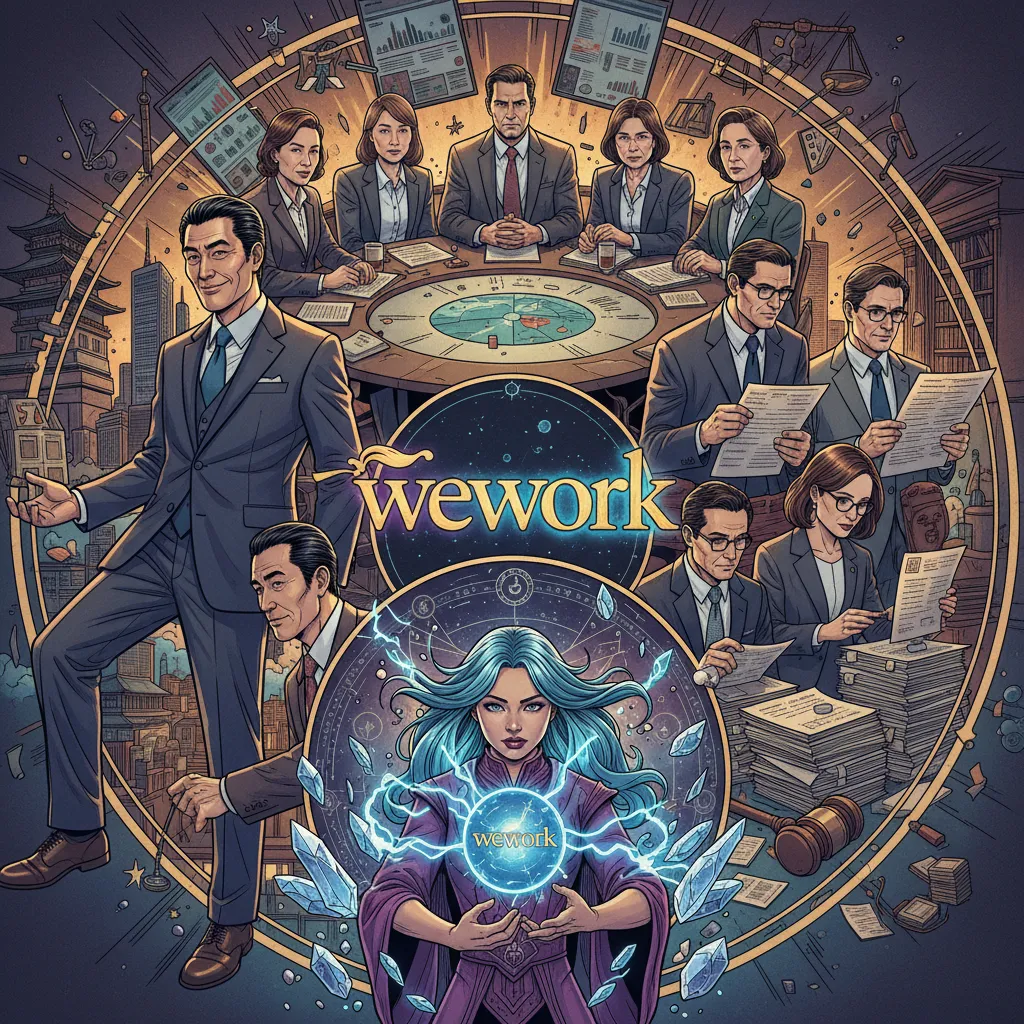
No heist movie is complete without the supporting cast — the enablers, the bystanders, and the victims.
Masayoshi Son
Son’s role in the WeWork catastrophe cannot be overstated. He was the gas that turned a campfire into a wildfire. His $10 billion+ commitment to WeWork transformed a moderately overfunded startup into a globally reckless spending machine. His investment philosophy — “give visionary founders unlimited capital and let them figure it out” — works great when the founder is Jack Ma building Alibaba. It works catastrophically when the founder is Adam Neumann buying wave pool companies and hotboxing private jets.
SoftBank’s Vision Fund eventually wrote down its WeWork investment by approximately $14 billion. One of the largest single investment losses in venture capital history. Son reportedly told his investors it was his biggest mistake. You think?
Rebekah Paltrow Neumann
Rebekah’s influence went far beyond her formal title. Multiple former employees have described her, in published accounts, as a shadow CEO whose whims could reshape entire departments on a Monday morning. She championed WeGrow, the bougie school that burned through millions before getting shuttered. She pushed wellness and spirituality initiatives that, while perhaps well-intentioned, had approximately nothing to do with the company’s core business of renting desks to people.
The “energy” firings became legendary inside the company, according to former employees. You could be great at your job, hitting every target, loved by your team — and then, as former employees have recounted, Rebekah Neumann would walk past you, sense something she didn’t like, and you’d be gone by lunch. Her connection to cousin Gwyneth Paltrow and what former colleagues described as a desire to build a Goop-like lifestyle empire inside WeWork added another layer of surreality to a company that was already operating in an alternate dimension.
Miguel McKelvey
McKelvey, the quiet co-founder, is the most sympathetic figure in this whole mess. He designed genuinely beautiful spaces and built a real product that people actually loved. But he was temperamentally incapable of reining in Neumann — like asking a librarian to wrestle a bear — and by most accounts, he stopped trying early. He departed after the ouster and has mostly stayed out of the spotlight since. Probably the smartest decision anyone in this story ever made.
The Employees
This is the part that makes the whole thing go from absurd to genuinely dark. Thousands of employees took below-market salaries because they believed in the mission. They trusted that their equity would make them whole. They relocated for WeWork. Turned down offers from Google, from banks, from companies that actually made money. Some uprooted families, moved across the country, bet their careers on a barefoot guy’s promise that they were all building something that mattered.
When the valuation collapsed, their stock options became toilet paper. The layoffs of late 2019 were handled with a callousness that was almost impressive in its completeness. According to published accounts, people found out from news articles. People found out from deactivated keycards. There were no meaningful severance packages. And while they were cleaning out their desks, Adam Neumann was negotiating his $1.7 billion exit.
That’s the part of this story that should make you angry. Not the tequila, not the jet, not the wave pools. The people who believed.
🎬 Chapter 10: The Cultural Afterlife — WeWork in Popular Memory
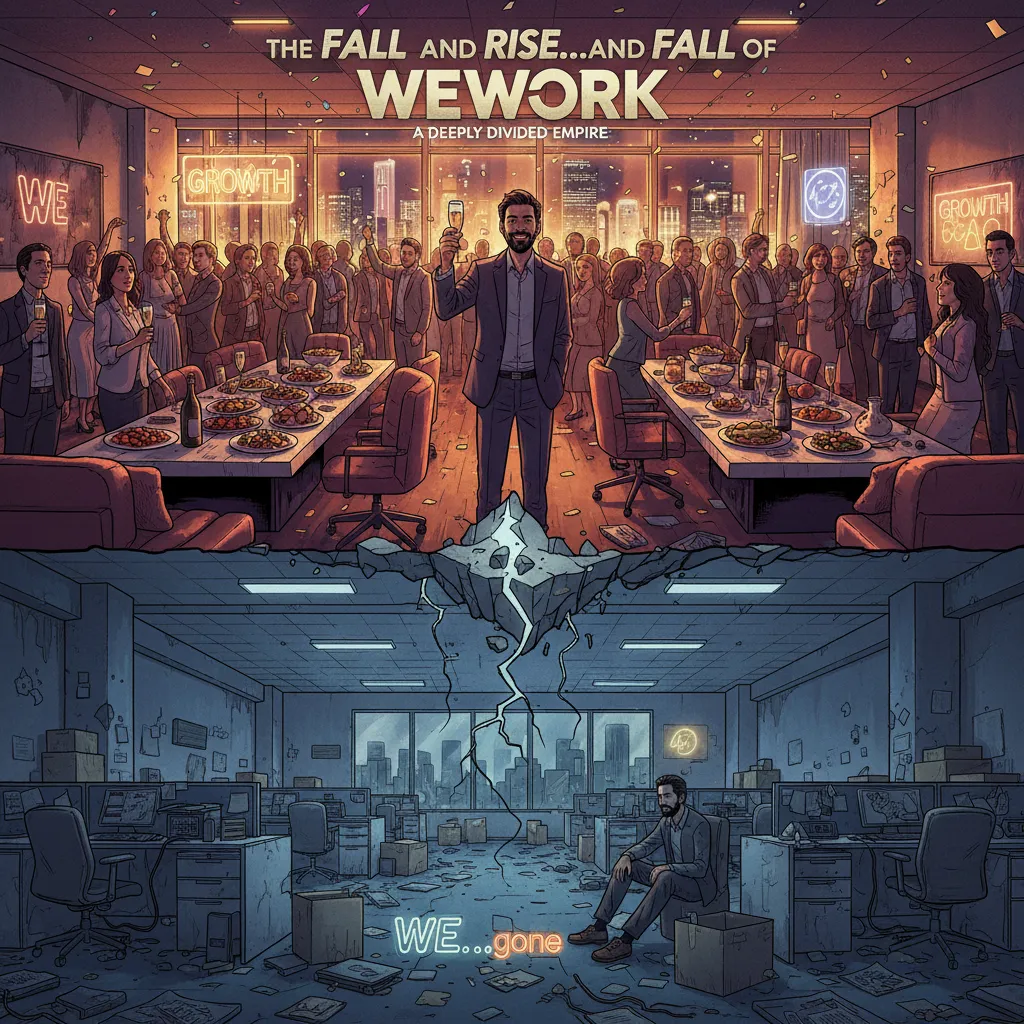
The WeWork saga has become one of the defining business stories of the 2010s — a parable so perfectly structured that Hollywood barely had to fictionalize it.
Books
Two definitive books tell the full story: Billion Dollar Loser by Reeves Wiedeman and The Cult of We by Eliot Brown and Maureen Farrell. Both are meticulously reported and absolutely bonkers. They reveal details that didn’t make the initial coverage — the full extent of the drinking culture, the bizarre internal power dynamics, the moments when employees and even some board members saw the iceberg coming but couldn’t get anyone to turn the wheel.
WeCrashed
Apple TV+ turned it into WeCrashed, a limited series with Jared Leto as Neumann and Anne Hathaway as Rebekah. Leto went full method — which, for a character this unhinged, must have been a wild ride. The show premiered in March 2022 and managed to capture both the comedy and the tragedy, introducing the saga to people who’d never heard the phrase “Community Adjusted EBITDA” (lucky them).
The Broader Lesson
WeWork has become a single-word shorthand for a very specific kind of corporate delusion: the “emperor has no clothes” startup. When you encounter a company with massive losses, grandiose language about “changing the world,” and a charismatic founder getting rich while the business bleeds out — the word you reach for is “WeWork.”
That might be Adam Neumann’s most lasting legacy. Not as a cautionary tale about real estate or venture capital, but as a permanent cultural reference point for the moment when everyone in the room knows the story doesn’t make sense but nobody wants to be the first one to say it out loud.
📊 The Lesson — What WeWork Teaches Us

WeWork isn’t just the story of one charismatic founder who got out over his skis. It’s a story about every guardrail in the system failing at the same time.
The Founder Problem
Neumann’s personal flaws — the self-dealing, the spending, the messianic delusions — were real and spectacular. But founders like him exist in every generation. The real question is whether the system around them provides guardrails or just vibes. In WeWork’s case, the board was captured, the investors were hypnotized by growth numbers, and the employees were silenced by a culture that treated dissent as betrayal. Every safety mechanism failed. Every single one.
The Capital Problem
SoftBank’s Vision Fund created an environment where a company could raise $10 billion without ever demonstrating a path to profitability. When capital is that cheap and that abundant, it doesn’t just enable bad business models — it actively selects for them. The companies that can absorb the most cash the fastest are, almost by definition, the ones burning it the least efficiently. Masa Son didn’t just fund WeWork’s bad habits. He demanded bigger bad habits.
The Narrative Problem
WeWork’s core deception was not financial — it was linguistic. By calling itself a “technology company” and a “community platform,” WeWork accessed valuation multiples that belonged to software businesses with 80% margins, not real estate operations with negative margins. It was the most expensive adjective swap in business history.
The lesson is almost stupidly simple: when a company’s language and its spreadsheets tell different stories, trust the spreadsheets. Always. Every time. The spreadsheets don’t care about your consciousness.
📅 Timeline

| Year | Event |
|---|---|
| 1979 | Adam Neumann born in Israel |
| 2001 | Neumann moves to New York City |
| 2008 | Neumann and McKelvey launch Green Desk in Brooklyn |
| 2010 | WeWork founded; first location opens at 154 Grand Street, SoHo |
| 2012 | WeWork raises $6.85M Series A from DAG Ventures |
| 2014 | WeWork valued at $5 billion after Series D round |
| 2015 | International expansion begins; WeWork enters London and Israel |
| 2016 | WeWork valued at $16 billion; launches WeLive co-living concept |
| 2017 | Masayoshi Son invests $4.4 billion after a 12-minute meeting; valuation reaches $20B |
| 2018 | WeWork loses $1.9 billion on $1.8 billion in revenue; valuation reaches $47B; WeGrow school launches |
| Jan 2019 | SoftBank commits an additional $2 billion investment |
| Aug 2019 | The We Company files S-1 for IPO; “Community Adjusted EBITDA” mocked worldwide |
| Sep 2019 | IPO postponed; valuation collapses from $47B to under $10B |
| Sep 24, 2019 | Neumann resigns as CEO |
| Oct 2019 | SoftBank takes control; Neumann receives $1.7B exit package |
| Nov 2019 | WeWork lays off approximately 2,400 employees |
| Feb 2020 | Sandeep Mathrani hired as CEO to lead turnaround |
| Mar 2020 | COVID-19 pandemic empties offices worldwide |
| Oct 2021 | WeWork goes public via SPAC at ~$9B valuation |
| Aug 2022 | Neumann raises $350M from Andreessen Horowitz for Flow |
| 2023 | WeWork stock falls below $1 |
| Nov 2023 | WeWork files for Chapter 11 bankruptcy |
| 2024–2026 | Neumann continues building Flow; WeWork restructures under bankruptcy |
💡 Key Insights
- ▸ WeWork's lesson: charisma can raise billions, but fundamentals determine survival. A $47B valuation meant nothing without a path to profit. The gap between narrative and numbers eventually closes — always.
- ▸ Neumann personally made hundreds of millions while the company burned cash. When a founder's personal wealth grows while the company hemorrhages money, misaligned incentives aren't just a red flag — they're a fire alarm.
- ▸ The most dangerous startup myth: that rapid growth equals success. WeWork grew fast, but every new office lost more money. Growth without unit economics is just organized wealth destruction.
- ▸ SoftBank's Vision Fund distorted an entire generation of startups by making capital so abundant that discipline became optional. When a single investor can pump $10B+ into a company with no profitability timeline, the feedback loops that normally kill bad ideas simply stop working.
- ▸ Neumann's comeback with Flow — raising $350M from Andreessen Horowitz just three years after WeWork's collapse — reveals Silicon Valley's deepest contradiction: the ecosystem that punishes failure in theory rewards audacity in practice. The same traits that destroyed $40B in value got him another check.
Sources
- The Real Deal - WeWork Timeline ↗
- Wall Street Journal WeWork Coverage ↗
- Reeves Wiedeman — Billion Dollar Loser: The Epic Rise and Spectacular Fall of Adam Neumann and WeWork ↗
- Eliot Brown & Maureen Farrell — The Cult of We: WeWork, Adam Neumann, and the Great Startup Delusion ↗
- SEC Filings — The We Company S-1 ↗
- WeWork Bankruptcy Filing (November 2023) ↗
- Apple TV+ — WeCrashed (Docudrama Series) ↗