Milton Hershey Sold His Caramel Business but Kept the Chocolate
In 1900, Milton Hershey sold Lancaster Caramel for $1 million while retaining its chocolate business, setting up a factory town and an unusual educational legacy.
View all stories about this mogul
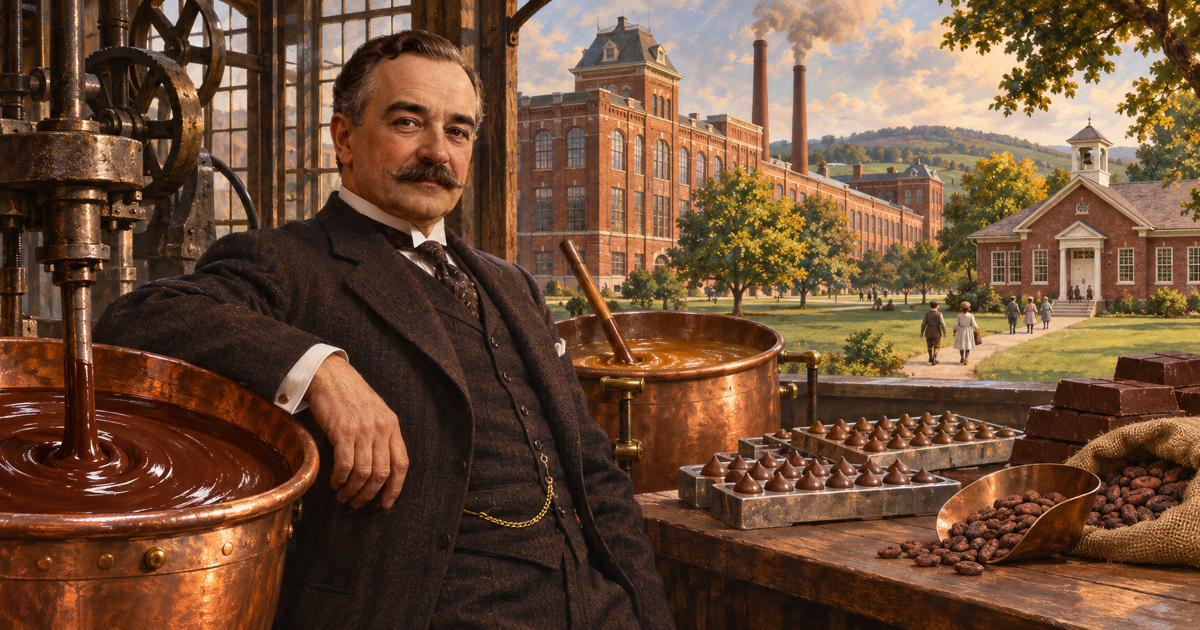
On August 10, 1900, Milton Hershey completed the sale of the Lancaster Caramel Company for $1 million. The buyer received the factory, caramel machinery, inventory, formulas and Crystal A trademark. Hershey kept the chocolate business and its equipment, then rented space in the factory he had just sold. The transaction separated the operation that had made him wealthy from the one on which he intended to concentrate next. Hershey Community Archives
That distinction matters more than the familiar outline of a confectioner abandoning caramel for chocolate. Hershey did not sell everything and start again with an untested idea. He retained an existing business, its production equipment and somewhere to operate. The sale released capital while preserving a working commercial foothold.
Eighteen years later, he made another consequential decision about ownership: he placed his chocolate-company shares in a trust supporting the school he and his wife, Catherine, had founded. One transaction separated two businesses; the other connected industrial wealth to an educational institution. Together, they explain why Hershey’s history concerns control and capital allocation as much as candy.
Chocolate Was Already Inside the Caramel Business
Hershey’s early career offers little support for the idea that his eventual success was inevitable. The Hershey Story museum describes him as penniless at 26, with two failed businesses. His subsequent caramel success therefore represented a substantial recovery before chocolate supplied the better-known chapter. The Hershey Story
That sequence changes the meaning of the 1900 sale. Lancaster Caramel was an achievement he chose to relinquish. Selling it required him to distinguish between the business that had rewarded his persistence and the business he wanted to own next. Personal attachment and future investment did not have to follow the same path.
The chocolate operation had developed alongside caramel manufacturing. The Hershey Company’s historical timeline records the establishment of Hershey Chocolate Company as a subsidiary in 1894. Its early products included chocolate used in conjunction with the caramel trade. Chocolate was an adjacent line of production before it became the company’s defining product. The Hershey Company
There was a practical connection between the two businesses. A caramel manufacturer already operated in confectionery, with knowledge of ingredients, production and customers. Chocolate presented different technical problems, but it did not require Hershey to enter an entirely unfamiliar commercial world. The relationship gave him a way to explore a new product while retaining an established source of business.
The equipment also preceded the sale. According to the museum, Hershey purchased chocolate-making machinery at the 1893 World’s Columbian Exposition in Chicago. He subsequently experimented with milk, sugar and cacao beans to develop milk chocolate suitable for production at scale. The machinery made experimentation possible; it did not supply a finished manufacturing process. The Hershey Story
Purchasing equipment and mastering a product are separate investments. Equipment can make a process physically possible while leaving its consistency, cost and commercial usefulness unresolved. Hershey’s chronology contains both steps: acquiring the means to manufacture chocolate, then working on what those means could reliably produce.
By the time he sold Lancaster Caramel, he had accumulated experience in chocolate as well as conviction about its prospects. The decision still carried risk. A successful caramel operation could not guarantee the success of a chocolate factory. But describing the move as a sudden leap obscures the years during which the second business existed inside the first.
The Sale Drew a Precise Boundary
The distinction between what Hershey sold and what he retained was the central feature of the agreement. American Caramel acquired the assets associated with the caramel business. Hershey also accepted a restriction against making caramels in Lancaster. His chocolate equipment and company remained outside the sale. Hershey Community Archives
A business sale is often reduced to its headline price. Here, the perimeter of the transaction was equally important. Had the buyer acquired the chocolate operation too, Hershey would have needed to reconstruct the capabilities he wanted to expand. By retaining them, he preserved continuity between his earlier experiments and his next investment.
The temporary rental arrangement made that continuity tangible. Ownership of the building changed, but Hershey’s chocolate manufacturing could continue within it. Property ownership and production capacity were separable. He could leave the caramel business without immediately leaving the premises.
The payment negotiations show another distinction: an agreed valuation does not settle the form in which a seller receives it. The archives describe bargaining over combinations of cash and American Caramel stock. Their account draws on a 1955 oral-history interview with John Myers, who had served as stenographer during the talks. That retrospective evidence deserves to be identified as such rather than presented as a contemporary transcript. Hershey Community Archives
The underlying financial issue is straightforward. Cash gives a seller purchasing power independent of the buyer’s subsequent performance. Shares leave some proceeds exposed to the acquiring company’s prospects. For an owner planning to direct resources into another business, that difference affects what a sale actually accomplishes.
It also helps explain why a profitable disposal can be more consequential than an acquisition. Hershey was reducing his direct commitment to one operation so that he could concentrate on another. The transaction’s value lay partly in the opportunities it allowed him to pursue after closing.
There is no need to treat that decision as proof that caramel had no future. Hershey needed chocolate to justify his investment; he did not need every competing confection to disappear. The defensible business lesson is narrower: he found a buyer for an established operation while protecting the assets essential to his preferred next business.
A Factory Required More Than a Recipe
The Hershey Company’s timeline dates the introduction of its milk-chocolate bar to 1900. It records the launch of Kisses in 1907. These products belong to the commercial expansion that followed the separation from Lancaster Caramel, but neither a launch date nor a recognizable brand explains the manufacturing system required to sustain it. The Hershey Company
The museum’s account places the start of construction on the new factory in 1903. Hershey selected Derry Township, Pennsylvania, the area of his birth. Moving production there meant committing money to a location and to fixed facilities, rather than simply adding another product to the rented Lancaster operation. The Hershey Story
A factory converts a commercial expectation into physical commitments. Buildings, machinery and supporting services must be paid for before they can earn a return. The owner exchanges flexibility for the possibility of producing larger quantities more efficiently. Hershey’s sale provided resources for that next phase, but resources alone could not establish whether customers would absorb the output.
Milk chocolate added a further operational requirement: the recipe had to work repeatedly. An appealing experimental batch is different from a product that a factory can reproduce at useful volume. In manufacturing, consistency determines whether an invention can become dependable merchandise. Customers encounter the finished bar, while the business carries the cost of making each bar sufficiently similar to the last.
The relationship between price and scale also runs in both directions. Larger production can spread some costs over more units, supporting a more accessible product. Yet a lower price requires enough sales to justify the capacity installed to serve it. Expanding a factory before demand materializes can leave an owner with expensive equipment and insufficient revenue.
Hershey’s earlier chocolate operation reduced some uncertainty by giving him experience before the major construction commitment. It did not remove the need to coordinate production, distribution and demand. The factory represented a larger version of a working business, with larger obligations attached.
This is where the sale and the factory belong in the same account. The sale concentrated his resources; the factory concentrated those resources in a particular product and place. The first decision created financial room. The second used that room to make a more substantial industrial commitment.
The Town Added a Financial System
Hershey’s undertaking extended beyond the factory walls. The museum identifies housing, schools, parks, public transportation and infrastructure among the facilities he developed. These were substantial additions to the responsibilities of a confectionery manufacturer. They made the surrounding community part of the project. The Hershey Story
The commercial logic and the social consequences were intertwined. A factory needs workers, and workers need places to live, services and ways to travel. Providing those facilities can help make an industrial location viable. It also gives the sponsoring business influence over more aspects of everyday life than employment alone.
Hershey Trust Company’s own history supplies a concrete example. Established in 1905, it initially served the growing community’s banking needs. Its services included payroll handling, savings accounts, mortgages and loans. The financial institution that later became closely associated with the school trust began with ordinary transactions required by a developing town. Hershey Trust Company
Payroll and mortgages connect industrial investment to household decisions. A wage supports current spending; access to housing finance can support a longer commitment to a location. The bank therefore belonged to the machinery of settlement as well as commerce. People moving to work near the factory needed financial services alongside physical infrastructure.
The choice of institutional form also mattered. The trust company’s history says Hershey sought advice from a Lancaster bank and was told that a trust company could conduct fiduciary business in addition to making mortgage loans. That capacity would later become central to its responsibilities. Hershey Trust Company
This should not be read backward as evidence that every part of the eventual arrangement was fully planned in 1905. Institutions can acquire responsibilities beyond those that initially justify their creation. A structure useful for a town’s finances could subsequently serve a much larger charitable purpose.
Nor does the provision of services by itself settle whether a company town serves every resident well. Housing, schools and recreation are concrete benefits, but their existence does not answer questions about authority or employee independence. The relevant point here is the scale of Hershey’s commitment: his chocolate investment brought with it responsibilities for a community whose needs exceeded the factory’s production schedule.
The town also made the business harder to understand through product sales alone. Its continued operation affected households and local institutions. When Hershey later reconsidered the destination of his wealth, the assets involved already connected manufacturing to a wider network of obligations.
Catherine Hershey Shared in the School’s Foundation
Milton and Catherine Hershey founded Hershey Industrial School on November 15, 1909. Both signed its deed of trust. The institution’s history records that its first ten students enrolled in 1910, living and studying in the Homestead, Milton’s birthplace. Milton Hershey School
Those details establish a specific beginning: a legal instrument, a residential setting and a small initial group of pupils. The school was operating years before the major 1918 transfer of company shares. Its existence therefore cannot be reduced to an instruction about what should happen after the founder’s death.
Catherine’s participation is essential to that chronology. Accounts organized entirely around the chocolate manufacturer’s later gift can make the school appear to have been his solitary undertaking. The founding document records a shared act. The institution’s original name also distinguishes its early purpose from the broader school that later developed.
An operating school creates recurring expenses. Buildings require maintenance; pupils require accommodation, teaching and care. A founder can meet those costs through personal payments, but an institution intended to continue needs a durable financial arrangement. The difference is between funding particular bills and establishing assets capable of supporting future expenditure.
The trust company’s history describes the original endowment as 486 acres, including the Homestead. It also records that Hershey personally paid many early expenses. Land and direct support gave the school a beginning, while the later stock transfer changed the resources available to sustain it. Hershey Trust Company
The distinction helps explain why founding and endowing deserve separate attention. A school can begin with limited resources and grow; an endowment can support continuity beyond the donor’s active participation. Neither act makes the other redundant. In Hershey’s case, several years of operation separated them.
In 1918, Ownership Acquired Another Purpose
On November 13, 1918, Hershey placed 5,000 shares of Hershey Chocolate Company equity stock in trust for the school. The school’s account describes this as the bulk of his wealth. It also notes that the gift attracted widespread public attention only in 1923, when newspaper reports attached a $60 million valuation to it. Milton Hershey School
The dates prevent a misleading compression. The transfer occurred in 1918; the widely reported valuation came later. It was a gift of shares, rather than a cash payment of that reported amount. Shares represent an ownership interest whose value can change, so the distinction is financial as well as chronological.
Giving stock also creates a different relationship from donating the proceeds of a completed sale. A cash gift can be invested independently of the original enterprise. A gift of company equity links the recipient’s resources to an operating business until that investment changes. Commercial performance and charitable funding become connected through ownership.
That connection creates responsibilities for those administering the assets. The school requires dependable support, while a company must invest, absorb costs and respond to competition. Retaining an ownership interest does not eliminate those pressures. It makes the quality of investment oversight consequential to the institution the gift was intended to support.
The trustee’s history emphasizes the breadth of the holdings associated with the chocolate company at the time. They extended to other Hershey enterprises and community services. Administering the gift therefore involved more than receiving a familiar confectionery name on a stock certificate. It brought a wider collection of assets into the school trust’s financial affairs. Hershey Trust Company
Hershey’s two ownership decisions point in different directions. In 1900, he separated an established business from the assets he wanted to develop. In 1918, he connected ownership of the resulting enterprise to a school. The first transaction increased his ability to choose where capital went. The second established a beneficiary beyond himself.
Neither decision should erase the work between them. Chocolate required experimentation and manufacturing investment; the town required services; the school required an operating organization. The legal transactions mattered because there were functioning businesses and institutions for them to reshape.
Hershey’s lasting business distinction lies in that sequence. He sold a successful operation without surrendering the activity he wanted to pursue, then assigned much of the wealth associated with that activity to an institution already educating children. The story begins with a carefully drawn boundary around a sale and ends with a durable connection between company ownership and educational support.
Frequently asked questions
Why did Milton Hershey sell Lancaster Caramel?
He wanted to concentrate on chocolate and retained the chocolate company and its equipment when he sold the caramel business in 1900.
Did Catherine Hershey help establish the school?
Yes. Milton and Catherine both signed the 1909 deed of trust founding Hershey Industrial School.
Did Hershey give the school $60 million in cash?
No. His 1918 gift consisted of company shares; the school traces the widely reported $60 million valuation to newspaper coverage in 1923.
💡 Key Insights
- ▸ The assets retained in a sale can matter as much as its price.
- ▸ Hershey developed chocolate within his existing confectionery business before concentrating on it.
- ▸ The factory town required financial services alongside housing and infrastructure.
- ▸ The 1918 stock gift connected company ownership to an operating school's support.
Sources
- Hershey Community Archives — Selling the Lancaster Caramel Company ↗
- The Hershey Story — Milton Hershey's History and Life ↗
- The Hershey Company — Company History ↗
- Hershey Trust Company — History ↗
- Milton Hershey School — School History ↗
- Milton Hershey School — The 1918 Gift and Its Public Disclosure ↗