James Dyson Licensed a Pink Vacuum in Japan Before Selling His Own
A Japanese licensing deal gave James Dyson royalty income before his British launch, showing why a working invention still needed a workable business model.
View all stories about this mogul
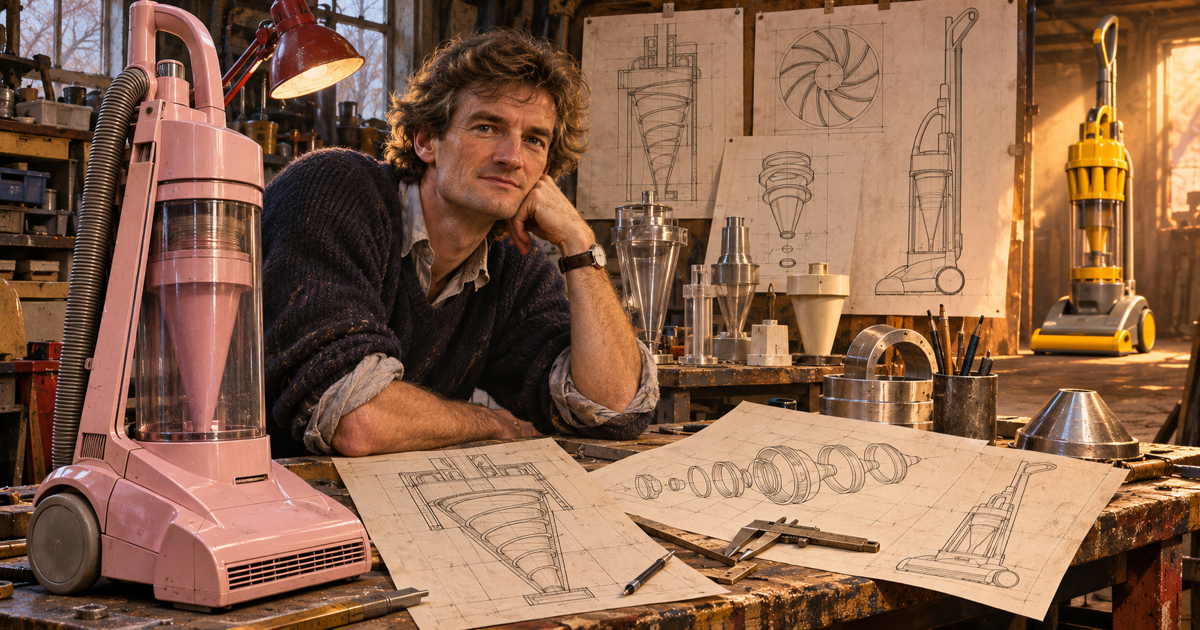
In 1986, James Dyson’s cyclone vacuum entered production in Japan as the G-Force. The royalties helped finance the cleaner he launched under his own name in Britain in 1993. A Japanese licensing agreement supplied a route to a business that established manufacturers had declined to build. The chronology is recorded by the Malaysian Investment Development Authority.
The G-Force was pale pink, an unusually conspicuous object for a household cleaning tool. Its place in the story is more substantial than its colour suggests. Before Dyson could sell British households a different way to collect dust, he needed someone to manufacture the invention, customers willing to buy it and income to keep development going.
That makes his business history more useful than the familiar tally of thousands of prototypes. The experiments explain the engineering effort. They do not, by themselves, explain the transition from an inventor with a working device to a company selling a finished appliance. That transition required a sequence of different commercial arrangements.
A factory problem supplied the starting point
Dyson had worked on the Sea Truck landing craft at Rotork before setting out on his own with the Ballbarrow in 1974. The barrow replaced a conventional narrow wheel with a broad pneumatic ball. His later vacuum project grew out of a problem encountered while making that earlier product, according to Dyson’s account of its founder.
Powder used to coat the Ballbarrow’s metal frames clogged the factory’s collection system. After seeing an industrial cyclone at a timber mill, Dyson built a large version to separate the waste powder from air. He subsequently tried a cardboard cyclone on a household vacuum in place of its bag. The connection was a shared separation problem across two very different scales.
The significant move was between applications. Dyson did not need to discover that spinning air could separate particles. He needed to establish whether an industrial principle could perform a domestic job within the restrictions of a household appliance. Size, cost and usability would determine whether the transfer had commercial value.
A factory installation and a vacuum cleaner face different purchasing decisions. An industrial customer can judge equipment against production requirements. A household buyer has to choose a complete appliance, carry it, store it, empty it and decide whether its price makes sense. A working separation mechanism answers only part of that buyer’s problem.
Dyson’s earlier work also complicates the image of an inexperienced outsider stumbling upon a profitable idea. By the time he tackled the vacuum, he had experience designing physical products and confronting production problems. His opportunity came from noticing a connection, but he had accumulated the practical knowledge needed to investigate it.
There is a useful distinction here between the first demonstration and the eventual product. Cardboard could establish enough feasibility to justify another experiment. It could not settle the choice of production materials, the durability of a finished cleaner or the economics of making it repeatedly. The cheap experiment reduced one uncertainty while leaving several expensive ones intact.
Thousands of experiments did not guarantee a manufacturer
Dyson gives the prototype count as 5,127. That figure belongs to the company’s account of its development process; it should be attributed rather than treated as an independently audited inventory. Its significance is the sustained iteration it describes, not a numerical threshold that other inventors should try to reproduce.
A contemporaneous study offers a closer view of the work. In his 1993 paper, design researcher Robin Roy described experiments with brass, aluminium and perspex models to establish cyclone shapes. He recorded a side-by-side, two-cyclone prototype in 1981 and subsequent development of a concentric arrangement. This was a progression through alternative physical designs. Roy’s Open University case study is particularly valuable because it predates Dyson’s later international scale.
The experiments addressed a specific difficulty: separating both coarse debris and fine dust. A model that collected one kind of material could still leave an important part of the cleaning problem unresolved. Repetition had value when it revealed what a particular geometry could and could not do.
That is a more precise reading of persistence than the usual instruction to keep failing. A prototype is useful because it produces information. Continuing to build the same unsuccessful arrangement without learning from it would consume money without advancing the product. The commercial importance of testing lies in what it allows the developer to change.
Roy also documented a separate obstacle. Two major British vacuum manufacturers saw Dyson’s prototype but declined to license it. Dyson attributed their reluctance partly to resistance to an outside invention and partly to the risk of a radical design. Those explanations were the inventor’s interpretation, not documented admissions by the manufacturers.
The distinction matters. Rejection demonstrates that a proposed transaction did not happen. It cannot establish every motive within the businesses that refused it. A factual history can describe Dyson’s frustration without pretending to have access to the financial assessments or internal discussions of every company he approached.
Licensing nevertheless had a clear attraction. It could connect an inventor’s design to another company’s manufacturing capacity. Dyson would not have to finance every part of production himself. The weakness was equally clear: a strategy built around licensing still required a manufacturer willing to sign.
Japan provided a paying route out of the workshop
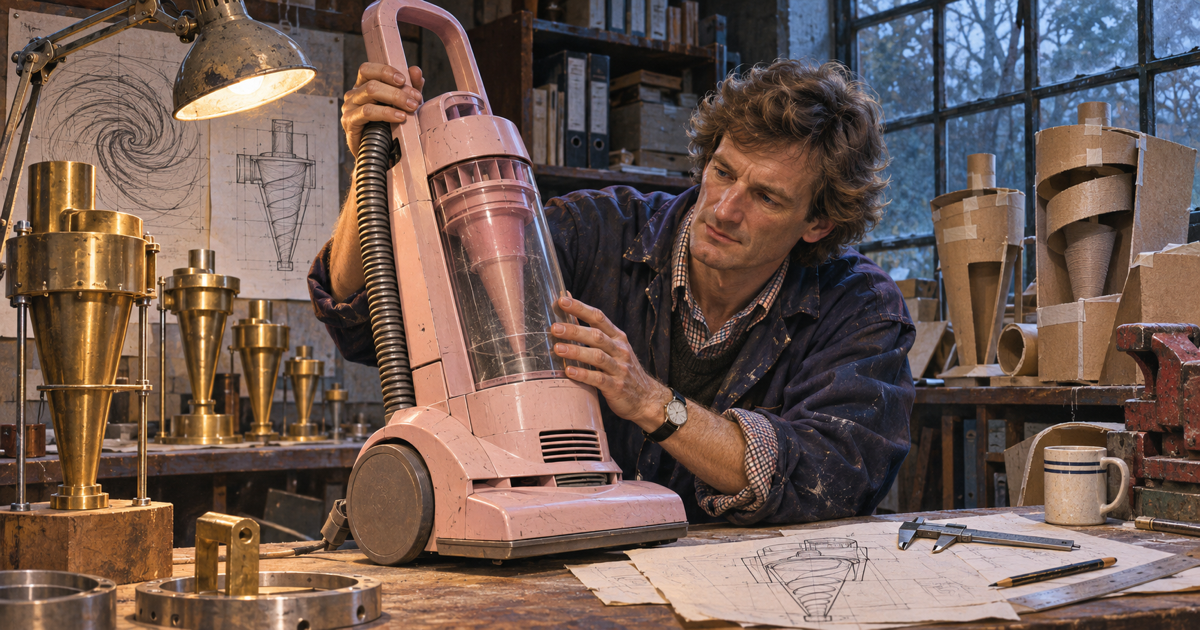
The G-Force supplies physical evidence of the agreement that followed. The Science Museum Group holds a cleaner manufactured in Tokyo by Apex, with a collection date range of 1985–1990. Its catalogue credits both James Dyson and the Apex design team. The associated objects include detachable cleaning heads, belts, a belt-fitting tool and original packaging. The museum’s record preserves a complete consumer product, not merely a proof of concept.
That joint credit is a useful corrective to an overly solitary account of invention. Dyson supplied the central development effort, but the saleable Japanese appliance also involved a manufacturing organisation and its designers. An invention can have an identifiable originator while its commercial form reflects work by several participants.
The attachments and packaging make the point tangible. A buyer was receiving equipment intended for ordinary use, with accessories and replacement components. Those details can disappear from founder stories because they seem less dramatic than a breakthrough. They are part of what separates an interesting mechanism from merchandise.
The deal also changed the financial sequence. MIDA records that G-Force royalties enabled Dyson and a small team to continue developing the technology from a garden workshop. Licensing therefore did more than secure a foreign launch. It produced income that could support another stage of work.
Roy’s study describes the Japanese cleaner as a relatively expensive product sold in limited numbers to design-conscious customers. That is an important qualification to its success. A niche product can generate useful revenue and demonstrate that someone will pay for an invention without establishing demand at a much lower price or much greater volume.
Japan’s role should not be flattened into a claim that one country’s consumers naturally understand invention better than another’s. The evidence supports a narrower conclusion: a particular Japanese company accepted a deal, and a particular product found customers there. Those transactions gave Dyson an option he had struggled to obtain elsewhere.
The financing lesson is similarly specific. Licensing can preserve development time when outright manufacturing would require more resources than an inventor has available. It also places the inventor at some distance from the finished product and its customers. Dyson’s next step would change that balance of responsibility.
A cleaner carrying his name changed the business
In 1993, Dyson began manufacturing a vacuum under his own name, starting with the DC01. MIDA connects that launch to the income from G-Force. The sequence matters: the British product followed the Japanese royalty stream rather than emerging directly from the first household experiment.
Roy recorded a British launch price of £199 for the Dual Cyclone, comparable with expensive conventional cleaners of the period. His study also described the use of conspicuous colour and a transparent chamber in Dyson’s designs. The product gave prospective customers something visible to connect with the claim that its internal operation was different.
A transparent chamber made collected dirt part of the presentation. With an enclosed mechanism, a salesperson has to explain what happens inside. An exposed collection area offers an immediate demonstration. It does not prove every performance claim, but it makes a feature easier to recognise and discuss.
The price comparison is also revealing. The commercial challenge was not simply to make an unusual vacuum available at any price. Dyson needed an appliance that buyers could compare with alternatives already on sale. A product positioned among premium cleaners faced a recognisable purchasing decision, even though its engineering differed.
Selling under his own name brought a broader set of obligations than receiving royalties. A product business has to make its design reproducibly, arrange distribution and deal with the consequences when the customer uses it. Manufacturing success depends on consistency across units, not just the performance of the developer’s best example.
This is an inference about the business model, rather than a claim about an undocumented internal decision. Moving from licensing to a branded appliance places more of the commercial relationship within the selling company. It creates opportunities to retain value, alongside demands on capital, operations and service.
The chronology also resists a neat five-year success story. Dyson dates the original vacuum frustration to 1978; the cleaner bearing his name arrived in 1993. The intervening years included development and licensing. Technical progress and the establishment of a business ran on overlapping schedules, with neither automatically completing the other.
The design had to survive a legal contest
Once a product is selling, competitors can test the boundaries of the protection around it. Dyson’s dispute with Hoover shows why a patent’s detailed wording can matter as much to a business as the general appeal of the original idea.
The Patents Court judgment of 3 October 2000 concerned European patent EP (UK) 0042723. The European Patent Office’s published summary describes a lower-efficiency cyclone followed by a higher-efficiency cyclone, with particular differences in their shapes. The case addressed the claimed arrangement, including how the stages separated coarse material and finer dust. The EPO’s account of Dyson v. Hoover sets out the technical and legal issues.
Hoover challenged the patent using earlier publications and arguments about novelty and obviousness. The court upheld the patent and found infringement. The outcome gave Dyson protection against the competing implementation at issue. It did not confer ownership of every use of a cyclone or every possible bagless cleaning system.
That boundary is central to understanding the business asset. A patent must describe an invention with sufficient precision to distinguish what is protected from what others remain free to do. The popular description of a product can be much broader than the legal claim that actually survives scrutiny.
The litigation also tests a simplistic account of originality. Earlier knowledge of cyclones did not, on its own, settle whether this particular domestic appliance arrangement was patentable. Equally, a successful appliance did not exempt its patent from challenge based on earlier technical work.
For a manufacturer, that distinction has practical consequences. Attractive industrial design can help a buyer identify a product, while a patent may protect aspects of its operation. These assets do different work. A visible difference does not automatically establish a legal right, and a legal right does not automatically persuade a customer to purchase.
Dyson’s case therefore extends beyond the workshop. The company had to translate engineering decisions into a product buyers could recognise and a technical claim a court would uphold. Each translation required a different kind of evidence. A dust-collection demonstration could not substitute for the patent’s wording.
The car project exposed a different limit
The later automotive project provides a check on any suggestion that Dyson’s vacuum experience amounted to a universally repeatable formula. On 10 October 2019, the company announced a proposal to close the project because it could not make the car commercially viable. Dyson also said an effort to find a buyer had not succeeded. The company’s automotive statement is explicit about the commercial problem.
The announcement praised the team’s engineering and said the company would seek alternative roles within its home business for as many employees as possible. Those were the company’s statements at the time. They establish its explanation and intended response, without providing an independent assessment of every technical or financial assumption.
The contrast with the vacuum is instructive because the decision changed. In the earlier story, Dyson continued development and eventually found a workable commercial route through a licensee. In the automotive project, the company concluded that further commitment to producing the vehicle was not justified by the commercial prospects.
A functioning product and a viable business answer different questions. Engineering can establish that a proposed device performs its intended task. Commercial viability additionally depends on what it costs to deliver and what customers will pay. Progress on the first question can leave the second unresolved.
This does not make the car cancellation a verdict against the vacuum strategy. It shows the limits of drawing a general rule from one successful product. A licence, a premium price or an identifiable technical advantage can contribute to a business only when the surrounding economics support them.
Read together, the two episodes support a more demanding account of persistence. The purpose of continued development is to discover a defensible way to sell a useful product. When a route appears, as it did with G-Force, it can finance the next step. When the company cannot establish that route, stopping remains a commercial decision available to it.
Dyson’s defining business achievement was assembling several kinds of proof in succession: a mechanism that worked, an overseas agreement that generated royalties, a branded appliance and enforceable protection for a particular design. The pink Japanese cleaner belongs near the centre of that history. It connected the invention to paying customers before Dyson could sustain the business carrying his name.
Frequently asked questions
What was the G-Force vacuum?
It was a cyclone vacuum manufactured by Apex in Japan, with design credited to James Dyson and the Apex team.
When did Dyson launch the DC01?
Dyson launched the DC01 under his own name in Britain in 1993, following the Japanese licensing period.
Why did Dyson stop its car project?
In October 2019, the company said it could not make the vehicle commercially viable and proposed closing the project.
💡 Key Insights
- ▸ Japanese licensing royalties helped finance Dyson's British product launch.
- ▸ A working prototype still required manufacturing and a route to customers.
- ▸ Patent protection depended on a specific technical arrangement.
- ▸ The cancelled car project separated engineering progress from commercial viability.
Sources
- Malaysian Investment Development Authority — Dyson ↗
- Dyson — James Dyson ↗
- Robin Roy, Open University — Case Studies of Creativity in Innovative Product Development ↗
- Science Museum Group — G-Force Cyclonic Vacuum Cleaner ↗
- European Patent Office — Dyson Appliances Ltd. v. Hoover Ltd. ↗
- Dyson — Automotive Update, 10 October 2019 ↗