James Dyson Built a Working Electric Car and Cancelled It Before Launch
James Dyson spent more than £500 million developing an electric car, then stopped the project in 2019 when engineering progress could not justify production.
View all stories about this mogul
On 10 October 2019, James Dyson announced that his company would close its electric-car project. Engineers had produced a vehicle he praised, but the business could not make the economics work. An attempt to find a buyer had also failed. The inventor associated with thousands of vacuum-cleaner prototypes had reached a different decision: this time, further persistence would not lead to a product launch.
The announcement made an unusually clear distinction between making something function and making it worth manufacturing. Dyson defended the engineering team while withdrawing the commercial commitment. His statement to employees said the company could not make the vehicle commercially viable. It was an admission with consequences for people, facilities and investment, rather than a complaint about an unfinished prototype.
Dyson’s official biography puts spending on the programme at more than £500 million in less than five years. That figure describes investment in the project; it should not be confused with an audited accounting loss or the wider technology investment programme discussed at the time. The car never became a customer product. Its history offers a useful corrective to the idea that a successful founder’s most valuable quality is refusing to stop.
The vacuum business supplied a persuasive precedent
Dyson had already built a company around a technical challenge to an established household appliance. His official account describes fitting a crude cardboard cyclone to a vacuum cleaner in place of its bag, then developing the approach through 5,127 prototypes. The DC01 reached the market in 1993. Whatever the appeal of that celebrated prototype count, the commercial milestone was a product customers could actually buy.
A bagless vacuum offered a proposition that could be explained in the course of an ordinary purchase: separate dust from the airflow without relying on a disposable collection bag. Customers did not need to understand every internal dimension of the cyclone to understand the intended benefit. The product connected an engineering decision to a familiar household frustration.
That connection matters more than the familiar portrait of an inventor working alone. Repeated experimentation can improve a design, but customers purchase an outcome. In Dyson’s case, an everyday task supplied a setting in which the new approach could be compared with what people already owned. Engineering and selling were linked by a problem that required little explanation.
The Cooper Hewitt, Smithsonian Design Museum records that Dyson entered the US market with the DC07 in 2002, after selling nearly ten million vacuum cleaners. That sequence is significant. The later international expansion followed substantial sales experience; it did not rest solely on a promising demonstration or a founder’s description of the technology.
The vacuum story nevertheless creates a temptation when applied to another industry. Once a long development effort has succeeded, another long development effort can appear to follow the same script. Rejection becomes evidence of originality, expense becomes evidence of commitment, and unfinished work becomes a reason to continue. None of those interpretations establishes that the next product can earn a return.
Shared components made the car a plausible experiment
An electric vehicle was an ambitious extension for an appliance company, but the proposed connection was intelligible. Dyson already worked with electric motors, batteries, airflow and the management of physical systems. In his retrospective account of the vehicle, James Dyson describes returning to the problem of vehicle pollution once the company had developed relevant technologies of its own.
The company’s product chronology shows what that adjacent expertise looked like in goods it had already sold. Its 2016 Supersonic hair dryer placed a compact motor in the handle and monitored air temperature. The 2018 Airwrap used airflow to attract and wrap hair around a barrel. These were different applications of motors, heat management and fluid behaviour within a consumer-products business.
Those examples help explain the logic of exploring a car. A company does not have to remain permanently inside the category in which it began. Knowledge accumulated while solving one problem can reduce the difficulty of approaching another. A motor or battery team may possess useful capabilities even when the eventual product looks very different from a vacuum cleaner.
The limit is equally clear. Useful capabilities are only part of a complete business. A car requires the integration of a vehicle, production arrangements, service provision and a price customers will accept. Expertise in a component does not establish the economics of the finished object. The relevant question was how much Dyson’s existing knowledge would help once all the other requirements were included.
That distinction separates a reasonable experiment from an inevitable expansion. Starting the programme could test whether the connection was strong enough. Continuing it required evidence that the complete vehicle could support a commercial operation. The company’s record in appliances provided a reason to investigate, rather than a guarantee that the investigation should end with a factory producing cars.
The proposed vehicle carried substantial commitments
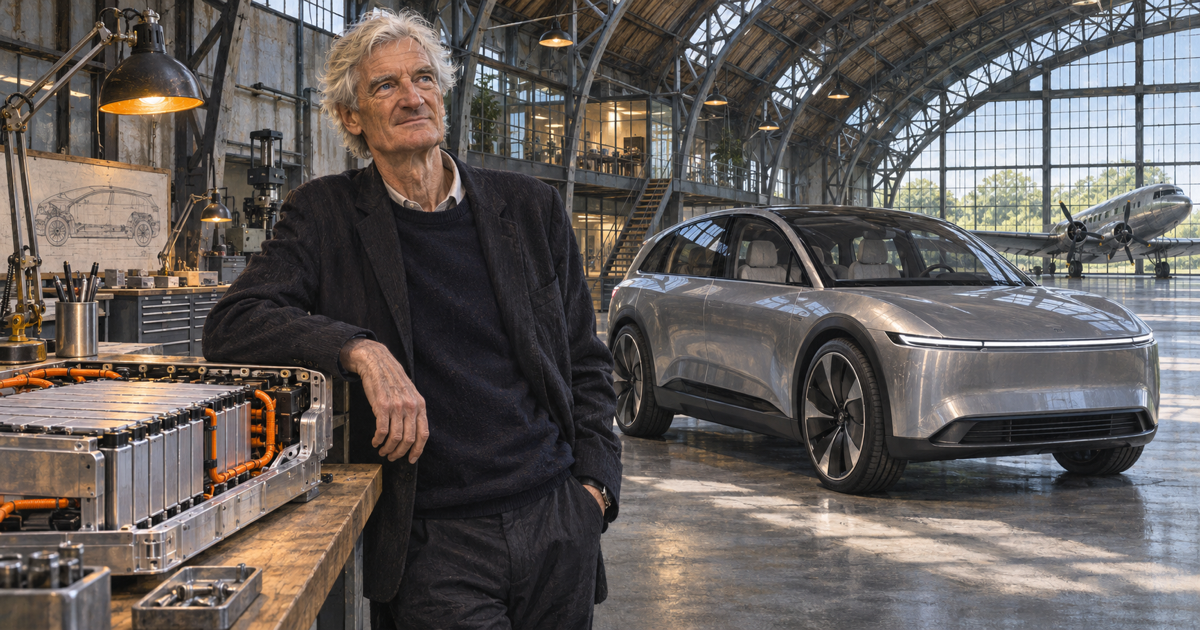
According to Dyson’s official biography, plans for the electric vehicle developed in 2014. The resulting design reached a pre-production stage. It was approximately five metres long, accommodated seven adults and incorporated a 150kWh battery. Dyson described a range of more than 600 miles, a claim about the proposed vehicle rather than a record established through customer ownership.
Those specifications identify a substantial passenger vehicle. They also explain why describing the project simply as an appliance maker adding wheels understates the task. Passenger accommodation, stored energy and the physical dimensions had to work together in one design. A decision that improved one aspect of the vehicle could impose requirements elsewhere.
A large battery illustrates the problem without requiring an invented cost estimate. More stored energy can support a longer driving range, but the battery also has to be purchased, housed and carried. The commercial value depends on what customers will pay for the resulting combination. A range figure alone cannot answer whether the whole vehicle offers an attractive proposition at a sustainable price.
The same reasoning applies to space. Seven seats can make a vehicle useful to a particular customer, but that usefulness must be assessed alongside the price and other ownership requirements. An engineering team can demonstrate that a configuration works. A manufacturer still needs enough buyers who prefer that configuration to the available alternatives.
Dyson’s investment also reached beyond the object itself. His retrospective says the company completed the purchase of sections of Hullavington airfield on 27 February 2017. Facilities give a development programme the room and equipment it needs; they also make the commitment more tangible. Once money has been spent on a site, abandoning the intended product becomes harder to explain, even when the future economics justify stopping.
It is important to keep the evidence within its limits. A pre-production vehicle is evidence of substantial development, but it does not establish the cost of sustained manufacture, the rate of defects in production or the expense of supporting customers over years. Those questions would have mattered to any launch decision. The published material does not provide a complete financial model answering them.
Dyson’s explanation exposed a difference in business models
In his retrospective, Dyson attributed the deteriorating commercial position to changes in the automotive market following the diesel-emissions scandal. He argued that established manufacturers could support electric-car losses through profitable conventional vehicles and the benefits of balancing their wider vehicle sales. That is the founder’s explanation of the competitive problem, rather than a neutral audit of every manufacturer’s accounts.
The distinction matters because it identifies a disadvantage that better engineering might not remove. If competitors can evaluate one product within a larger portfolio, a new entrant may face a different financial test. The entrant must consider whether the proposed business can stand on the resources and revenues available to it. Matching a feature does not necessarily mean matching a rival’s capacity to finance the product.
For Dyson, the comparison was therefore broader than whether its car was technically interesting. A consumer could choose among vehicles produced under different commercial arrangements. The price of a rival vehicle might reflect objectives beyond the profit on that individual sale. A newcomer would still need to decide what price and volume could justify its own commitment.
This does not establish that an independent electric-car business was impossible. It establishes why Dyson’s appliance experience could not settle the question. The relevant costs, competitive incentives and purchasing decisions had changed. A successful method of developing premium household products had to be tested again against the economics of a much larger purchase.
The public record also leaves a boundary around the explanation. Dyson did not release a complete set of vehicle cost assumptions in the sources used here. It would be misleading to reconstruct a precise break-even price from the development spending or battery capacity alone. The documented conclusion is narrower: management decided the project lacked a viable commercial future under the conditions it faced.
That conclusion is still substantial. It means that the company withdrew despite having made technical progress and invested heavily. The car did not fail because no one had imagined a workable design. The programme ended when the organisation responsible for paying for production declined to take the next commercial step.
Closing the programme was a separate management task
The October 2019 announcement said Dyson had undertaken a serious effort to find a buyer for the project without success. A sale could have given the work another owner, but the statement records no completed transaction. The decision to close therefore followed an unsuccessful attempt to find an alternative route for the vehicle.
Dyson also said the company would seek other internal roles for as many affected employees as possible, with sufficient vacancies to absorb most into its home-products business. Those were commitments expressed at the time of the announcement. They should not be converted into a claim that every affected person ultimately moved into another job within the company.
The distinction between a commitment and an outcome is especially important in a story often told through the founder’s decisions. Closing a programme is experienced by employees through assignments, consultations and employment changes. The founder can announce the strategic conclusion in a few paragraphs; the organisation still has to carry it out.
The same statement preserved a wider £2.5 billion technology investment programme and identified batteries, sensing, vision systems and robotics among continuing interests. The amount referred to that broader programme, rather than a disclosure that the cancelled car itself had consumed £2.5 billion. Keeping those figures separate prevents an abandoned project from acquiring an exaggerated price tag through repetition.
There is also a financial reason to distinguish stopping a product from discarding everything associated with it. People, equipment and technical knowledge may have other uses. Dyson later said engineering talent recruited through the automotive effort had been applied elsewhere. That is a plausible source of continuing value, although the published account does not quantify how much of the original expenditure it recovered.
Learning should therefore be treated as an asset to examine, rather than a word that automatically cancels a loss. A team may emerge with better capabilities while the original commercial project remains unsuccessful. Both can be true. Assessing the decision requires looking at what survived and what additional spending was avoided, without pretending that either can be measured precisely from the announcement alone.
A cancelled car did not end the appliance business
Dyson’s later results make clear that the vehicle cancellation was not the collapse of the company. In its 2024 results announcement, Dyson reported revenue of £6.6 billion, profit before tax of £561 million and sales of more than 20 million products. Those figures concern the appliance and technology business that continued after the car programme ended.
The company also reported research and development spending of £8 million a week in 2024. It identified adverse conditions and disruptions, including currency movements, a global reorganisation and a factory fire in the Philippines. The release provides a later financial snapshot, rather than proof that every subsequent investment choice succeeded or that the car expenditure paid for itself.
That distinction prevents two opposite distortions of the history. The cancelled vehicle should not be inflated into a general corporate downfall. Equally, the company’s continuing sales do not retrospectively make the vehicle a successful investment. The operating business survived, while the specific attempt to become a car manufacturer ended before customers could buy the product.
The more revealing comparison is between Dyson’s two development stories. Thousands of vacuum prototypes form a narrative in which continued work eventually produced a saleable appliance. The electric-car programme forms a narrative in which substantial development led management to reject production. Treating only the first as an example of entrepreneurship leaves out the responsibility to stop financing an unattractive next step.
Past spending cannot by itself justify future spending. Once the vehicle programme had consumed more than £500 million, the relevant decision concerned the additional commitment required to launch and support it. That is an economic interpretation of the case, not a claim to know the board’s unpublished calculations. The public announcement supplies the essential fact: Dyson declined to proceed despite the work already completed.
There was a reputational cost to acknowledging that boundary. A founder identified with persistence had to explain why persistence was no longer the right answer. But the alternative would have required a commercial justification beyond the appeal of completing the story. A finished vehicle could vindicate an engineering team while still failing to justify the business needed to put it on the road.
The surviving public record consequently supports a specific legacy. James Dyson demonstrated that he could finance and organise the development of an electric vehicle, then accepted that this did not oblige his company to manufacture it. The most consequential decision in the programme was the one that prevented the working car from becoming a product.
Frequently asked questions
Why did James Dyson cancel his electric car? Dyson announced in October 2019 that the vehicle could not be made commercially viable. An attempt to find a buyer for the project had also failed.
How much did Dyson spend developing the car? Dyson’s official biography says the project received more than £500 million in less than five years. This is distinct from its wider technology investment programme.
Did the cancelled car cause Dyson to close? No. The appliance business continued; Dyson reported £6.6 billion in revenue and £561 million in profit before tax for 2024.
💡 Key Insights
- ▸ A working prototype does not establish a viable manufacturing business.
- ▸ Shared technical expertise can justify exploration without guaranteeing expansion.
- ▸ Development spending and wider investment commitments are different figures.
- ▸ Stopping a project can protect a business that continues to operate profitably.
Sources
- Dyson — Automotive update, 10 October 2019 ↗
- Dyson — James Dyson official biography ↗
- Dyson — The Dyson Battery Electric Vehicle, by James Dyson ↗
- Dyson — Core Technologies, Invention: A Life ↗
- Cooper Hewitt, Smithsonian Design Museum — James Dyson: Designing Out Annoyances ↗
- Dyson — 2024 financial results ↗