Jørgen Vig Knudstorp Rescued LEGO by Selling Parks and Cutting Complexity
LEGO's recovery required more than popular toys: Jørgen Vig Knudstorp sold assets, simplified production and rebuilt the economics behind its plastic bricks.
View all stories about this mogul
On July 13, 2005, Blackstone announced a €375 million acquisition of LEGOLAND Parks, covering four attractions in Denmark, England, Germany and California. LEGO was relinquishing majority ownership of places where its plastic bricks became buildings large enough to walk around. Under chief executive Jørgen Vig Knudstorp, preserving the toymaker meant accepting a smaller operating perimeter. The deal joined the parks with Merlin Entertainments rather than closing them. Blackstone’s announcement records the transaction.
The disposal captured the difficult distinction at the centre of LEGO’s recovery: a valuable expression of a brand could still be an activity the manufacturer should stop owning outright. Visitors could love LEGOLAND while the toy company needed the money and management attention committed to it. The rescue therefore involved decisions about capital, product design and accountability, alongside decisions about what children would buy.
A 35-year-old inherited an unfinished rescue
Knudstorp became chief executive in 2004, aged 35. He had joined LEGO in September 2001, subsequently led its strategy department and served as acting chief financial officer during part of 2003. His appointment followed an action plan announced in March 2004, so the restructuring was already under way before he took the top job. LEGO’s contemporary report explicitly connected recovery with keeping the company in the Kirk Kristiansen family’s private ownership. LEGO’s 2004 annual report sets out that chronology.
That sequence matters when assigning credit. Knudstorp inherited an organisation attempting to repair itself, with measures already in motion and owners who wanted to retain it. His task was to make the recovery coherent and durable. Describing him as someone who arrived with the first recognition of trouble would erase the earlier work and obscure the harder question: why had corrective action not yet produced a satisfactory company?
His experience inside strategy and finance also gave the appointment a particular character. He was neither the founder nor a new purchaser installing a plan after an acquisition. He had already occupied positions from which he could examine the relationship between ambitions, operating decisions and financial results. The promotion placed responsibility for acting on those observations with someone who had helped study them.
Private ownership supplied an objective, rather than immunity from financial pressure. If the owners wanted to avoid surrendering the company, assets and activities had to be judged against that objective. Keeping every existing operation could conflict with keeping the manufacturing company independent. The parks sale made that trade concrete: LEGO could retain an economic connection to an attraction without continuing to carry it on the same terms.
A rescue also needs a distinction between urgency and haste. Cash shortages demand prompt decisions, but the fastest apparent saving can damage the product or the ability to deliver it. Knudstorp’s challenge was to identify which commitments supported the construction system and which consumed resources without strengthening its economics. That required looking beneath the familiarity of the LEGO name.
More products had created more obligations
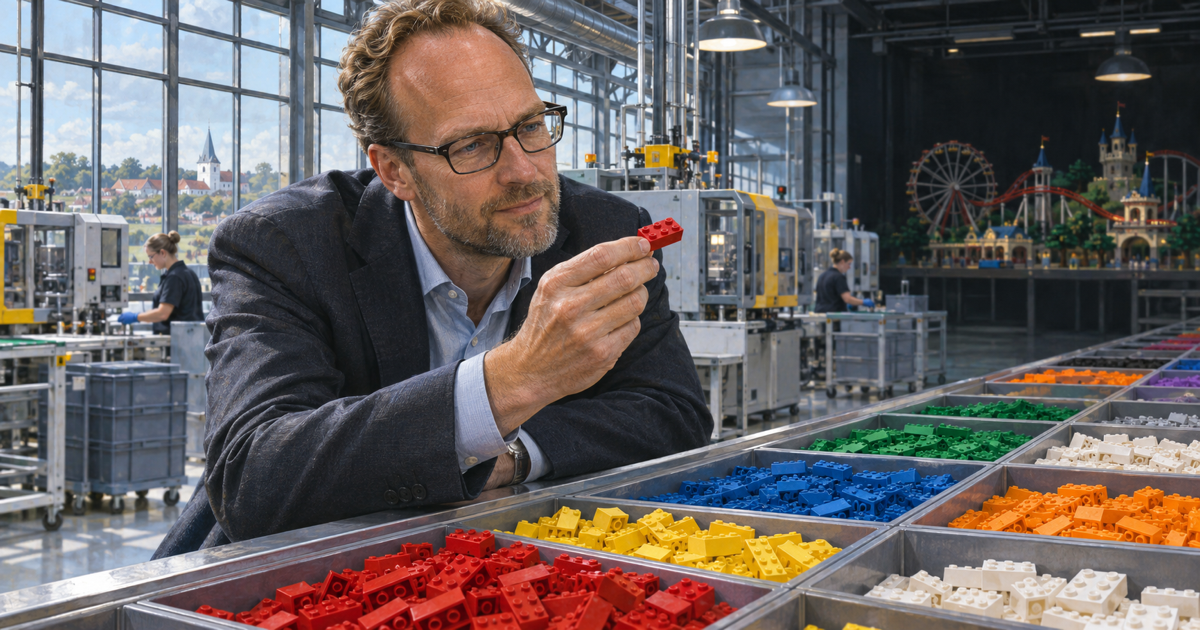
Harvard Business School’s account of LEGO describes expansion into branded clothing and entertainment development, alongside building sets with increasing numbers of unique components. It records the company’s first financial loss in 1998. An earlier restructuring under Poul Plougmann reduced staff and streamlined operations, yet the financial position deteriorated. Product complexity continued to interfere with forecasting, inventory and replenishment. The account identifies simplifying the range and reconnecting with customers as central elements of Knudstorp’s response. Harvard Business School’s case discussion explains the connection.
A unique component creates obligations beyond its appearance in a finished model. It needs tooling, production planning, storage and a place in the packing process. Someone must forecast how many will be needed and arrange for them to arrive alongside every other component required by the set. Its cost therefore cannot be understood solely by weighing the plastic or timing the moulding operation.
Consider the difference between a standard brick shared by several sets and a specialised piece used in one. Demand for the shared brick can be spread across multiple products. If one set disappoints, another may still consume the stock. The specialised piece has fewer destinations. Its usefulness depends more heavily on the accuracy of a particular forecast, and its remaining inventory can become difficult to redeploy.
There is a corresponding problem when demand exceeds expectations. A warehouse may contain most of the pieces for a popular set and still be unable to supply a complete box. A missing component can prevent the sale of everything assembled around it. Looking only at the total inventory value conceals that mismatch: an abundance of unwanted pieces cannot substitute for a shortage of a necessary one.
This is why a product can look successful in isolation while making the wider organisation harder to operate. Its designer sees an attractive model; its commercial team sees a plausible selling price. Production and logistics absorb the extra combinations. Unless those consequences enter the decision, each addition can appear reasonable while the cumulative range becomes expensive and unreliable.
Reducing complexity therefore changes the questions asked before launch. Does a proposed element create a play experience that existing pieces cannot provide? Will it be useful elsewhere? Can its likely demand support the operating burden? Those questions require judgement. A rule against every new part would eventually impoverish the product, while unrestricted novelty would leave the cost of variety unresolved.
The parks sale separated the brand from its balance sheet
The LEGOLAND transaction involved substantial attractions, not a collection of marginal promotional sites. Blackstone’s announcement reported more than 5.6 million visits to the parks in 2004 and described combining them with Merlin’s existing operations. It presented a 70% interest for Blackstone and management and a 30% interest on the LEGO side. LEGO’s subsequent accounts specified that the retained interests were divided equally between the LEGO Group and KIRKBI. The distinction matters because those entities should not be treated as interchangeable.
An attraction operator and a toy manufacturer face different operating problems. A park must manage attendance, accommodation, maintenance and the use of physical space. A construction-toy producer must coordinate product development, component availability, packaging and retail demand. Shared characters and visual identity do not eliminate those differences. Common branding is a reason to cooperate; it is not sufficient evidence that the same company should finance and operate both.
The retained minority interests made the decision more nuanced than abandoning LEGOLAND. The owners could continue participating in the attractions’ prospects while bringing in a different majority owner and combining the parks with an established leisure operator. For the manufacturer, the transaction changed the amount and form of its exposure. The brand relationship survived a significant change in the ownership structure.
This is a useful distinction in assessing distressed asset sales. A sale can be necessary without proving the asset was intrinsically poor. The relevant questions include what the seller needs, whether another owner can operate the asset more effectively, and what obligations remain after the transaction. Calling the parks a distraction would flatten those questions into a judgement about their popularity or quality.
Nor does receiving cash establish that the remaining operation has recovered. Sale proceeds can relieve immediate pressure and create time for repairs. They cannot be collected repeatedly from the same asset. The transaction would justify its place in a rescue only if the continuing toy operation became capable of supporting itself after the relief had passed through the accounts.
That made the disposal and the component programme complementary. One changed where capital was committed; the other addressed the demands made on production and inventory. Selling an attraction would not solve missing pieces in a warehouse. Simplifying a set would not release the capital tied up in a park. LEGO needed decisions at both levels.
The accounts distinguish recovery from accounting relief
LEGO’s 2005 annual report recorded a net profit of DKK 505 million, against a restated 2004 net loss of DKK 1,931 million. The reversal was substantial, but its composition matters. The report attributed DKK 331 million of the 2005 profit to continuing activities and DKK 174 million to discontinued activities. It also showed revenue rising 12% to DKK 7,050 million and profit before special items, financing and tax increasing to DKK 468 million from DKK 63 million. These figures come from the report’s comparative presentation. LEGO’s 2005 annual report provides the breakdown.
Those measures answer different questions. Net profit captures the overall accounting result. Continuing activities help isolate the operation that remains. A result before special items helps readers look past some consequences of restructuring, although it is not a substitute for examining them. A credible recovery should become visible across several measures rather than depend on the most flattering one.
The enormous swing in the headline result also needs context from the starting year. LEGO’s original 2004 report recorded major asset impairments and restructuring expenses. It explained that production capacity had been planned for growth above what materialised. The charges recognised that previous expectations no longer supported the recorded value of parts of the operation.
An impairment is not identical to cash leaving the bank in the year it is recognised. Nevertheless, it carries information about earlier investment decisions. Equipment or facilities acquired for an optimistic future can remain physically usable while being worth less economically. A later profit comparison benefits when such charges do not recur on the same scale, even before considering improvements in ordinary trading.
The appropriate reading is therefore more demanding than celebrating the difference between two bottom lines. Did customers buy more? Did the ongoing operation earn more from those sales? How much of the improvement came from transactions or charges that would not repeat? LEGO’s report supplies evidence of operating progress, while its separate categories prevent the whole reversal from being credited to ordinary toy sales.
Comparison itself requires care. The 2005 report changed the accounting treatment of certain retail contributions and restated earlier figures. A reader who places a revenue number from the original 2004 report beside the 2005 total without checking that adjustment can produce a misleading growth calculation. The comparison used here follows the later report’s restated series.
There is a managerial implication as well as an accounting one. A team can improve the appearance of a troubled year by selling assets, recognising losses or changing the operating perimeter. Some of those decisions may be necessary. The test is whether the remaining company earns a satisfactory return after the exceptional work has been done. The rescue had to create that capacity.
Refocusing left room for licensed stories and new ideas
Returning attention to construction toys did not require withdrawing from every external story or digital product. The 2005 report identified BIONICLE as LEGO’s largest-selling theme and Star Wars as its second largest. It also described the successful Star Wars computer game as a project undertaken with an external partner. At the same time, LEGO decided that it would introduce no new CLIKITS products after 2006.
These choices give substance to the otherwise vague instruction to focus on the core. A licensed setting can supply characters and an audience while the manufacturer contributes the construction experience. A partner can supply capabilities for a game. A product can also be stopped when continued effort fails to establish a satisfactory place for it. The relevant boundary concerns the contribution and obligations of each activity.
That is a more useful standard than measuring the distance between an idea and a plain rectangular brick. Construction systems require invention to remain interesting. New mechanisms, themes and combinations can strengthen the reason to buy. The discipline lies in asking whether each extension reinforces a capability the company can deliver and whether the resulting economics justify the resources committed.
Customer relationships belong in that assessment because internal enthusiasm is an unreliable demand forecast. A model can impress its designers and still miss what builders want to do with it. Conversely, an apparently familiar product can offer substantial value to a customer whose existing collection gives its pieces additional uses. Research and feedback help distinguish those possibilities before production magnifies the consequences.
LEGO’s 2006 organisation made those relationships more explicit. Its report described a Markets & Products area combining product development with commercial responsibilities, a Community, Education & Direct area responsible for direct consumer relationships and education, and a Global Supply Chain area spanning purchasing through delivery to distribution centres. Cross-functional boards were intended to coordinate decisions across those responsibilities. LEGO’s 2006 annual report documents the structure.
An organisation chart cannot by itself establish that coordination works. Its significance here is the attempt to make connected decisions visible. Product development affects supply; supply affects availability; availability affects retailers and consumers. If each function optimises only its own figures, the company can end up with attractive designs, efficient individual production runs and an unsatisfactory assortment of finished goods.
The same logic limits a purely financial version of the rescue. Cutting costs without protecting the reasons people buy can weaken future demand. Expanding enthusiastically without accounting for the cost of delivery can recreate the original strain. LEGO needed a process in which creative, commercial and manufacturing judgements could challenge one another before commitments became expensive to reverse.
A recovery built to survive its chief executive
Knudstorp’s tenure eventually extended well beyond the emergency. LEGO’s 2016 annual report records that he stepped down as chief executive on December 31, 2016, with former chief operating officer Bali Padda succeeding him on January 1, 2017. It also described Knudstorp’s move towards leadership of the new LEGO Brand Group. Those dates mark the end of his operating tenure; they should not be confused with a complete departure from LEGO-related responsibilities. LEGO’s 2016 annual report records the transition.
The turnaround is often compressed into the return of the brick. Its more specific achievement was aligning the attractions of the product with the requirements of making and selling it. A component had to justify its place in production. An adjacent activity had to justify its claim on capital. A reported profit had to be examined for what the continuing operation contributed.
None of those tests supplies a permanent answer. A specialised element can deserve investment; a licensed theme can justify royalties; a minority stake can preserve an attractive opportunity. The decisions depend on evidence and circumstances. Treating the recovery as a universal instruction to shrink would miss the judgement involved in choosing what to retain and what to develop.
The July 2005 transaction remains a concrete illustration of that judgement. LEGO allowed another operator to take majority ownership of a conspicuous expression of its name while it repaired the less visible machinery behind its boxed products. The parks continued to carry the identity. The manufacturer gained room to concentrate on the production, inventory and customer decisions on which its survival depended.
Frequently asked questions
When did Jørgen Vig Knudstorp become LEGO’s chief executive?
He became chief executive in 2004, aged 35, after joining LEGO in 2001 and working in strategy and finance.
Did LEGO close LEGOLAND during its recovery?
No. The four parks entered a €375 million transaction with Blackstone in 2005 and were combined with Merlin Entertainments.
What changed beyond the parks sale?
LEGO reduced product complexity, concentrated on construction toys and strengthened the connection between customer demand, product development and its supply chain.
💡 Key Insights
- ▸ A strong brand does not justify owning every activity associated with it.
- ▸ Specialised components create costs across production, forecasting and inventory.
- ▸ Asset-sale proceeds and continuing operating profits measure different things.
- ▸ LEGO's refocusing preserved room for licensed themes and external partners.