George Eastman Sold a Camera Customers Had to Send Back
In 1888, George Eastman sold a $25 camera that returned to Rochester for processing. Kodak's breakthrough joined simple hardware to a repeat service business.
View all stories about this mogul
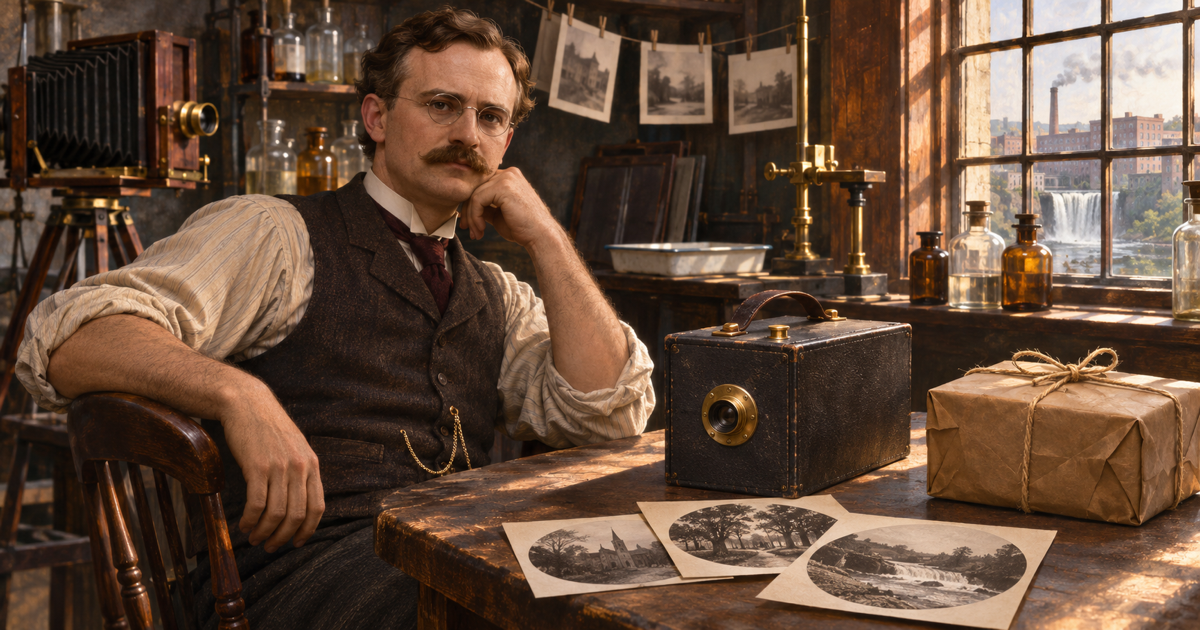
In 1888, George Eastman’s first Kodak camera cost $25 and arrived loaded for 100 exposures. After taking the photographs, its owner sent the entire camera to Rochester, New York. Another $10 paid for developing, printing and reloading. The camera was a product customers purchased, used and then handed back to its supplier. Duke University’s advertising archive documents the arrangement.
That return journey explains much of Eastman’s achievement. He offered an amateur a manageable task—taking pictures—and organized a business to perform the difficult work that followed. The camera and the processing service belonged to the same proposition. Understanding that arrangement requires looking beyond the box to the manufacturing, chemistry and advertising that supported it.
A bank clerk confronted the equipment
Eastman encountered photography while preparing for a holiday he never took. A colleague suggested bringing a camera, and the purchase introduced him to an awkward collection of equipment. According to the George Eastman Museum, the weight, cost and inconvenience helped direct his attention toward improving the process. He was still a young employee of the Rochester Savings Bank, with no photographic company to protect and no established product line to defend. The museum’s biography traces that beginning.
Photography presented a business problem before it presented Eastman with a consumer brand. People who wanted photographs also faced the work of preparing and handling sensitive materials. A potential customer had to decide whether the result justified learning the procedure, acquiring the apparatus and transporting it. Improving only the camera would leave much of that burden in place.
Eastman’s early work therefore concerned the photographic surface. Dry plates offered a way to separate preparation from the moment a picture was taken. A manufacturer could prepare material in advance; a photographer could use it later. The commercial importance lay in transferring a task from each individual operator to a producer equipped to repeat it.
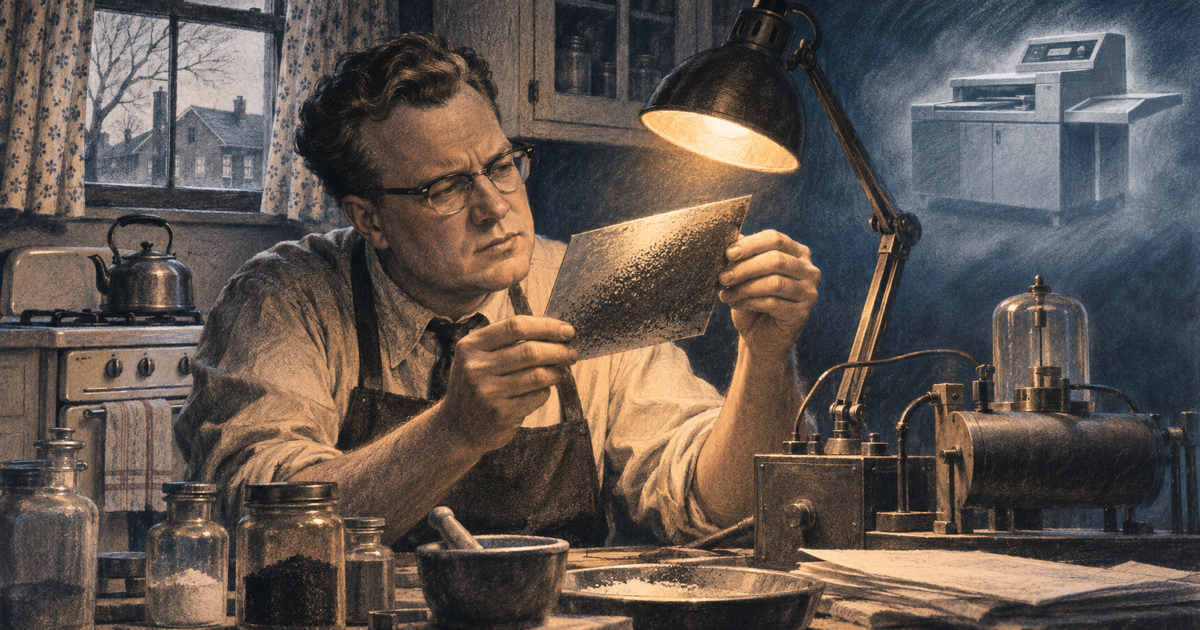
He experimented with gelatin emulsions in his mother’s kitchen for three years. By 1880, he had patented a machine for coating dry plates. In 1881, with financing from Rochester businessman Henry Strong, he formed the Eastman Dry Plate Company. Those milestones show a progression from personal frustration to a manufacturing concern, rather than a sudden leap from bank counter to famous camera.
The coating machine deserves attention because it addressed consistency and output. A workable photographic formula was one requirement; applying it repeatedly to material for sale was another. Customers purchasing prepared plates were buying the expectation that a manufacturer could perform this operation reliably. Eastman’s business depended on making that expectation reasonable.
There was also a narrower initial audience. Selling photographic materials meant serving people already interested in taking photographs. Reaching someone who had never considered becoming a photographer required a different offer. The eventual Kodak system would tackle that second problem, but the manufacturing business came first.
The $25 box was only part of the purchase
The Smithsonian’s surviving original Kodak, serial number 2443, makes the product concrete. Its collection record identifies a camera sold in 1888 for $25, loaded with film and supplied with a leather carrying case. The photographs were circular, approximately 2⅝ inches across. This was an object designed to leave a workshop or studio and accompany its owner. The Smithsonian record preserves those specifications.
The format also helps explain what Eastman was selling. A customer did not need a large finished print to establish the value of possessing a personal photograph. The small circular image was a usable result. The commercial question was whether enough people wanted that result when the apparatus and procedure became easier to manage.
Duke’s account describes a plain black box with a button for exposure and a key for advancing the film. There was no focusing adjustment or viewfinder on the original model. These omissions reduced the operations placed in the user’s hands. They also limited control: simplicity involved decisions about which choices the manufacturer would make in advance.
A fixed procedure can make a product easier to explain. Rather than persuade a novice to understand every technical possibility, a seller can demonstrate a short sequence. Kodak’s famous promise, “You press the button—we do the rest,” compressed the division of work into one sentence. Its force came from describing an actual service arrangement.
The price needs equal care. Twenty-five dollars was a substantial opening purchase; the first Kodak did not place a camera within every household’s reach. Eastman’s initial advance concerned ease of use. Affordability would require further changes. Treating those two developments as identical erases the distance between the 1888 camera and the later dollar Brownie.
The early product can therefore be understood as a test of convenience at a meaningful price. Would customers pay to avoid mastering the preparation and finishing of photographs? The return service gave Kodak a practical answer to that question: the customer could obtain pictures while leaving those operations to the company.
Rochester performed the work the customer avoided
The processing arrangement created a precise division of responsibility. The owner chose the subject and exposed the film. Kodak handled the subsequent technical work and supplied another loaded camera for continued use. The manufacturer’s involvement extended beyond the original sale into the production of the result the purchaser actually wanted.
That distinction matters when assessing the business. A camera sitting on a shelf is a durable possession. Making photographs consumes sensitive material and requires processing. Under the original arrangement, further use could bring a customer back into a paid relationship with Kodak. This recurring relationship was inherent in the offer, although the prices alone tell us nothing about its profit margin.
The $10 service charge was two-fifths of the camera’s initial $25 price. That calculation establishes the significance of the follow-up payment without establishing what Kodak earned from it. Labor, materials, handling and other expenses stood between a payment and a profit. A history of the business should keep revenue mechanics separate from unsupported claims about exceptional margins.
For the customer, convenience carried a cost in time and possession. A finished roll meant sending away the camera, and results were not available at the moment of exposure. Kodak removed technical obligations while retaining a physical journey between the amateur and the processing operation. The system simplified participation without making photography instantaneous.
It also concentrated responsibility. If an inexperienced user obtained disappointing pictures, the camera, sensitive material, instructions and processing could all matter. Selling these elements together gave the company an interest in how they worked as a sequence. The relevant unit of performance was a satisfactory photograph, rather than a mechanical device considered alone.
The Metropolitan Museum of Art identifies this combination of simplified apparatus and company processing as central to Kodak’s expansion of amateur photography. Its account emphasizes the opening of photography to people without professional training or technical credentials. That interpretation places the business achievement in the organization of the experience as well as the equipment. The Met’s history explains the connection.
The arrangement is sometimes tempting to describe using later business terminology. The historical details are more useful. Customers paid for a loaded camera, exposed a finite quantity of material and paid again to have the resulting work completed. Each step had a visible purpose. The service was something a purchaser could understand before knowing much photographic chemistry.
The chemistry required several inventors
The convenience of the Kodak should not obscure the collaborative development beneath it. PBS’s history identifies William Hall Walker, whom Eastman hired in 1884, as a collaborator on the Eastman-Walker Roll Holder. The mechanism allowed photographic material to advance through a camera in a roll, reducing the need to handle separate plates. PBS’s historical account supplies that attribution.
Roll handling connected two parts of the problem. A camera could contain material for repeated exposures, while its operator could advance that material mechanically. The photographer’s work between pictures became smaller. A useful consumer experience thus depended on the relationship between the sensitive surface and the machinery that moved it.
The original paper film also had shortcomings. PBS describes its results as mediocre and identifies chemist Henry Reichenbach’s work on transparent flexible film, achieved in 1889. Eastman’s company had introduced its camera before every important material problem was settled. Product development continued after the public offer had acquired a name and a slogan.
That chronology guards against an overly tidy invention story. The Kodak camera of 1888 and the transparent film development of 1889 were related steps, separated in time. Combining them into one moment would conceal the imperfect material used in the earlier product and the subsequent work of a named chemist.
Commercial simplification can require greater technical effort within the supplier’s operation. The purchaser sees fewer tasks because specialists have resolved or absorbed them elsewhere. Kodak’s button did not eliminate chemistry; it placed much of the chemistry outside the amateur’s immediate responsibility. That is a statement about where work occurred, rather than a claim that the work disappeared.
Eastman’s contribution can be assessed without assigning every invention to him. Financing research, selecting a product, organizing production and presenting the result to customers were substantial responsibilities. Naming Walker and Reichenbach makes the account more precise while leaving room to examine Eastman’s role as the organizer of the business.
The same distinction helps explain why a successful demonstration was insufficient. Material needed to behave consistently in customers’ hands and through processing. A camera sold to amateurs had to fit a repeatable commercial procedure. Research and operations were therefore connected to the credibility of the advertised promise.
Advertising supplied occasions to take pictures
Kodak needed customers to imagine themselves using the camera. The Met describes advertisements showing women and children operating it. Those images supplied evidence for the intended message: photography could belong to people outside the trained profession. The prospective buyer was invited to identify with an ordinary user rather than admire a specialist from a distance.
This was a consequential choice of subject. Technical advertising can explain what a machine does, yet leave a novice unsure why to own it. Showing someone using a camera in everyday life addresses that second uncertainty. It places the apparatus within an activity a customer already recognizes.
The pictures people made supplied an expanding set of occasions. The Met documents snapshots of holidays, gatherings, children, pets, houses and important events. The subject matter helps explain why photography could become a repeated practice. A purchaser did not need an exceptional public ceremony to justify another exposure; ordinary personal life provided material.
Albums gave those photographs a further use. The Met describes their arrangement into sequences, with captions and sometimes collage. An exposure could become part of a record assembled over time. For the business, this suggests why the usefulness of the camera could persist after the novelty of the first photographs had passed.
The scale reported by the Met must be read carefully. It cites an 1898 photographic journal’s estimate that more than 1.5 million roll-film cameras had reached amateurs. That is a contemporary estimate covering roll-film cameras, not a verified total of Kodak sales. It supports the breadth of the emerging activity without assigning every camera to Eastman’s company.
Advertising also helped make a technical category intelligible. A shopper who recognized a use for photography still needed confidence about what to do next. A memorable promise, a recognizable product and a visible example of its use could work together. Their effectiveness depended on the company delivering results consistent with the simplicity it advertised.
There was a tension within that promise. Every removed adjustment made operation easier to describe, while also narrowing what a user could control. Kodak’s offer made sense for customers who valued access to a photograph more than command of the full process. The product’s appeal followed from that particular allocation of choices.
The dollar Brownie widened the opening
In 1900, Kodak introduced the Brownie at a price of $1. Duke’s account presents it as a major step toward making amateur photography broadly affordable. Compared with the original Kodak’s $25 entry price, the difference was stark. It should not be mistaken for a comparison between otherwise identical cameras or complete lifetime costs.
A cheaper camera reduced the amount a new customer had to commit before taking any pictures. Film and finishing still belonged in the user’s total expenditure. The entry price mattered because it stood at the beginning of that relationship, before a purchaser had experienced the pleasure or usefulness of making photographs.
The Brownie extended an idea already visible in the earlier Kodak: make the initial act manageable for an amateur. In the first camera, a service arrangement carried much of the burden. The later price reduction addressed a further obstacle. Ease of use and purchase price were distinct constraints, and Kodak worked on both over time.
Duke also records the company’s commitment to advertising, including the appointment of an advertising manager in 1892. Manufacturing improvements alone did not explain the product to prospective users. The company devoted resources to presenting photography as something people could adopt and continue doing.
Eastman’s rise consequently offers a specific business history rather than a universal formula. Prepared photographic materials, mechanical roll handling, processing and consumer promotion reinforced one another in this case. Each addressed a different part of the distance between wanting a picture and obtaining one. Removing only one obstacle would have left others for the amateur to negotiate.
The original Kodak’s return journey captures the arrangement most clearly. The company accepted work that customers were being encouraged to avoid. Its simple public promise rested on a more involved operation elsewhere. The achievement was measurable in the user’s changed task: choose a subject, make an exposure and let a commercial organization finish the photograph.
Eastman did not make that organization alone, and the first camera did not instantly make photography cheap. The dated products, named collaborators and separate prices establish a more useful account. Over successive steps, Kodak made participation easier and then lowered the opening cost. The black box mattered because of the working system attached to it.
Frequently asked questions
What did the first Kodak camera cost?
It sold for $25 in 1888, loaded for 100 exposures. Developing, printing and reloading cost another $10.
Why did customers send the entire camera back?
The original service arrangement placed film removal, processing and reloading with the company, reducing the technical work required of the owner.
Did George Eastman invent every part of the Kodak system?
No. Collaborators included William Hall Walker on the roll holder and Henry Reichenbach on transparent flexible film.
💡 Key Insights
- ▸ Kodak paired a camera sale with paid processing and reloading.
- ▸ Simpler operation preceded a broadly affordable purchase price.
- ▸ Named collaborators supplied essential mechanical and chemical advances.
- ▸ Advertising connected photography to repeatable occasions in ordinary life.
Sources
- Duke University Libraries: Ellis Collection of Kodakiana ↗
- George Eastman Museum: About George Eastman ↗
- Smithsonian National Museum of American History: Original Kodak Camera, Serial No. 2443 ↗
- The Metropolitan Museum of Art: Kodak and the Rise of Amateur Photography ↗
- PBS American Experience: George Eastman ↗