Cathie Wood: Visionary Disruptor or the Face of Peak Tech Bubble Thinking?
Cathie Wood turned ARK Invest into the loudest public bet on disruption of the 2020s. Then the rate cycle changed, the market mood broke, and conviction itself became the controversy.

View all stories about this mogul
Cathie Wood did not merely run a fund. She sold a lens for seeing the future. In that lens, old valuation frameworks were too backward-looking, legacy incumbents were too slow, and exponential technologies were about to reorder everything from transportation to medicine to money itself. For a while, the market loved that story so much it treated her less like a portfolio manager than like a prophet with a ticker symbol.
Then the cycle turned.
That is what makes Cathie Wood one of the most revealing mogul figures of the past decade. Her story is not about a backroom scam, cooked books, or vulgar self-enrichment in the old sense. It is about what happens when a public-market operator builds a cult of conviction around the right themes at exactly the right moment — and then has to live through the moment when the price of belief changes.
This is why she belongs in Fall, not because she disappeared, but because the market stopped treating certainty like a superpower.
Chapter 1: Before ARK, There Was a Long Apprenticeship in Big Ideas

Cathie Wood’s later image as a disruption evangelist can make people forget how institutional her background really was. According to ARK’s own biography, she spent years at Jennison Associates, then co-founded Tupelo Capital Management, and later became chief investment officer of global thematic strategies at AllianceBernstein. This matters because it means she did not arrive from nowhere with a few flashy stock charts and a Twitter following.
She came out of the professional asset-management world. She learned how large pools of capital behave. She learned how macro narratives influence sector rotations. Most importantly, she learned that the market often pays most aggressively for managers who can tell a coherent story about structural change.
That thematic muscle became the spine of everything she later built. Cathie was never trying to be a classic value investor. She wanted to organize capital around technological transformation long before most firms were comfortable doing it in such concentrated public form.
Even before ARK, the outline was there: top-down vision, strong macro views, and unusual comfort staking reputation on unpopular time horizons.
Chapter 2: ARK Was Built as a Product, Not Just a Firm

When Wood registered ARK in 2014, the pitch was sharper than the average fund launch. She was not simply offering stock selection. She was offering a branded framework for investing in disruptive innovation across robotics, artificial intelligence, DNA sequencing, energy storage, blockchain, and next-generation internet platforms.
That framing was powerful because it converted abstract technological excitement into something tradeable. Most people cannot underwrite a ten-year future for autonomous mobility or genomic medicine. But they can buy an ETF that claims to bundle those futures together.
ARK’s flagship fund, ARKK, became the cleanest retail wrapper for that idea. If you believed traditional benchmarks were too full of incumbents and too slow to recognize nonlinear change, ARKK looked like liberation. It was liquid, easy to understand, and built around names investors could tell stories about.
This was Wood’s first great business insight: in public markets, a worldview that can fit on a one-page thesis sheet is more scalable than a subtle one. ARK was legible. Legibility attracts flows.
Chapter 3: The Pandemic Turned Her Into a Symbol

Plenty of managers had technology exposure before 2020. Cathie Wood became famous because the pandemic shock reorganized the market in favor of exactly the companies ARK wanted to own. Remote work, digital payments, e-commerce acceleration, software adoption, electric vehicles, and biotech optimism all crowded into one historical window.
That timing was explosive.
ARKK’s performance in 2020 became the kind of number that escapes finance and enters popular culture. It was no longer a specialist’s trade. It became a retail phenomenon, a media obsession, and a personality engine. Cathie was on television, in headlines, in podcasts, and in every conversation about high-growth investing.
This is where her mogul status really formed. She stopped being only a money manager and became a public character representing a wider belief: the future belongs to aggressive believers, not spreadsheet conservatives.
That message landed beautifully in a world drunk on stimulus, home trading, and technological acceleration.
Chapter 4: Transparency Became a Marketing Weapon

One of ARK’s most distinctive choices was radical openness around portfolio thinking and daily trades. Investors could see what the funds were buying and selling. Wood and her team published research, price targets, thematic frameworks, and regular commentary explaining why conventional analysis was missing the point.
This was not just investor relations. It was distribution strategy.
Opacity can feel sophisticated, but transparency scales better when you are trying to build an audience beyond institutions. ARK let followers feel close to the action. They could mirror trades, debate positions, and internalize the language of exponential growth. That made the funds feel participatory rather than distant.
The result was powerful brand formation. Cathie Wood was not a faceless allocator behind quarterly letters. She was visible, quotable, and repeatable. Her conviction was part of the product.
That is a dangerous strength. When a manager’s persona becomes intertwined with the investment case, inflows can accelerate faster than discipline.
Chapter 5: The Boom Was About Reflexivity as Much as Research

ARK’s rise was not simply a story of great stock picks. It was also a story of reflexivity.
Strong returns drew media attention. Media attention drew retail investors. Retail investors drove inflows. Inflows reinforced demand for the very names ARK already owned. Rising prices then validated the narrative that disruptive innovation was being underpriced by old-school analysts. The loop fed itself.
For a while, that loop looked like genius.
Wood’s bold targets for companies like Tesla helped sharpen her image as someone willing to be mocked early in order to be vindicated later. Her willingness to own volatile names made her look principled rather than cautious. In a period when caution felt embarrassing, that mattered enormously.
But reflexive systems have a nasty property: when they reverse, the story that once explained everything begins to explain the collapse too.
Chapter 6: When Rates Rose, the Faith Trade Broke
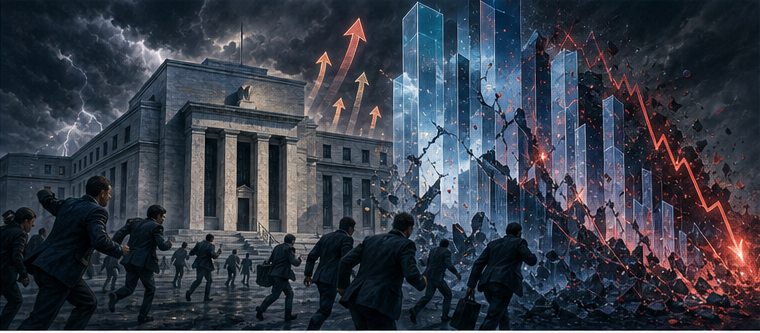
The ARK worldview was built around long-duration growth. That works best when capital is cheap, future earnings are richly rewarded, and investors are willing to pay enormous multiples for the possibility of category dominance.
Then inflation surged. Central banks tightened. The market stopped pricing distant dreams as generously. Suddenly, the same portfolio construction that once looked visionary started to look dangerously exposed.
Reuters described ARK’s flagship fund as getting slammed in 2022 alongside other growth vehicles as higher interest rates crushed appetite for speculative, future-heavy equities. That was the mechanical part of the fall.
The psychological part was harsher.
Investors who had treated Cathie as the face of the next era now had to ask whether they had merely bought the most charismatic packaging of the zero-rate bubble. The names did not all become worthless. The problem was that the market no longer granted them infinite narrative runway.
Conviction did not disappear. It lost pricing power.
Chapter 7: The Critique Got More Serious Than “She Was Early”

Every aggressive manager gets mocked during a drawdown. What changed with Cathie Wood was that the criticism became structural.
Skeptics argued that ARK confused story quality with portfolio quality. That the funds were too concentrated, too correlated, too exposed to liquidity shocks, and too willing to accept valuation extremes so long as the disruption narrative still sounded grand enough. Critics also pointed out that being right about a technological trend is not the same as being right about a stock’s entry price.
This is the line many retail investors never fully absorb. A technology can reshape the world and still make public-market buyers miserable if they pay the wrong multiple or fund the dream at the wrong point in the cycle.
Cathie’s greatest strength — refusing to bow to consensus valuation discipline — became the sharpest knife turned against her. Her defenders saw courage. Her critics saw theology.
Chapter 8: Yet the Loyalists Never Fully Left

A true collapse story ends in exile. Cathie Wood’s story did not.
Even after the bruising drawdowns, she retained a committed audience. Reuters noted in 2024 that Wood was still publicly defending ARK’s strategy in letters to investors, arguing that the environment would become friendlier again as rate pressure eased. That persistence tells you something important.
She was never only selling recent returns. She was selling a map of reality.
Maps survive longer than trades. Investors who stuck with ARK were often not saying, “I love every quarter of this fund.” They were saying, “I still believe the world will eventually look more like Cathie’s thesis than the benchmark’s thesis.” That is a much deeper kind of loyalty.
It also explains why her public reputation remained strangely durable. A manager who is merely lucky loses followers fast. A manager who becomes the avatar of a worldview can stay relevant long after the P&L turns ugly.
Chapter 9: Was She a Visionary or a Bubble Mascot?

The honest answer is that she was both, depending on what question you are asking.
If the question is whether Cathie Wood saw real technological shifts before many large incumbents took them seriously, the answer is yes. ARK was early and forceful on themes that absolutely mattered: AI, electric vehicles, genomics, digital wallets, robotics, and the convergence of software with physical industries.
If the question is whether she also became the perfect mascot for peak pandemic-era growth speculation, that answer is also yes. Her brand thrived in a market that rewarded bold duration bets and theatrical certainty. When the macro regime changed, the weakness of that same architecture became impossible to hide.
Her fall, then, is not a moral melodrama. It is a valuation drama.
She was not exposed as fake. She was exposed as cyclical in ways her mythology implied she had transcended.
Chapter 10: The Real Lesson of Cathie Wood

Cathie Wood’s place in mogul history is secure because she turned asset management into narrative entrepreneurship. She built a public identity, a research ecosystem, a product family, and a tribe of believers around one central claim: that disruptive innovation deserves concentrated, unapologetic capital.
That claim made her rich, famous, and wildly influential.
It also trapped her.
Once you become the human embodiment of conviction, moderation becomes almost impossible. Pulling back too early makes you look compromised. Sticking to the thesis through pain makes you look reckless. The market eventually forces a bill on that tension.
Cathie Wood did not vanish beneath that bill. But she did lose something more interesting than money: the presumption that certainty about the future can exempt you from the price you pay in the present.
That is why her story belongs here. Not as a punchline, and not as a coronation. As a warning about how quickly visionary capital can turn into a referendum on belief itself.
💡 Key Insights
- ▸ Cathie Wood's genius was not just stock picking. It was packaging a complete worldview around disruptive innovation and making ordinary investors feel like they could buy the future directly.
- ▸ ARK's rise showed how narrative, transparency, and ETF liquidity can create a reflexive feedback loop in which performance, inflows, and media attention reinforce one another.
- ▸ Her fall was not a simple fraud story or total implosion. It was a harsher lesson: conviction looks like brilliance in a zero-rate mania and like denial when the discount rate finally matters again.