Bill Gates and the Microsoft Antitrust War: The Browser Battle That Nearly Broke the Empire
In the late 1990s, Bill Gates controlled the operating system on more than 95% of the world's personal computers — and then a free browser turned that dominance into the most dangerous legal fight of his career. This is how Microsoft nearly got split in two.
View all stories about this mogul
At the peak of Microsoft’s power, Bill Gates sat atop a company whose software ran on more than 95% of the world’s desktop computers — and still decided that a free web browser was too dangerous to leave to anyone else. That decision triggered one of the most consequential antitrust cases in business history. The U.S. government accused Microsoft of using Windows as a weapon, a federal judge ordered the company split in two, and for a moment the most powerful man in technology looked genuinely vulnerable. This was not a story about a buggy browser. It was a story about what happens when a monopoly panics.
🌐 Chapter 1: Netscape Was Small, but the Threat Was Existential (1994–1997)
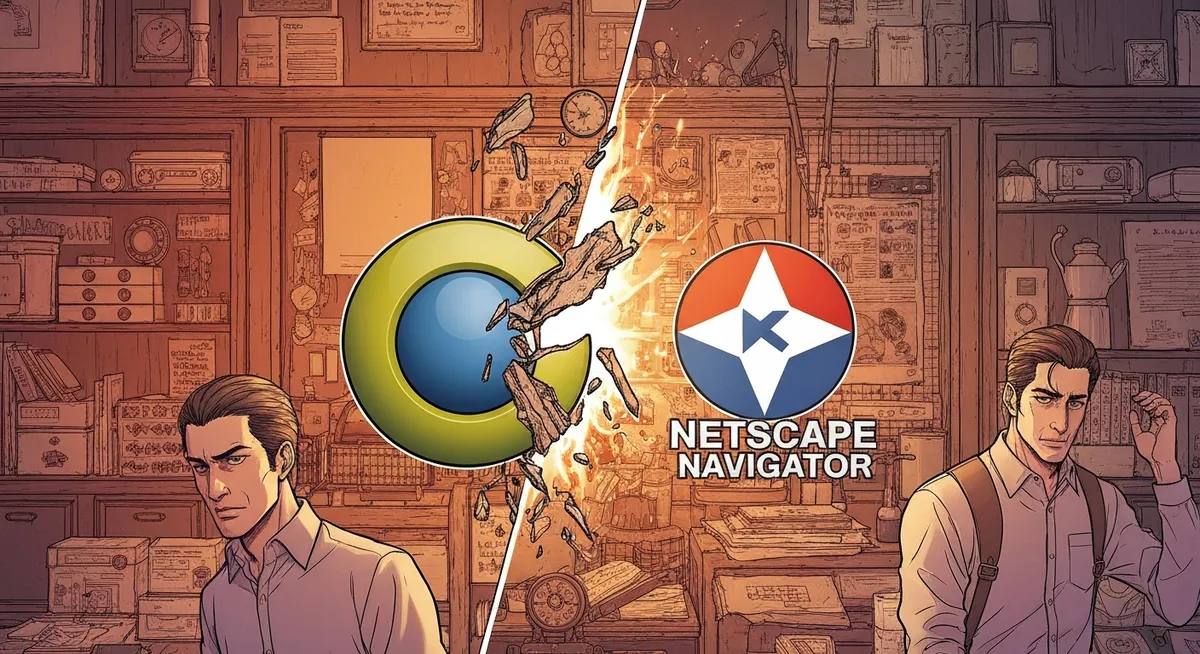
In 1994 and 1995, the web stopped feeling academic and started feeling commercial. Netscape Communications was founded on April 4, 1994. By 1995, Netscape Navigator had become the dominant browser of the early web, and the browser itself began to look like the new front door to computing.
That terrified Microsoft.
The company already owned the operating-system layer. Windows 95 launched on August 24, 1995, and Microsoft understood that if developers began building web-based software that ran inside a browser, the operating system underneath might matter less. A browser could become what executives sometimes called a kind of middleware layer — a software platform sitting between Windows and the user.
This was the real reason the browser wars became so vicious. Netscape was not just another app. It was a possible escape route from Windows.
By mid-1995, Netscape had roughly 75% of browser market share. Microsoft, meanwhile, controlled a desktop operating-system franchise that exceeded 95% share on Intel-compatible PCs. Those two numbers explain the entire war. One company owned the machine. The other was racing to own the future on top of it.
Microsoft’s answer was brutally simple: make Internet Explorer free, ship it to every Windows user, and make life hard for PC manufacturers that wanted to highlight anything else. Internet Explorer 1.0 shipped alongside the Windows 95 Plus! pack in August 1995. Then the releases came faster, the bundling got tighter, and the fight stopped being about browser quality alone.
Netscape could innovate. Microsoft could preinstall.
That was the imbalance that mattered.
⚖️ Chapter 2: The Government Decided the Browser Was Not Really Free (1997–1999)
Microsoft had already signed a 1994 consent decree with the Department of Justice promising not to tie other products to Windows in certain ways. But as Internet Explorer became more deeply fused to the operating system, the government concluded Microsoft was effectively doing exactly that.
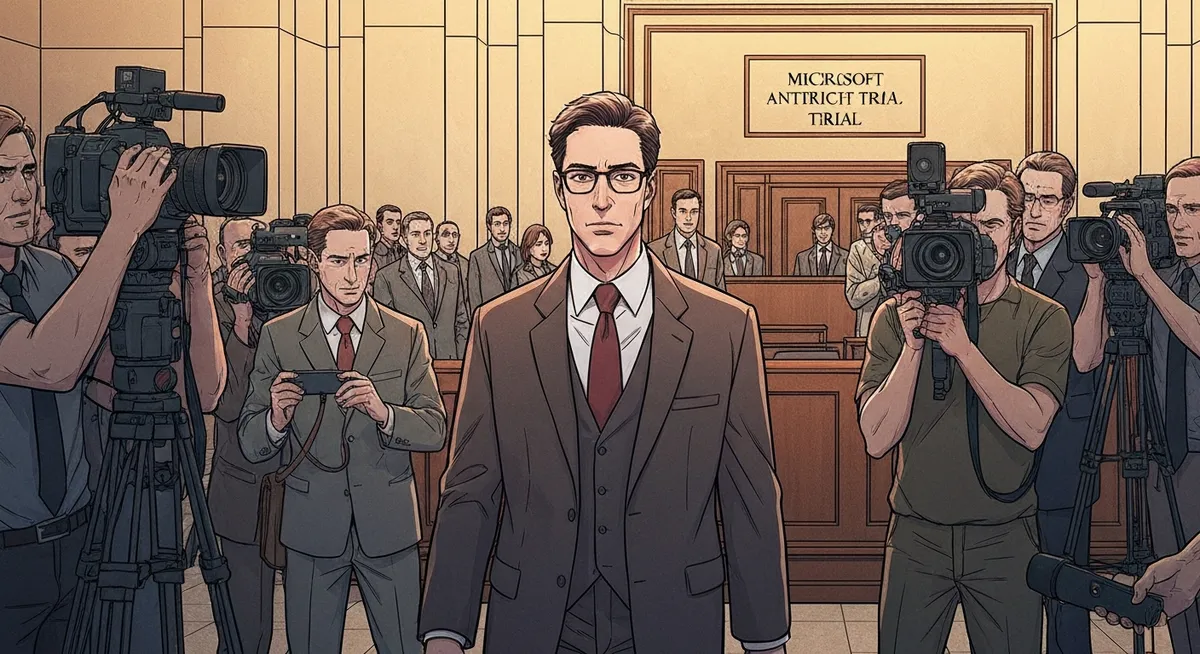
In October 1997, the DOJ moved against Microsoft over its Internet Explorer tactics. On May 18, 1998, the real war began: the Department of Justice, joined by attorneys general from 20 states and the District of Columbia, filed the major antitrust case that would define Gates’s public image for years.
The government’s theory was straightforward. Microsoft had a monopoly in PC operating systems, and it used that monopoly to crush threats that might weaken Windows. The browser was the most visible example, but the case also touched Microsoft’s treatment of PC makers, software developers, Java, and any rival that looked capable of becoming a platform.
Bill Gates did not help his cause.
His videotaped deposition from August 27, 1998 became famous for the wrong reasons. Gates came across as evasive, hyper-literal, and combative. He argued over definitions, claimed not to recall key details, and seemed less like a visionary founder than a man trying to out-lawyer the room.
Then came the part that truly mattered: the findings.
On November 5, 1999, Judge Thomas Penfield Jackson issued his Findings of Fact. The document concluded that Microsoft possessed monopoly power in the market for Intel-compatible PC operating systems and had used that power in ways that harmed competition. This was the moment the case stopped being a political fight and became a legal disaster.
Microsoft had spent years insisting it was just competing hard. The court was now saying the company had crossed the line from hard competition into illegal monopoly maintenance.
🪓 Chapter 3: For One Year, America Really Was Going to Break Microsoft Apart (2000–2001)
The spring of 2000 was the most dangerous stretch of Gates’s corporate life.
On April 3, 2000, Judge Jackson issued his Conclusions of Law, holding that Microsoft had violated Section 2 of the Sherman Act. On June 7, 2000, he imposed the remedy regulators had wanted most: a breakup. Microsoft would be split into two companies — one focused on operating systems, the other on applications and everything else.
It was the most dramatic antitrust remedy proposed against a major American technology company since AT&T.
Gates had already stepped down as Microsoft’s CEO in January 2000, handing the job to Steve Ballmer, but nobody seriously thought he had ceased to be the central force at the company. The breakup order landed not just on Microsoft, but on Gates’s entire model of empire-building. For two decades he had won by making Microsoft the center of everything. Now the government was trying to rip the center out.
And yet Microsoft survived.
On June 28, 2001, the U.S. Court of Appeals for the D.C. Circuit largely upheld the core monopoly findings against Microsoft. That mattered. The company did not win on the substance. But the appeals court threw out the breakup order and sent the case back, citing problems with the remedy process and Judge Jackson’s conduct outside court.
So Gates lost the moral and legal argument that Microsoft had behaved cleanly — but he escaped the corporate death sentence.
That distinction changed tech history.
Had the breakup survived, Microsoft might have entered the 2000s as two weaker, distracted companies. Instead it entered bruised, supervised, and still intact.
🧬 Chapter 4: Microsoft Won the Browser War and Lost the Mood of the Era (2001–2002)
After the appeals decision, the case ended not with a corporate execution but with a settlement. In November 2001, the Justice Department and Microsoft reached an agreement. In November 2002, Judge Colleen Kollar-Kotelly approved the final judgment.
Microsoft avoided dismemberment. It agreed to share some technical information with third-party developers, ease certain restrictions on computer manufacturers, and accept outside monitoring. Those were meaningful constraints, but they were far short of a breakup.
On paper, that looked like survival.
In strategic terms, though, the victory was thinner than it appeared.
Internet Explorer did eventually dominate the browser market. Netscape’s share collapsed from more than 90% in the mid-1990s to a tiny remnant within a decade. But Microsoft’s triumph contained a trap. Once Netscape was neutralized, Internet Explorer stagnated. The company that had fought so hard to control the web moved too slowly to define its next phase.
While Microsoft was dealing with antitrust oversight, internal caution, and the legacy of the case, the center of gravity in technology shifted. Google took search. Apple reinvented consumer hardware. Amazon built cloud infrastructure. Facebook captured social distribution. Microsoft remained enormous, but it no longer looked inevitable in every adjacent market.
The antitrust war did not destroy Gates’s empire. It did something subtler: it ended the feeling that Microsoft could bend the future simply by deciding to.
That is why this episode still matters. The case against Microsoft became the reference point for every later argument about Big Tech power — defaults, bundling, self-preferencing, and the quiet force of being preinstalled on the machine everybody already owns.
Gates did not get broken. But he got checked.
And for the rest of Silicon Valley, that check became a warning label.
📅 Timeline

| Year | Age | Event |
|---|---|---|
| 1994 | 38 | Netscape Communications is founded on April 4 |
| 1994 | 38 | Microsoft signs a DOJ consent decree over licensing practices |
| 1995 | 39 | Netscape dominates early browser usage as the web explodes into the mainstream |
| 1995 | 39 | Windows 95 launches on August 24; Internet Explorer 1.0 ships with the Windows 95 Plus! pack |
| 1997 | 41 | DOJ moves against Microsoft over Internet Explorer bundling tactics |
| 1998 | 42 | On May 18, DOJ, 20 states, and D.C. file the landmark antitrust case |
| 1998 | 42 | Gates gives his videotaped deposition on August 27 |
| 1999 | 43 | Judge Jackson issues Findings of Fact on November 5, concluding Microsoft holds monopoly power |
| 2000 | 44 | On April 3, the court finds Microsoft liable under the Sherman Act |
| 2000 | 44 | On June 7, Judge Jackson orders Microsoft broken into two companies |
| 2001 | 45 | On June 28, the D.C. Circuit upholds core monopoly findings but vacates the breakup order |
| 2001 | 45 | Microsoft reaches a proposed settlement with the DOJ in November |
| 2002 | 46 | The final antitrust settlement is approved, keeping Microsoft intact but under restrictions |
❓ FAQ

Why did the U.S. government sue Microsoft?
Because regulators argued Microsoft used its Windows monopoly to block competition in adjacent markets, especially web browsers. The central claim was that Microsoft tied Internet Explorer to Windows and used its dominance with PC manufacturers to make rival browsers harder to distribute.
Did Microsoft actually get broken up?
No. A federal judge ordered a breakup in June 2000, but the D.C. Circuit threw out that remedy in June 2001 while still affirming major monopoly findings against Microsoft.
Why was Netscape such a threat to Bill Gates?
Because a successful browser could become a software platform of its own. If developers built more applications for the web, Windows risked becoming less important.
Did Microsoft win the browser war?
Commercially, yes. Internet Explorer eventually crushed Netscape’s market share. Strategically, the win was messier: Microsoft emerged intact but slower, more cautious, and less dominant in shaping the next era of the internet.
Why does this case still matter today?
Because it established the modern regulatory playbook for tech platforms. Questions about defaults, bundling, gatekeeping, and ecosystem control all run through the same logic first tested at full scale in the Microsoft case.
💡 Key Insights
- ▸ Microsoft's real weapon in the browser war was not a better browser. It was distribution. Once Internet Explorer shipped with Windows, Netscape had to fight a product that arrived preinstalled on almost every PC in the world.
- ▸ The antitrust case showed how platform power works: when one company controls the operating system, every adjacent market can become unfairly tilted before the rival even gets a chance to compete on product quality alone.
- ▸ Gates did not lose the company, but he lost something nearly as important: strategic freedom. After the case, Microsoft was still huge, yet it was far more cautious and less aggressive in the markets that defined the next decade.
- ▸ The Microsoft trial became the template for modern Big Tech scrutiny. Long before regulators focused on app stores, search, and social media, the Gates case laid out the core argument: dominant digital platforms can use bundling and defaults as weapons.