The Albrecht Brothers: How Two German Recluses Built the World's Discount Empire
They never gave interviews. They never appeared in public. One of them was kidnapped and haggled with his captors over the ransom. Karl and Theo Albrecht took a bombed-out corner store in postwar Germany and turned it into Aldi — the discount grocery empire that terrified Walmart, conquered Europe, and proved that selling less could earn you more.

View all stories about this mogul
🏚️ Chapter 1: The Rubble Store
In 1945, the city of Essen, Germany was rubble.
Allied bombing had destroyed 90% of the city center. The Krupp steel works — once the industrial engine of the German war machine — was a smoking ruin. The population was starving, displaced, and traumatized. Germany had unconditionally surrendered, and the occupying powers were dividing the country into zones of control.
In the midst of this devastation, a small grocery store on Huestraße reopened. It had been run by Anna Albrecht — the mother of Karl (born 1920) and Theo (born 1922) — since 1913. The store had survived the war, barely. The brothers, recently returned from military service (Theo from the Eastern Front, Karl from the Western Front), took over operations.
The store was tiny — perhaps 200 square feet. The selection was minimal: bread, butter, canned goods, and whatever else could be sourced in the chaos of postwar Germany. The prices were as low as the brothers could make them. The service was nonexistent — customers served themselves.
This was not a business strategy. This was survival. But the principles that would define Aldi for the next eight decades were already present in that rubble store: minimal selection, minimal cost, minimal frills.
“The Albrecht brothers learned their business in the ruins of Germany. When everything has been destroyed, you learn what is essential and what is not. Aldi was built on the principle that most of what a conventional store offers is not essential.”
The brothers were shaped by their experiences. Karl was the eldest, quieter, more analytical. Theo was the younger, more outgoing (by Albrecht standards, which is to say he occasionally spoke to non-family members). Both were marked by the war — by the deprivation, the destruction, and the knowledge of how quickly everything could be taken away.
This wartime psychology — the visceral understanding that waste is not just expensive but morally wrong — would permeate every aspect of the company they built.
📊 Chapter 2: The System
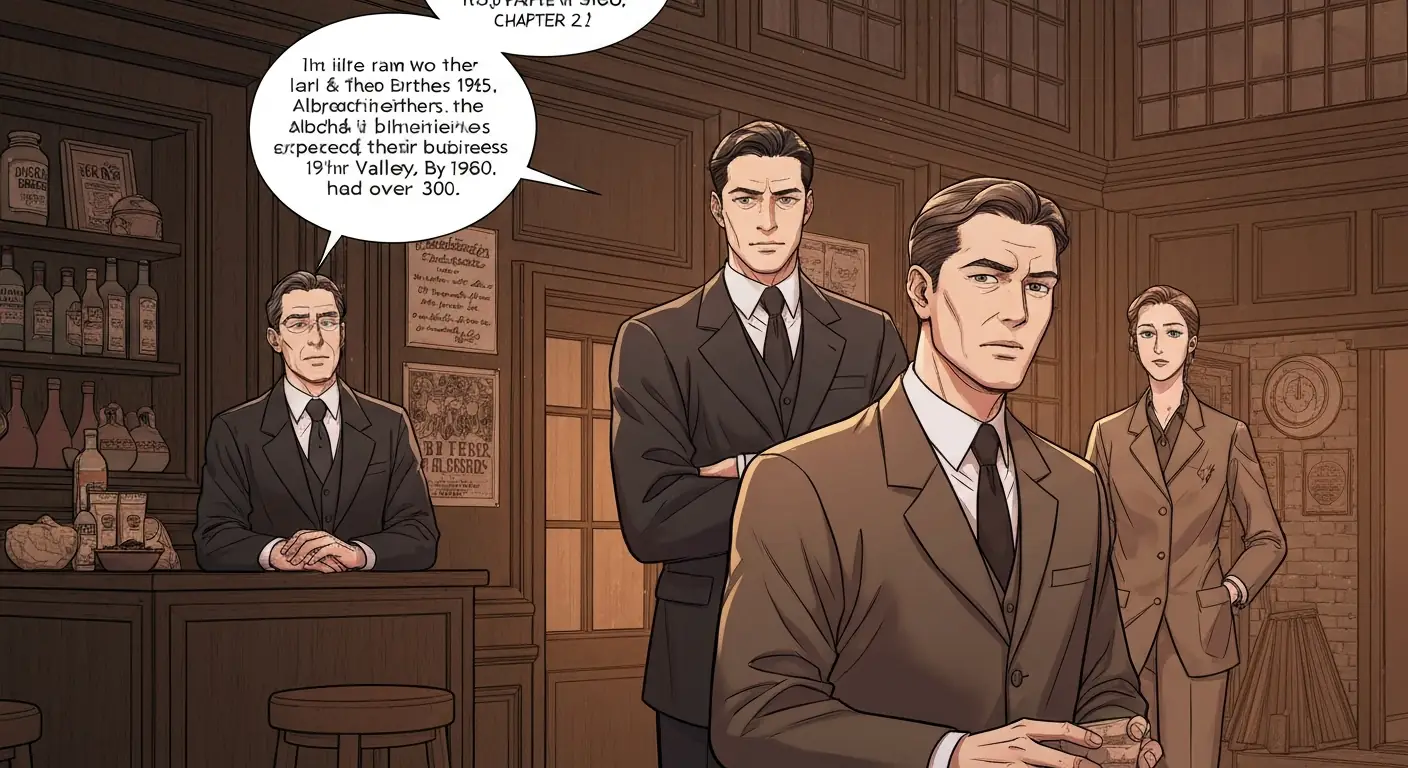
Through the late 1940s and 1950s, the Albrecht brothers expanded their grocery business across the Ruhr Valley. By 1950, they had 13 stores. By 1960, they had over 300.
The expansion was not chaotic. It was systematic, precise, and relentlessly focused on cost reduction. The Albrecht brothers were not entrepreneurs in the typical sense — they were engineers of efficiency. Every aspect of their stores was optimized for one thing: lower prices.
Fewer products. While a conventional German supermarket carried 10,000-15,000 items, an Albrecht store carried fewer than 600. Each item was carefully selected to represent the best-selling product in its category. You couldn’t choose between 30 different tomato sauces. You could choose one — the one the Albrechts had determined offered the best quality at the lowest cost.
No brands. Almost everything in an Albrecht store was a private-label product — manufactured for the store by third-party producers, sold under the store’s own brand name. By eliminating name-brand products, the Albrechts eliminated the brand markup — the premium that consumers paid for a recognizable logo.
No frills. No music. No decorations. No deli counter. No bakery. No service meat department. Products were displayed in their shipping boxes, stacked on simple shelves or pallets. The stores looked like warehouses because, functionally, they were.
Minimal staff. Each store was run by a skeleton crew — typically 3-4 employees for an entire store. Cashiers were extraordinarily fast (Aldi cashiers were famously efficient — they memorized product codes rather than scanning barcodes, at least in the early decades). Stocking was done during business hours by the same staff who ran the registers.
“Every decision at Aldi was filtered through one question: does this reduce cost for the customer? If yes, do it. If no, eliminate it. Decorations? Cost. Music? Cost. Bags? Cost (Aldi charged for bags decades before it became environmentally fashionable). Every unnecessary cent was an insult to the customer.”
The result was prices that were 20-40% lower than conventional supermarkets. Not on some items — on everything. And the quality was not dramatically worse. For many products, Aldi’s private-label items were equivalent to or better than name brands.
Customers noticed. Sales grew. The brothers expanded.
✂️ Chapter 3: The Split

In 1960, Karl and Theo Albrecht had a disagreement.
The subject was cigarettes. Specifically, whether their stores should sell cigarettes.
Theo wanted to sell them. Cigarettes were high-margin, frequently purchased products that drove store traffic. Karl was against — cigarettes attracted shoplifters, complicated inventory management, and were inconsistent with the simplified product selection that was the core of their model.
The disagreement was irresolvable. And so, in 1960, the brothers did something remarkable: they split the company in two.
Aldi Nord (North), run by Theo, took the stores in northern Germany. Aldi Süd (South), run by Karl, took the stores in southern Germany.
The split was amicable — the brothers continued to cooperate on purchasing and strategy. But operationally, the two companies were independent. They developed separately, expanded into different international markets, and eventually became two of the largest grocery retailers in the world.
“The split was the most productive disagreement in retail history. Instead of fighting over cigarettes, the brothers divided the empire and doubled it. Aldi Nord went north and east. Aldi Süd went south and west. Between them, they conquered the world.”
Aldi Süd became the larger and more internationally aggressive of the two. Under Karl’s leadership, it expanded to Australia (1999), the United States (1976), and the United Kingdom (1990). Aldi Nord expanded across northern Europe and entered the United States under the Trader Joe’s brand — yes, Trader Joe’s is owned by Aldi Nord.
The Trader Joe’s connection surprises most Americans. Aldi Nord acquired Trader Joe’s in 1979. The quirky, friendly, Hawaiian-shirt-wearing grocery chain was, underneath the branding, an Aldi concept: limited selection, private-label products, low prices, high quality. Just with better marketing and a more cheerful vibe.
🔫 Chapter 4: The Kidnapping

On November 29, 1971, Theo Albrecht was kidnapped.
Two men — a lawyer named Heinz-Joachim Ollenburg and his accomplice, Paul Kron — abducted Theo as he left the Aldi Nord office in Essen. They held him for 17 days and demanded a ransom of 7 million Deutsche Marks (approximately $2 million at the time).
What happened during those 17 days has become the stuff of German corporate legend.
Theo Albrecht, even as a hostage, could not stop being Theo Albrecht. According to various accounts (the details vary because the Albrechts never discussed it publicly), Theo attempted to negotiate the ransom down. He reportedly argued with his captors about the amount, telling them it was too high and that he would pay less.
Whether this negotiation actually happened or is an embellishment of the Aldi mythology is unclear. What is documented is that the ransom was eventually paid — reportedly by the bishop of Essen, Franz Hengsbach, who served as an intermediary.
Theo was released unharmed on December 16, 1971.
“The kidnapping was the defining trauma of the Albrecht family. It transformed their already extreme privacy into something approaching paranoia. After 1971, the brothers became ghosts — invisible, unreachable, and protected by layers of security that rivaled those of heads of state.”
The ransom payment had a postscript: Theo later attempted to deduct the ransom as a business expense on his tax return. German tax authorities refused. Theo appealed. The case went to the German Federal Finance Court, which ruled in 1973 that ransom payments were not tax-deductible.
Whether this story is evidence of extreme frugality, dark humor, or both, it perfectly captures the Albrecht approach to money: every cost is a cost, and every cost should be minimized. Even the cost of being kidnapped.
🇺🇸 Chapter 5: The American Invasion

Aldi entered the United States in 1976, opening its first store in Iowa.
The timing was strategic. The American grocery market was dominated by large, full-service supermarkets — Kroger, Safeway, A&P — that offered 30,000+ products, deli counters, bakeries, and extensive brand selections. There was no significant discount grocery format in the United States.
Aldi introduced Americans to a concept they’d never seen: a small, no-frills store with 1,500 items, all private label, at prices dramatically lower than any conventional supermarket.
The initial reception was mixed. American consumers were accustomed to choice — 30 different cereals, 20 different pasta sauces, 15 different laundry detergents. Walking into an Aldi and seeing one option for each category was disorienting. Many shoppers found the spartan stores off-putting.
But the prices won converts. When Aldi’s milk was $1 cheaper per gallon, its eggs were 50 cents cheaper per dozen, and its bread was $1 cheaper per loaf, the savings added up quickly. For families on tight budgets — which was a growing segment of the American population — Aldi’s value proposition was irresistible.
“Americans initially resisted Aldi because they associated choice with quality. They believed that a store with 30,000 items must be better than a store with 1,500. Aldi taught them that the opposite could be true — that fewer choices, carefully curated, could deliver better value.”
Aldi expanded slowly and steadily across the American Midwest and East Coast. By 2025, there were over 2,300 Aldi stores in the United States, with plans to reach 3,000. Aldi was the fastest-growing grocery chain in America, gaining market share while traditional supermarkets stagnated.
The “Aldi Effect” became a recognized phenomenon in the grocery industry: whenever Aldi entered a market, competitors were forced to lower their prices, improve their private-label offerings, and rethink their cost structures. Aldi didn’t just compete — it reshaped the competitive landscape.
👻 Chapter 6: The Invisible Empire

Karl Albrecht died on July 16, 2014, at the age of 94. Theo Albrecht had died on July 24, 2010, at the age of 88.
Neither brother gave a single interview in the last four decades of their lives. There are fewer than ten known photographs of either man from after the 1970s. They attended no industry events. They made no public statements. They issued no press releases beyond the legally required minimum.
This level of secrecy was unprecedented for business leaders of their wealth and influence. In an era of TED talks, Twitter threads, and corporate PR machines, the Albrecht brothers operated as if the outside world didn’t exist.
The secrecy was maintained by the Albrecht family foundation structures, which controlled both Aldi Nord and Aldi Süd through a series of trusts and holding companies designed to prevent any single family member from gaining too much control (and to minimize taxes).
“The Albrechts were the anti-Zuckerbergs. In a world where every billionaire had a personal brand, a Twitter account, and a PR team, the Albrechts had nothing. And their nothing was more powerful than anyone else’s everything.”
The family’s combined wealth was estimated at over $40 billion by the mid-2020s, making them one of the richest families in Germany. But unlike the Quandts (BMW), the Reimanns (JAB Holding), or other German industrial dynasties, the Albrechts were genuinely unknown to the public.
This anonymity was, in its own way, a form of power. By revealing nothing, the Albrechts controlled the narrative completely — which is to say, there was no narrative. No scandals. No controversies. No media cycles. Just two ghost billionaires and a grocery empire that kept growing.
🌍 Chapter 7: Aldi in the 2020s

By 2025, the combined Aldi empire (Nord and Süd) operated over 11,000 stores in more than 20 countries. Combined revenue exceeded $130 billion, making Aldi (in aggregate) one of the largest retailers in the world.
The company had evolved from the austere, warehouse-like stores of its early decades into something slightly more polished. Modern Aldi stores had better lighting, cleaner layouts, and a wider selection of fresh produce and organic products. The “Aisle of Shame” — as American shoppers affectionately called the special-buy center aisle, which featured a rotating selection of random products from garden tools to scuba gear — had become a cultural phenomenon.
But the core principles remained unchanged: limited selection, private-label focus, minimal frills, and the lowest possible prices.
Aldi’s private-label products — which accounted for approximately 90% of items sold — had improved dramatically in quality. Blind taste tests regularly showed that Aldi’s store brands matched or exceeded name brands in quality. The stigma of “generic” products had largely disappeared, thanks in part to Aldi’s relentless quality improvements.
“Aldi proved that the traditional grocery model — 30,000 products, dozens of brands per category, endless choice — was not what customers actually wanted. What customers wanted was a good product at a good price, and they didn’t care whose name was on the label.”
🏆 Chapter 8: The Discount Philosophy

The Albrecht brothers didn’t just build a grocery chain. They built a philosophy.
That philosophy — radical simplification in service of the customer — has implications far beyond retail.
The Aldi Playbook:
-
Less is more. By offering fewer products, Aldi made shopping faster, simpler, and cheaper. The reduction in choice was a feature, not a bug. In any business, ask: are we offering complexity that the customer doesn’t want or need?
-
Eliminate what doesn’t add value. Music, decorations, elaborate displays, fancy shopping carts — conventional supermarkets spent millions on features that didn’t reduce prices or improve product quality. Aldi eliminated all of it. Every cost that doesn’t add customer value is a cost that should be removed.
-
Concentrate purchasing power. By carrying one tomato sauce instead of thirty, Aldi could negotiate dramatically better prices from suppliers. The reduction in selection wasn’t just about simplicity — it was about leverage.
-
Private label is a weapon. Aldi’s 90% private-label assortment eliminated the brand markup, gave Aldi control over quality, and made price comparison with competitors difficult (you can’t compare Aldi’s “Fit & Active” granola bar with a Quaker bar on a unit-price basis because they’re different products).
-
Secrecy is strategy. By revealing nothing about their operations, the Albrechts prevented competitors from understanding the Aldi model at a level that would allow replication. Most companies overshare. The Albrechts undershared. And they won.
“Karl and Theo Albrecht took a bombed-out corner store and built a $130 billion empire by asking one question, over and over, for 80 years: what can we eliminate? That question — the question of subtraction rather than addition — is the most powerful question in business.”
Two brothers from the rubble of postwar Germany. Two grocery stores that became 11,000. Two fortunes that exceeded $40 billion. And zero interviews.
The numbers speak for themselves. Which is exactly how the Albrecht brothers would have wanted it.
Aldi (combined Nord and Süd) operates over 11,000 stores in more than 20 countries with combined revenue exceeding $130 billion. Aldi Nord also owns Trader Joe’s in the United States. Both companies remain controlled by Albrecht family foundations. Karl Albrecht died in 2014; Theo Albrecht died in 2010.
🏷️ Chapter 9: The Private Label Revolution (1960s-1980s)
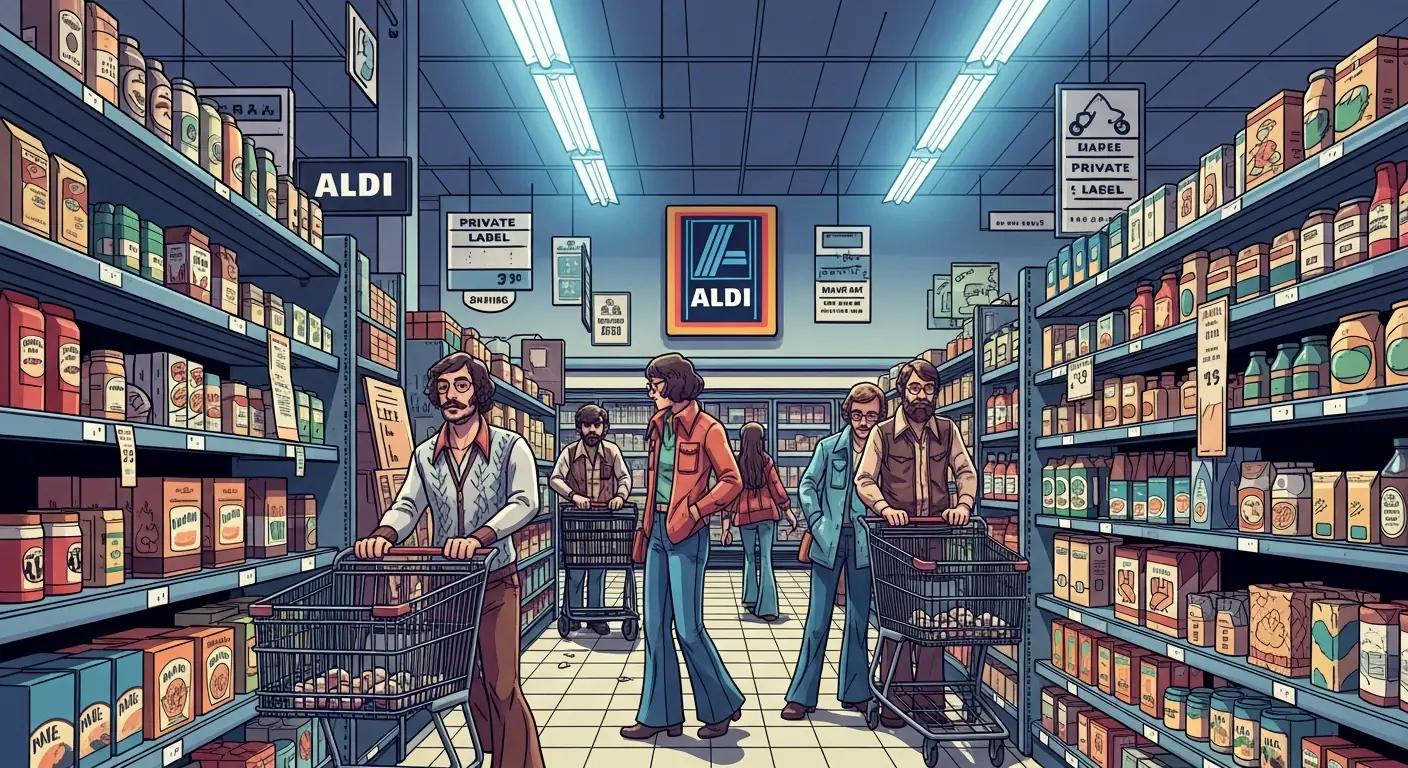
So, the Albrecht brothers were masters of efficiency, right? They cut costs everywhere. But one of their most revolutionary, and frankly, genius moves wasn’t just selling cheap stuff; it was making cheap stuff their own. We’re talking about the unapologetic embrace of private labels, a concept that seems utterly ubiquitous today but was radical, even a bit risky, when Aldi doubled down on it.
From Unknowns to Icons: The Birth of Aldi Brands
Think about it: in the 1960s and 70s, store brands were often seen as the cheap, inferior alternative to “real” brands. They were the dusty cans on the bottom shelf, bought only by the truly desperate or incredibly frugal. But Karl and Theo Albrecht saw an opportunity. They didn’t just want to sell other people’s discounted goods; they wanted to control the entire supply chain, from producer to shelf. This meant creating their own brands, which they could price precisely as they wished, without the burden of marketing costs, national advertising, or retailer markups demanded by big-name manufacturers.
By the mid-1960s, Aldi stores were already heavily leaning into private labels. Instead of offering Nestlé coffee, they’d offer “Markus Kaffee” (named after Theo’s son, perhaps?). Instead of Coca-Cola, it was their own cola. These weren’t just generic products; they were Aldi’s brands, developed in collaboration with suppliers who often produced the very same goods for the national brands, just with different packaging and, crucially, a vastly different price tag. This wasn’t about deception; it was about stripping away the fluff. Why pay for a celebrity endorsement and a flashy TV ad when all you want is a decent cup of coffee? The Albrechts understood that for many consumers, especially in post-war Germany, value trumped vanity.
Supplier Squeeze & Quality Control
Now, let’s be clear, this wasn’t all sunshine and daisies for their suppliers. The Albrecht brothers were notoriously tough negotiators. They demanded rock-bottom prices, massive volumes, and ironclad quality. If a supplier couldn’t meet their stringent cost targets, Aldi simply found another who could. This “supplier squeeze” was legendary, but it also fostered incredibly efficient manufacturing processes among those who did work with Aldi. Becoming an Aldi supplier meant guaranteed massive orders, but it also meant operating on razor-thin margins and absolute adherence to specifications.
Despite the low prices, the Albrechts were surprisingly fastidious about quality. They weren’t selling junk; they were selling functional, reliable products. They developed rigorous internal testing protocols, often blind-testing their private labels against leading national brands. The story goes that if an Aldi product didn’t meet or exceed the quality of its branded counterpart in internal tests, it simply wouldn’t make it to the shelves. This commitment helped overcome the initial consumer skepticism about store brands.
“Aldi didn’t just sell private labels, they legitimized them. They showed that you could offer quality without the brand tax. It was a masterclass in challenging consumer perception and supply chain power dynamics.” – Retail analyst, circa 1990.
By focusing on a limited assortment of high-quality private labels, Aldi didn’t just save money; they built trust. Customers learned that if it was on an Aldi shelf, it was likely good enough, and definitely cheaper. This strategy was a cornerstone of their growth and would eventually force much larger, more established retailers to re-evaluate their own brand strategies. Suddenly, having your own store brand wasn’t a sign of weakness; it was a sign of smart business.
💥 Chapter 10: The “Aldi Effect” and Retail Shake-Up (1970s-2000s)
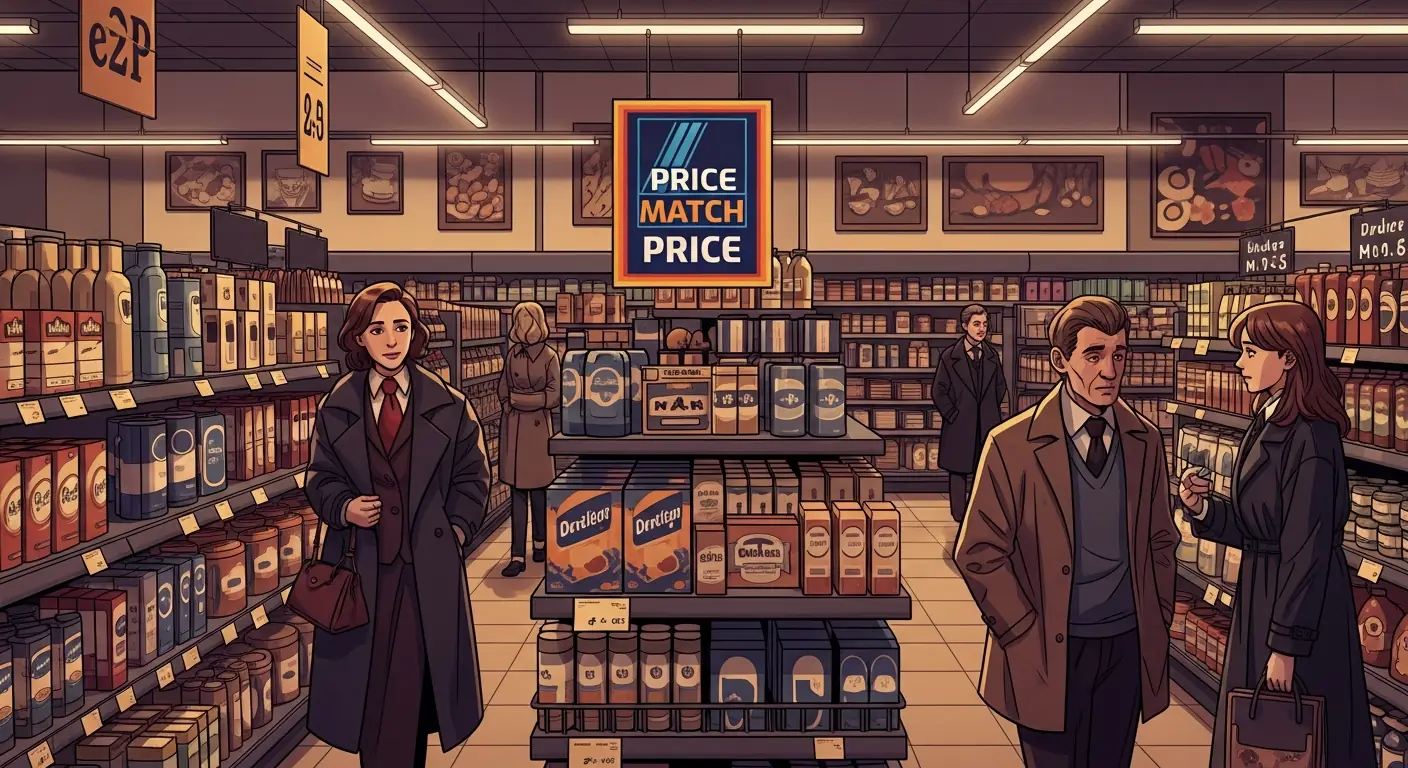
Imagine you’re a big, established supermarket chain in the 1970s. You’ve got wide aisles, thousands of products, fancy displays, and maybe even a butcher counter. You’re feeling pretty good about yourself. Then these scruffy, no-frills Aldi stores start popping up, selling only a few hundred items out of boxes, and undercutting your prices by a mile. At first, you probably scoffed. “Who would shop there?” you’d think, sipping your morning coffee from a branded mug. Oh, how wrong you’d be. The Albrechts weren’t just building a grocery chain; they were unleashing a retail earthquake – the “Aldi Effect.”
The Price War Inferno
The “Aldi Effect” wasn’t just a cute phrase; it was a brutal reality for conventional retailers. As Aldi expanded its footprint across Germany and then internationally – into the Netherlands, Belgium, and famously the US in 1976 – they forced an uncomfortable reckoning. Their relentless focus on price meant that if you were a competitor selling a similar product, you either matched their price or watched your customers walk out the door. This wasn’t just about a few cents; it was often a 15-20% price differential, sometimes even more.
This created a vicious price war, especially in their home market. Established players like Rewe, Edeka, and even department store food sections found themselves bleeding market share and profits. Some tried to ignore Aldi, dismissing them as a “poor man’s store.” Others launched their own discount formats, often half-heartedly. But few truly grasped the depth of Aldi’s operational efficiency. The discounters weren’t just cheap; they were lean, mean, fighting machines. The pressure was so intense that many smaller, independent grocers simply couldn’t compete and went out of business. It was a Darwinian struggle for retail survival.
From “Poor Man’s Store” to Smart Shopping
Perhaps the most profound impact of the Aldi Effect was the shift in consumer perception. Initially, shopping at a discounter might have carried a certain stigma. But as inflation bit and economic pressures mounted, especially during the oil crises of the 1970s and subsequent recessions, frugality became less about necessity and more about smart decision-making. Aldi, and later its imitators, normalized discount shopping. Suddenly, clipping coupons and chasing sales at multiple stores seemed like more effort than it was worth. Why bother when Aldi offered consistently low prices every day?
“Aldi didn’t just change how people shopped; they changed how people thought about shopping. They made it acceptable, even smart, to buy generic. They democratized value.” – Business historian, looking back at the 1980s.
This cultural shift was massive. It wasn’t just low-income families flocking to Aldi; middle-class and even affluent shoppers, keen to save money on staples, started filling their trolleys there. The perceived “sacrifice” of foregoing branded goods for Aldi’s private labels began to evaporate as the quality proved consistently good. This widespread acceptance proved that consumers, given the choice, would prioritize tangible savings over abstract brand loyalty, especially for everyday items.
Reshaping the Supply Chain
Beyond just price, the Aldi Effect forced traditional retailers to radically rethink their own supply chains and operational models. They had to learn from the enemy. This meant reducing product assortments, negotiating harder with suppliers, streamlining logistics, and cutting back on unnecessary store frills. The rise of “category killers” and efficient big-box stores like Walmart in the US (which, in a way, applied similar principles on a grander scale) can be seen as a direct response to the discounter challenge. Aldi proved that you could achieve profitability with lower margins, but only if your operational costs were absolutely microscopic. They didn’t just disrupt retail; they gave it a masterclass in efficiency, whether the incumbents wanted it or not.
👑 Chapter 11: The Heirs and the Hidden Fortunes (1990s-Present)

So, the Albrecht brothers built an empire worth tens of billions, but they hated the spotlight more than a vampire hates sunshine. This presented a rather unique challenge: how do you pass on one of the world’s largest retail fortunes and maintain strict control without ever really showing your face? The answer, as it turns out, involved a brilliant, if utterly opaque, system of family foundations designed to safeguard their wealth, perpetuate their business philosophy, and keep the pesky public firmly at arm’s length.
The Foundations: A Fortress of Fortune
Long before their respective deaths, Karl and Theo Albrecht meticulously planned their succession, not through public share offerings or corporate boards, but through complex, interlocking family foundations. For Aldi Nord, Theo Albrecht established the Markus Foundation and the Lukas Foundation in 1973. For Aldi Süd, Karl Albrecht set up the Siepmann Foundation in 1971. These aren’t your typical charitable foundations; they are the legal owners of the vast majority of the Aldi empire. Their primary purpose is to ensure the continued existence and success of the Aldi businesses and to provide for the Albrecht families.
This structure is a masterpiece of control and privacy. The foundations are managed by boards, often comprising family members and trusted long-time executives. They dictate the strategic direction of the Aldi Nord and Aldi Süd groups, effectively ensuring that the founding brothers’ principles – frugality, secrecy, long-term thinking – remain paramount. Dividends from the massively profitable Aldi operations flow into these foundations, which in turn use a portion to support the Albrecht heirs. This means the family benefits immensely from the wealth without having direct, individual ownership stakes that would require public disclosure. It’s a financial moat around a very private castle.
Passing the Torch (Reluctantly)
The transition of power from Karl and Theo to the next generation was, predictably, as quiet as a church mouse wearing felt slippers. Theo passed away in 2010 at the age of 88, and Karl followed in 2014 at 94. While their sons, Theo Jr. (Aldi Nord) and Karl Jr. (Aldi Süd), were involved in the business for decades, they largely maintained their fathers’ reclusive habits. Theo Jr. even famously resigned from active management in 2004 due to health issues, remaining involved only through the foundation boards. Karl Jr., despite his immense wealth, was known for his extreme frugality, reportedly driving a modest car and living in a relatively normal house.
This hands-off approach from the direct heirs in day-to-day operations, while still maintaining ultimate control through the foundations, is fascinating. It suggests a desire not just to protect the wealth but to protect the culture of the business. The foundations are tasked with appointing managers who embody the Aldi spirit, rather than relying solely on blood relatives who might lack the necessary drive or vision. This system is designed to be self-perpetuating, ensuring that the Albrechts’ vision outlives the Albrechts themselves.
Keeping the Billions Buried
The sheer scale of the Albrecht family’s wealth is staggering. At the time of his death, Karl Albrecht was estimated by Forbes to be the richest person in Germany, with a net worth of around $26 billion. Theo’s family was also in the multi-billion-dollar range. Yet, they lived lives of almost monastic simplicity, utterly detached from the ostentatious displays of wealth common among other billionaires. Their homes were unpretentious, their cars modest, and their public appearances virtually non-existent.
The foundation structure allows this extraordinary wealth to remain largely “buried” from public scrutiny, managed by a select few, and used to further the business rather than fuel lavish lifestyles. It’s a powerful testament to their belief that true power and influence come from quiet, sustained control, not from flashy headlines or socialite gatherings. The Albrechts mastered the art of being incredibly rich and incredibly anonymous simultaneously, a feat almost unheard of in the modern age.
⚔️ Chapter 12: The German Discount Wars: Aldi vs. Lidl (1970s-2000s)
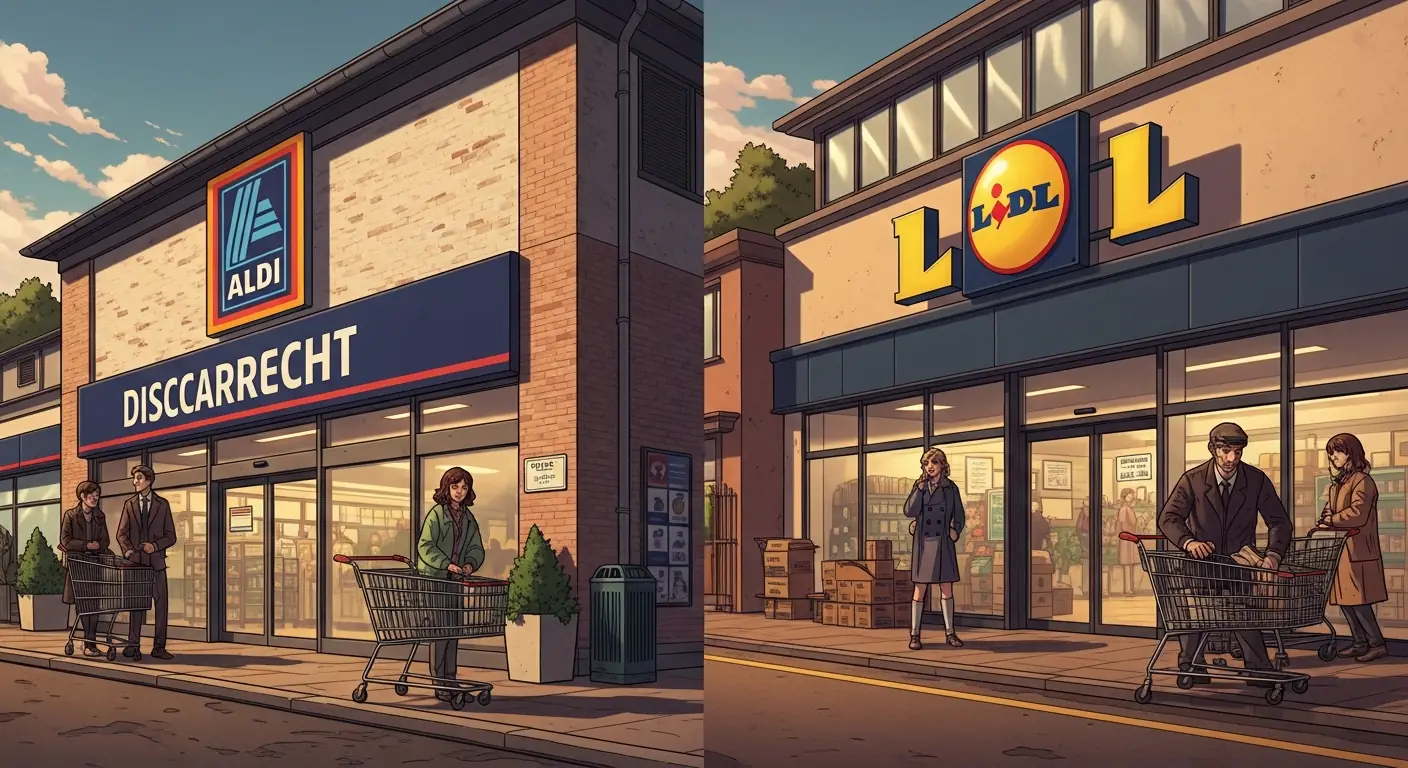
You can’t talk about Aldi without eventually talking about Lidl. It’s like talking about Coke without mentioning Pepsi, or the Beatles without the Stones. While Aldi pioneered the discount model, it wasn’t long before others caught on. And none caught on quite as successfully, or as aggressively, as Lidl, part of the powerful Schwarz Group. The rivalry between these two German discount giants wasn’t just a competition; it was a multi-decade, globe-spanning war for market share, often fought with razor-sharp prices and surprisingly similar tactics.
The Copycat Challenge
Lidl’s story began in the 1930s, but it was under the leadership of Dieter Schwarz, son of the founder Josef Schwarz, that it truly transformed into Aldi’s fiercest rival. In the early 1970s, just as the Albrecht brothers were solidifying their dual Aldi Nord/Süd empires, Schwarz studied the Aldi model and decided to replicate it, but with a twist. Lidl adopted many of Aldi’s core principles: limited assortment, private labels, no-frills stores, and aggressive pricing. But they also made some key differentiators.
Initially, Lidl’s stores were often slightly larger than Aldi’s, carrying a slightly wider range of products, including more branded goods alongside their own private labels. They also embraced fresh produce and baked goods earlier and more aggressively than Aldi, which initially stuck to a very dry-goods-heavy model. This slight divergence allowed Lidl to appeal to a segment of the market that wanted Aldi’s prices but perhaps a touch more variety or a perception of freshness. It was a clever way to enter the market without being a direct clone, yet still riding the wave of discount enthusiasm that Aldi had created.
Strategic Skirmishes and Global Expansion
The competition between Aldi and Lidl wasn’t confined to Germany; it went global. As Aldi Süd expanded into the US in 1976, and Aldi Nord into other European markets, Lidl followed suit, often entering markets just a few years later. They became each other’s shadows, pushing into the UK, Spain, France, and eventually making a huge splash in the US market in the late 2010s, directly challenging Aldi’s long-established presence there.
This meant a constant game of one-upmanship. If Aldi introduced a new special buy, Lidl would quickly counter. If Aldi upgraded its store aesthetics, Lidl would soon follow. This dynamic forced both companies to continually innovate and refine their models, benefiting consumers in the process. For example, the “middle aisle” phenomenon – where both stores offer an ever-changing array of non-food items like power tools, garden furniture, or camping gear – became a signature competitive battleground. These aren’t just random items; they are meticulously sourced, high-margin goods designed to drive foot traffic and impulse buys. It’s a subtle nod to their entrepreneurial spirit, even amidst their massive scale.
“The rivalry between Aldi and Lidl is one of the most compelling business stories of the last 50 years. They are two titans who perfected the same game, forcing each other to be sharper, leaner, and more innovative, creating a retail arms race that redefined grocery shopping.” – Retail analyst, reflecting on the discounter phenomenon.
The Customer as the Ultimate Winner
While the Albrecht and Schwarz families certainly weren’t sending each other Christmas cards, their intense rivalry ultimately benefited millions of consumers worldwide. Their constant battle to offer the lowest prices and best value forced traditional supermarkets to adapt or die, leading to a general downward pressure on grocery prices across the board. They democratized high-quality, affordable food, making it accessible to a wider demographic.
In Germany, the combined market share of Aldi and Lidl is formidable, consistently dominating the discount sector. Globally, they continue to expand, each with their own loyal customer base, but always keeping a watchful eye on the other. It’s a testament to the power of competition that two companies, built on such similar principles, could both achieve such staggering success, largely by simply trying to out-discount the other. And for us, the shoppers, that’s a win-win.
👻 Chapter 13: The Final Curtain: Legacies of Secrecy (2010s-Present)

The Albrecht brothers built an empire on the principle of invisibility. They shunned publicity, avoided interviews, and cultivated an almost mythical reclusiveness. So, it was perhaps fitting, though no less remarkable, that their final acts – their deaths – were handled with the same unwavering commitment to privacy. When Karl and Theo Albrecht finally exited the world stage, they did so with the same quiet dignity and anonymity that characterized their entire lives, leaving behind a legacy that is both profoundly impactful and deeply, almost frustratingly, private.
Exit Stage Left: The Quiet Departures
Theo Albrecht, the younger of the two and the one who endured the infamous kidnapping, passed away on July 28, 2010, at the age of 88. His death was announced with a brief, understated press release, followed by an equally low-key funeral. There were no public memorials, no grand tributes from world leaders, just a quiet acknowledgment of his passing. For a man who, at one point, was among the wealthiest individuals on the planet, his departure was almost imperceptible to the wider world.
Four years later, his elder brother, Karl Albrecht, followed suit, dying on July 21, 2014, at the advanced age of 94. Again, the news was handled with a characteristic lack of fanfare. Obituaries appeared in major publications, often piecing together the scant details of his life from decades-old accounts, highlighting his extreme wealth and equally extreme reclusiveness. There were no public statements from the family, no eulogies broadcast, just the quiet end of an era. These were men who built a global retail powerhouse, yet remained virtually unknown beyond their closest circle. It was a final, emphatic statement about their values.
The Price of Privacy
One might wonder why such powerful, wealthy individuals would go to such extraordinary lengths to avoid the spotlight. Was it simply a matter of personal preference? Or was there a deeper, more strategic reason? The kidnapping of Theo in 1971 certainly cemented their resolve to remain anonymous, turning their natural shyness into an absolute ironclad rule. They understood that visibility attracts attention, and attention, for them, meant risk.
Their reclusiveness wasn’t just about avoiding paparazzi; it was about maintaining control. By remaining anonymous, they could make tough business decisions without public outcry, manage their vast fortunes away from prying eyes, and ensure that the focus remained squarely on the business, not on the personalities behind it. This allowed Aldi to operate with a single-minded focus on its core mission, unburdened by the distractions and demands often placed on publicly visible corporate leaders. The price of this privacy was, for them, well worth it, even if it meant sacrificing any personal recognition for their incredible achievements.
“The Albrechts were the ultimate paradox: global business titans who were allergic to fame. Their reclusiveness wasn’t a quirk; it was a fundamental pillar of their corporate strategy and a testament to their unique worldview.” – Journalist reflecting on the brothers’ lives.
A Blueprint for Business Anonymity
The legacy of Karl and Theo Albrecht extends far beyond the discount aisles of Aldi. They left behind a blueprint for how to build and maintain an incredibly successful, multi-billion-dollar global enterprise while remaining almost entirely anonymous. In an age of celebrity CEOs and constant social media scrutiny, their story stands as a powerful counter-narrative. They proved that you don’t need a personal brand to build an iconic one. You don’t need to be on magazine covers to be incredibly influential.
Their commitment to secrecy continues through their family foundations and the current leadership of Aldi Nord and Aldi Süd. The companies remain privately held, fiercely independent, and largely run by executives who uphold the founders’ principles. The Albrecht brothers’ lives were a testament to the power of focus, frugality, and, above all, the quiet, unwavering pursuit of a vision. They built an invisible empire, and then they vanished, leaving behind a world forever changed by their discount revolution, but still wondering about the men who started it all.
💡 Key Insights
- ▸ Aldi's radical simplification — offering 1,500 items instead of 30,000, using store-brand products instead of name brands, and eliminating all frills — was not just cost-cutting. It was a complete rethinking of what a grocery store should be. By offering fewer choices, Aldi reduced decision fatigue for customers, simplified inventory management, and concentrated purchasing power on each item. The result: lower prices, faster shopping, and higher sales per square foot than conventional supermarkets.
- ▸ The Albrecht brothers' obsessive secrecy — no interviews, no public appearances, no corporate communications beyond the minimum — was both personal preference and competitive strategy. By revealing nothing about their operations, supply chain, or margins, they prevented competitors from understanding or replicating the Aldi model. Information asymmetry was a deliberate competitive weapon.