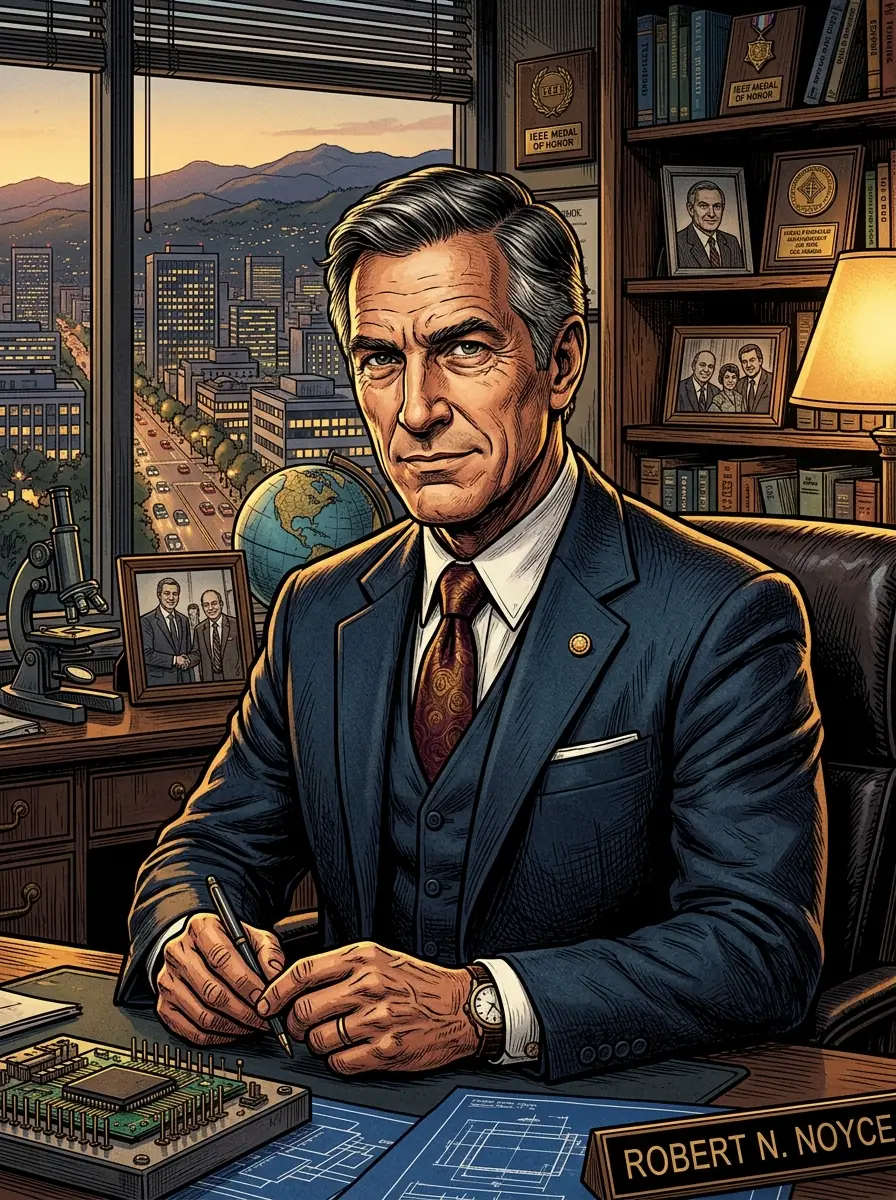
Robert Noyce: The Mayor of Silicon Valley Who Invented the Future
Before Steve Jobs, before Bill Gates, before anyone you've ever heard of — there was Bob Noyce. He co-invented the integrated circuit, co-founded Intel, and created the culture of Silicon Valley itself. Then he died at 62, and the man who made everything possible became the one everyone forgot.
View all stories about this mogul
🌾 Chapter 1: The Preacher’s Son
Robert Norton Noyce was born on December 12, 1927, in Burlington, Iowa. His father was a Congregational minister. His mother was the daughter of a minister. Religious service, intellectual curiosity, and midwestern decency were the family business.
Burlington, Iowa was small-town America in its most concentrated form. Population 25,000. Summers were hot. Winters were cold. Entertainment was church socials, high school football, and whatever mischief you could make on the banks of the Mississippi River.
Bob Noyce was, by all accounts, the golden boy. Smart, athletic, handsome, charming — he was the kid who was effortlessly good at everything. He sang in the choir. He played sports. He built things in the garage. He won science fairs. He was the kind of kid who made other kids’ parents sigh with envy.
“Bob Noyce was the most naturally gifted person I ever met. Not just intellectually — he had this quality of making everyone around him feel like they were part of something exciting. He could walk into a room and the energy would shift.” — Gordon Moore, co-founder of Intel
He attended Grinnell College in Iowa, where two things happened that would shape the rest of his life. First, he was introduced to transistors by his physics professor, Grant Gale, who had obtained some of the first transistors ever produced by Bell Labs. Noyce was electrified (literally and figuratively) by the possibilities.
Second, he nearly got expelled. Noyce and a friend stole a pig from a local farm for a luau. In 1940s Iowa, stealing livestock was a serious offense. Grinnell’s administration wanted to expel him. Professor Gale intervened, arguing that losing Noyce would be a greater loss to science than a pig was to a farmer.
Noyce was suspended for a semester. He graduated in 1949, went to MIT for his PhD in physics, and headed west.
💡 Chapter 2: The Traitorous Eight
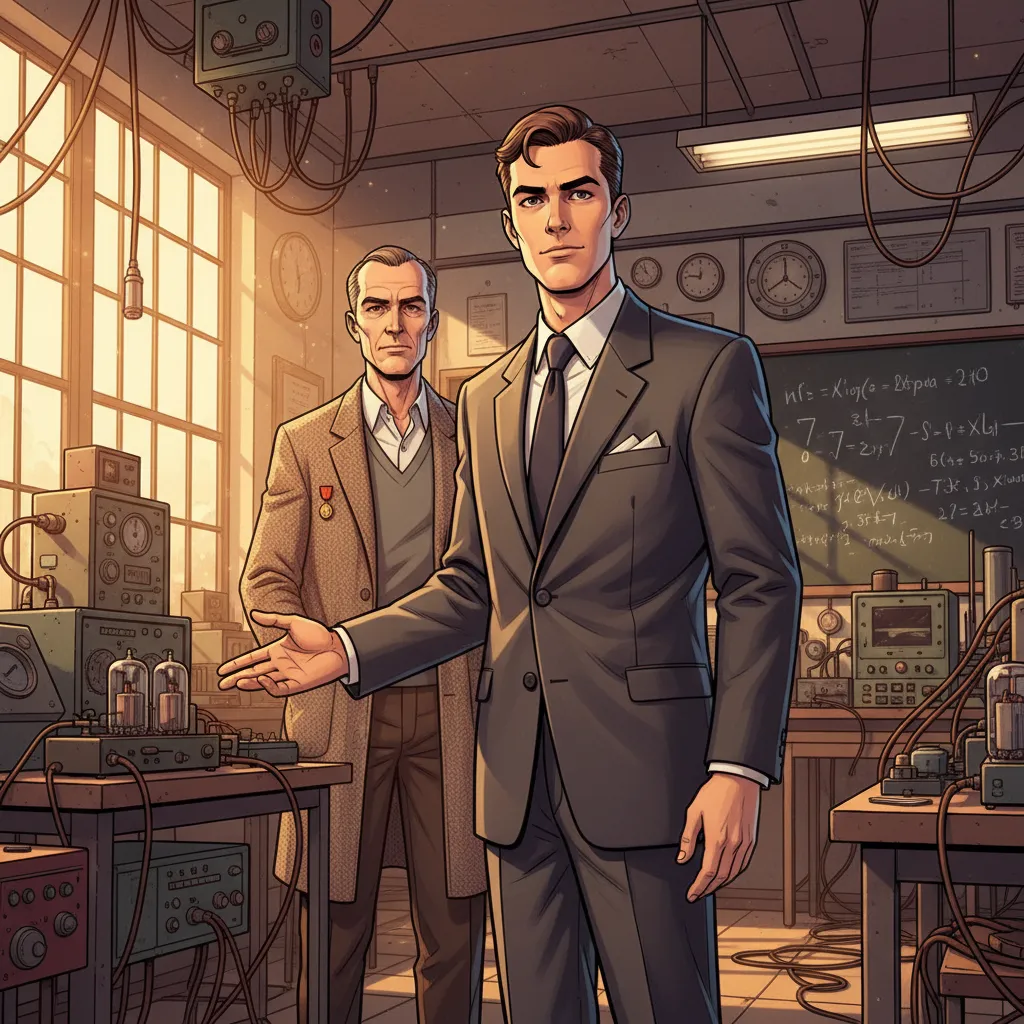
In 1956, Bob Noyce joined Shockley Semiconductor Laboratory in Mountain View, California. William Shockley — co-inventor of the transistor and Nobel Prize winner — had started the lab to commercialize transistor technology.
On paper, it was a dream job. In practice, it was a nightmare. Shockley was brilliant but pathological. He was paranoid, micromanaging, and abusive. He ordered lie detector tests for his employees. He publicly humiliated researchers who disagreed with him. He made technical decisions based on ego rather than evidence.
Within a year, eight of Shockley’s best engineers — including Noyce — had had enough. In September 1957, they resigned en masse to form their own company: Fairchild Semiconductor.
Shockley called them “the traitorous eight.” The name stuck, but its connotation flipped: in Silicon Valley mythology, the Traitorous Eight are heroes — the founding fathers who established the principle that talent could leave and start something new.
“The Traitorous Eight didn’t just start a company. They started a culture. Before 1957, leaving your employer to start a competitor was seen as betrayal. After the Eight, it was seen as ambition. They gave permission to an entire generation of entrepreneurs to quit their jobs and build the future.”
Noyce emerged as the leader of the group — not because he was the best engineer (several others were his technical equals) but because he was the best leader. He had the charisma, the vision, and the ability to inspire people. He was, as Tom Wolfe would later write, “the natural minister’s son — the man everyone wanted to follow.”
Fairchild Semiconductor was funded by Fairchild Camera and Instrument Corporation, which provided $1.5 million in exchange for the right to buy the startup. The deal was arranged by Arthur Rock — who would later become the first great Silicon Valley venture capitalist.
The Traitorous Eight went to work. And what they built at Fairchild would change the world.
🔬 Chapter 3: The Chip
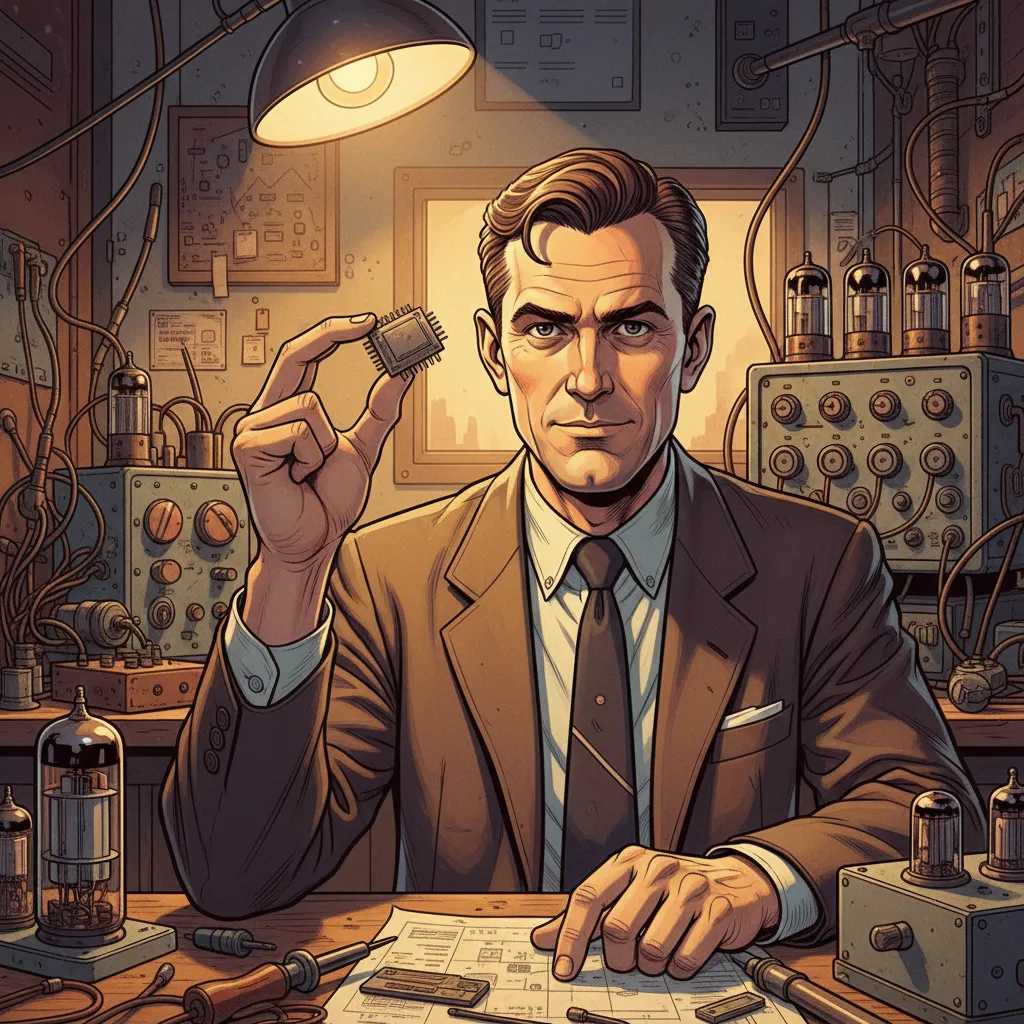
In 1959, Robert Noyce invented the integrated circuit.
Or rather, he co-invented it. Jack Kilby at Texas Instruments had built a working integrated circuit a few months earlier, in 1958. But Kilby’s version used germanium and had external wire connections that made it impractical for manufacturing. Noyce’s version used silicon and a planar manufacturing process that could be mass-produced.
Noyce’s integrated circuit — the monolithic IC, built on a single silicon chip with all components and connections integrated into the chip itself — was the version that became the standard. It was the foundation of the microelectronics industry. It was the invention that made modern computing possible.
An integrated circuit combines multiple electronic components — transistors, resistors, capacitors — onto a single chip of silicon. Before the IC, electronic circuits required individual components to be wired together by hand. A computer might contain thousands of individual transistors, each soldered into place. The IC put all those components on a single chip the size of a fingernail.
The implications were staggering. Circuits could be smaller, faster, cheaper, and more reliable. Computers could shrink from room-sized to desk-sized to pocket-sized. The entire trajectory of the information age — from mainframes to PCs to smartphones — was made possible by the integrated circuit.
“Noyce didn’t just invent a chip. He invented the future. Every computer, every phone, every car, every appliance, every medical device, every satellite, every weapon system — everything electronic in the modern world — runs on integrated circuits descended from what Noyce built at Fairchild in 1959.”
The patent dispute between Noyce and Kilby was eventually settled — both men are credited as co-inventors. Kilby received the Nobel Prize in Physics in 2000 (Noyce had died in 1990 and Nobel Prizes are not awarded posthumously).
But in the semiconductor industry, it was Noyce’s planar process that became the standard. Fairchild Semiconductor became one of the most important companies in the history of technology, and the integrated circuit became the building block of modern civilization.
🏗️ Chapter 4: The Fairchild Tree
Fairchild Semiconductor was a spectacular success — and a spectacular talent incubator.
The company generated enormous revenue from its integrated circuit and transistor products. But more importantly, it generated founders. Over the next two decades, engineers who had worked at Fairchild would leave to start dozens of semiconductor and technology companies. The phenomenon became known as the “Fairchild Tree” or the “Fairchildren.”
Companies spawned directly or indirectly from Fairchild include:
- Intel (co-founded by Noyce and Gordon Moore)
- AMD (founded by Jerry Sanders, a Fairchild executive)
- National Semiconductor
- LSI Logic
- Signetics
- Amelco
- And dozens more
The Fairchild diaspora created the critical mass of semiconductor companies, venture capital, and engineering talent that made Silicon Valley what it is. Before Fairchild, the Santa Clara Valley was orchards and small towns. After Fairchild, it was the center of the global technology industry.
“Fairchild was the Big Bang of Silicon Valley. Almost everything that followed — Intel, AMD, the entire semiconductor industry, the venture capital ecosystem, the startup culture — can trace its origins back to Fairchild. And Fairchild can trace its origins back to eight engineers who had the audacity to quit.”
But Fairchild had a structural problem: it was owned by Fairchild Camera, an East Coast conglomerate that didn’t understand or appreciate the semiconductor business. Profits from Fairchild Semiconductor were siphoned to the parent company. The engineers who had built the business received minimal financial reward. The culture of innovation was being crushed by corporate bureaucracy.
By the late 1960s, Noyce and Gordon Moore had seen enough. It was time to leave again.
🏢 Chapter 5: Intel
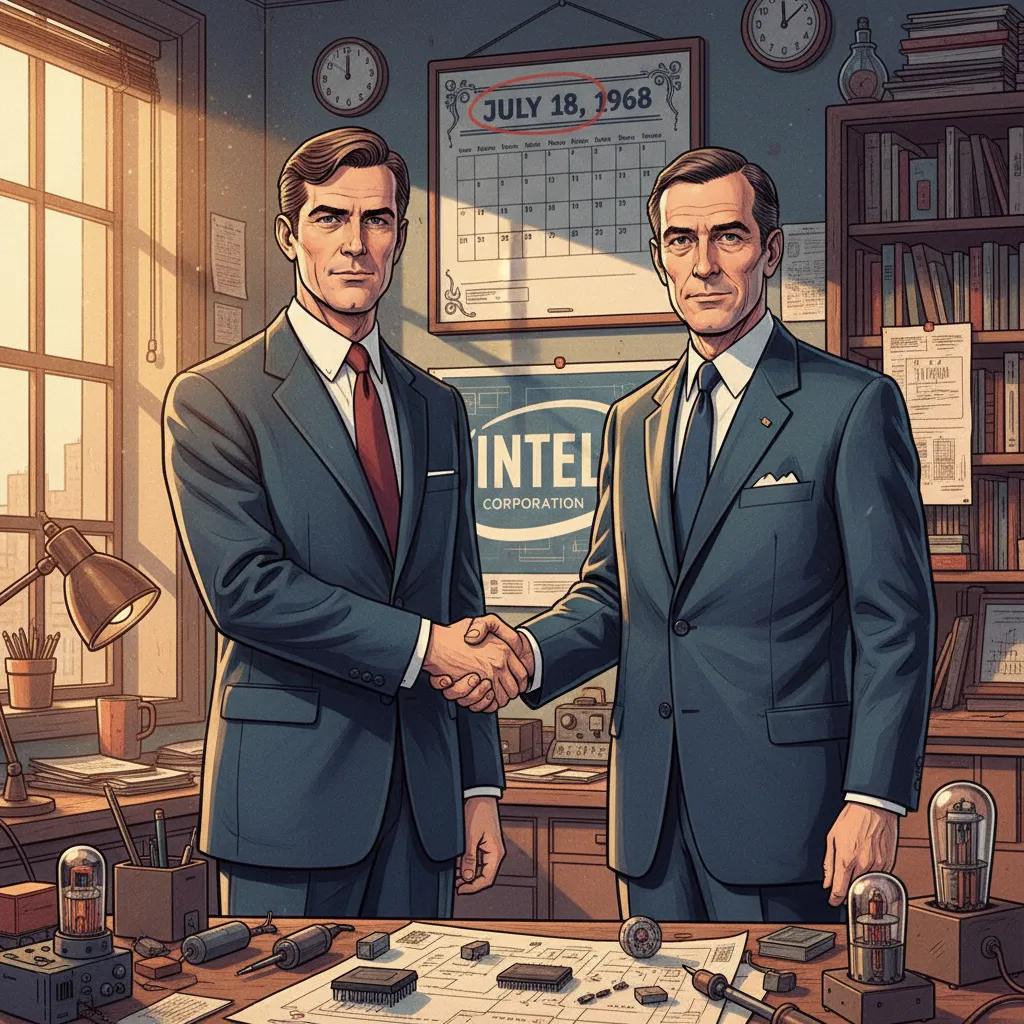
On July 18, 1968, Robert Noyce and Gordon Moore founded Intel Corporation.
The name was a portmanteau of “integrated electronics.” Arthur Rock raised the initial funding — $2.5 million — with a single phone call. Noyce and Moore’s reputations were so strong that investors committed without a business plan.
Intel’s founding mission was to develop semiconductor memory — replacing the magnetic core memory used in computers with silicon chips. The first product, the 1101 — a 256-bit static RAM chip — was modest by modern standards but revolutionary for its time.
But Intel’s true breakthrough came in 1971, when an engineer named Ted Hoff designed the Intel 4004 — the world’s first commercial microprocessor. A microprocessor was an entire central processing unit (CPU) on a single chip — a computer’s brain, miniaturized to the size of a fingernail.
The 4004 was designed for a Japanese calculator company, but its implications went far beyond calculators. A programmable processor on a chip meant that you could build a general-purpose computer around a single, inexpensive component. The microprocessor was the enabling technology for the personal computer revolution that would follow in the next decade.
Intel followed the 4004 with the 8008, the 8080, the 8086, and eventually the 80386 — the processor family that would power IBM PCs and their clones, establishing Intel’s dominance in personal computer processors that would last for decades.
“Intel created the microprocessor — the chip that made personal computers possible. And personal computers made the internet possible. And the internet made the modern world possible. The chain of causation runs directly from Bob Noyce’s office in Santa Clara to every connected device on Earth.”
🤝 Chapter 6: The Culture Creator
Robert Noyce’s contribution to Silicon Valley wasn’t just technological. It was cultural.
At Fairchild and then at Intel, Noyce established a management style that broke every rule of American corporate culture:
No hierarchy. Noyce rejected the East Coast corporate model of rigid hierarchies, reserved parking spaces, corner offices, and executive dining rooms. At Intel, everyone sat in cubicles. There were no reserved parking spaces. The CEO ate in the same cafeteria as the janitor.
Stock options for everyone. Noyce pioneered the practice of granting stock options to employees at all levels — not just executives. This meant that a secretary or a lab technician could share in the company’s success. The practice aligned employee interests with company performance and created the wealth-generation machine that would define Silicon Valley.
Casual dress. At a time when IBM executives wore dark suits and white shirts as a uniform, Noyce showed up in a sport shirt and khakis. The message: we judge you on your work, not your wardrobe.
Meritocracy. At Noyce’s companies, ideas won on their merits, not on the seniority of the person proposing them. A junior engineer with a great idea could challenge a senior executive. This created an environment of intellectual honesty that attracted the best talent.
“Noyce didn’t just build companies. He built a culture. The flat hierarchy, the stock options, the casual dress, the meritocratic ethos — this is the Silicon Valley operating system. And Noyce wrote it.”
Tom Wolfe, in his famous 1983 Esquire profile, called Noyce “the Mayor of Silicon Valley” — not because he held an elected office, but because he was the person everyone looked to for leadership, wisdom, and example.
Noyce was the model of the Silicon Valley CEO before the archetype existed: technically brilliant, charismatic, accessible, democratic in temperament, and evangelical about the transformative potential of technology.
Every startup founder who has worn a hoodie to a board meeting, every company that has offered stock options to interns, every office that has replaced corner offices with open plans — all of them are, consciously or not, following the template that Bob Noyce established.
💔 Chapter 7: The Personal Cost

Noyce’s professional life was a rocket ship. His personal life was more turbulent.
His first marriage, to Elizabeth Bottome, produced four children but ended in divorce in 1974. Friends attributed the split to Noyce’s total immersion in work — he was building Intel during its most critical growth years, and the demands of running a rapidly growing semiconductor company left little room for family life.
He married Ann Bowers — Intel’s first director of human resources — in 1974. The second marriage was happier, but Noyce’s intensity and his commitments outside the home remained consuming.
Noyce was a risk-taker in his personal life as well as his professional one. He was an amateur pilot, a scuba diver, a skier, and a hang glider. He seemed to seek the same adrenaline in his leisure that he found in building companies.
“Bob ran at full speed in every direction simultaneously. He built companies, invented technology, flew planes, dived into oceans, and tried to be a father and husband. Something had to give. Usually it was the personal relationships.”
In his final years, Noyce became increasingly involved in public policy — particularly in advocating for the American semiconductor industry’s competitiveness against Japan’s growing dominance in chip manufacturing. He helped found Sematech, a consortium of American semiconductor companies that cooperated on manufacturing technology research.
On June 3, 1990, Robert Noyce died of a heart attack at his home in Austin, Texas. He was 62 years old.
🏆 Chapter 8: The Forgotten Father
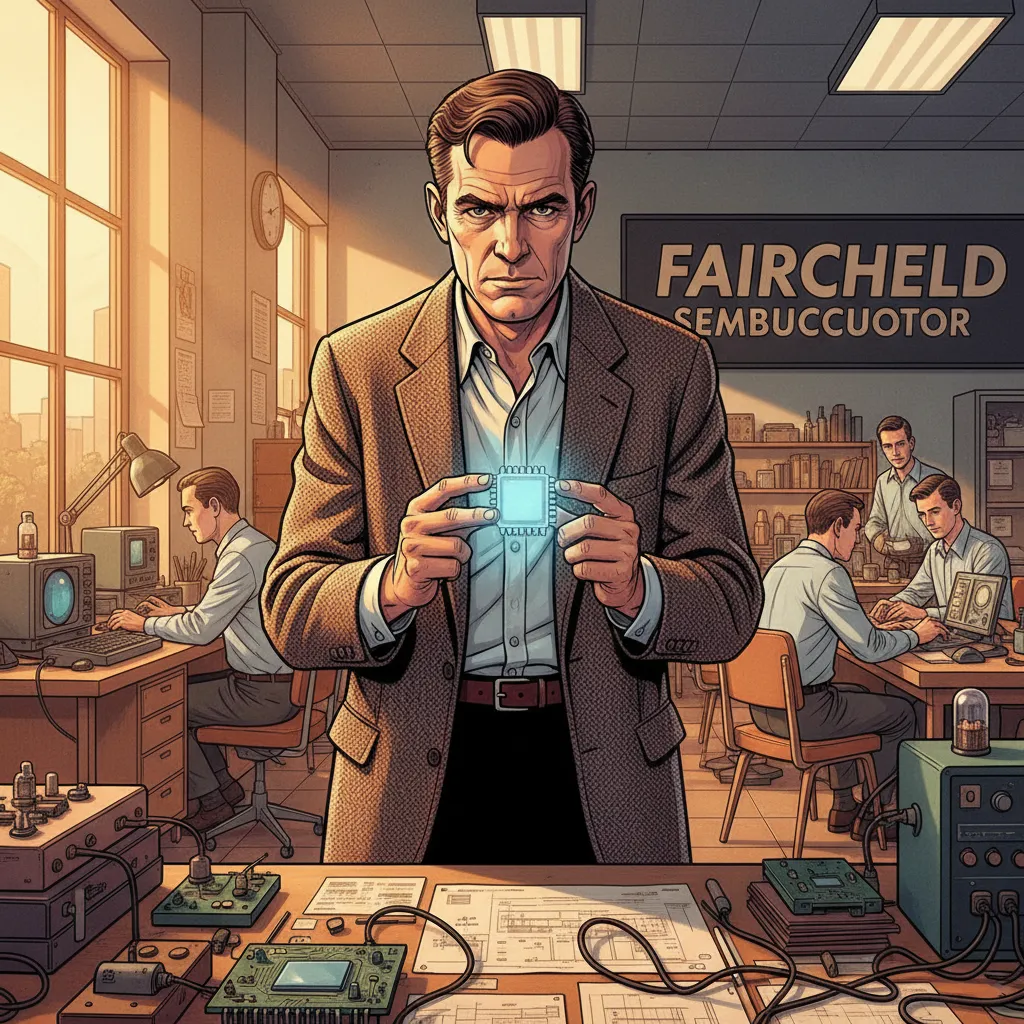
Robert Noyce is Silicon Valley’s forgotten father.
Ask a random person to name the founders of the tech industry, and you’ll hear Steve Jobs, Bill Gates, Mark Zuckerberg, Jeff Bezos. You will almost never hear Robert Noyce.
This is deeply unfair. Without Noyce’s integrated circuit, there are no personal computers. Without personal computers, there is no software industry. Without the software industry, there is no internet revolution. Without the internet revolution, there is no Gates, no Jobs, no Zuckerberg, no Bezos.
The chain of causation is direct and unbroken: Noyce’s inventions enabled everything that followed.
But Noyce died in 1990 — before the internet boom, before the dotcom era, before social media, before smartphones. He died before the technologies he had enabled reached the mainstream. He died before the culture he created became a global phenomenon.
And so he was forgotten. Not maliciously — just chronologically. The world remembers the people it can see, and by the time the information age arrived in full force, Bob Noyce was gone.
“Noyce is to Silicon Valley what George Washington is to America — the founding father whose vision and values created the conditions for everything that followed. But Washington has monuments. Noyce has a building named after him at Intel and a few paragraphs in history books. The disparity is unconscionable.”
What the world should learn from Robert Noyce:
-
Culture is technology. Noyce’s most lasting invention wasn’t the integrated circuit — it was the management culture of Silicon Valley. Flat hierarchies, stock options, meritocracy, and intellectual openness are the “software” on which the hardware industry ran.
-
Leave when the institution fails you. Noyce left Shockley. He left Fairchild. Each time, he didn’t just leave — he built something better. The willingness to walk away from a bad situation is the first step toward creating a good one.
-
Share the wealth. Stock options for all employees was a radical concept that aligned interests and created motivation. The wealth generated by Silicon Valley was, in its early decades, remarkably broadly shared (compared to other industries). Noyce deserves credit for establishing this norm.
-
The foundation matters more than the building. Noyce built the foundation — the chip, the culture, the ecosystem. Others built the buildings — the products, the services, the platforms. Foundations are invisible. Buildings are photogenic. But without the foundation, there is no building.
-
You don’t have to be famous to be important. Noyce was the most important person in the history of Silicon Valley, and most people have never heard of him. Importance and fame are different things. Noyce had the former. He didn’t need the latter.
Robert Noyce co-invented the integrated circuit, co-founded Intel, created the culture of Silicon Valley, and enabled the information age. He did all of this by the age of 62, and then he died before the world fully understood what he had made possible.
The preacher’s son from Iowa built a church of silicon. And billions of people worship in it every day without knowing his name.
Intel Corporation, co-founded by Robert Noyce in 1968, had revenue of approximately $54 billion in 2024. The integrated circuit — co-invented by Noyce and Jack Kilby — is the foundation of the global semiconductor industry, which generated over $600 billion in revenue in 2024. Robert Noyce died on June 3, 1990, at the age of 62.
🧑🤝🧑 Chapter 9: The Mentor and the Maestro (1970s)
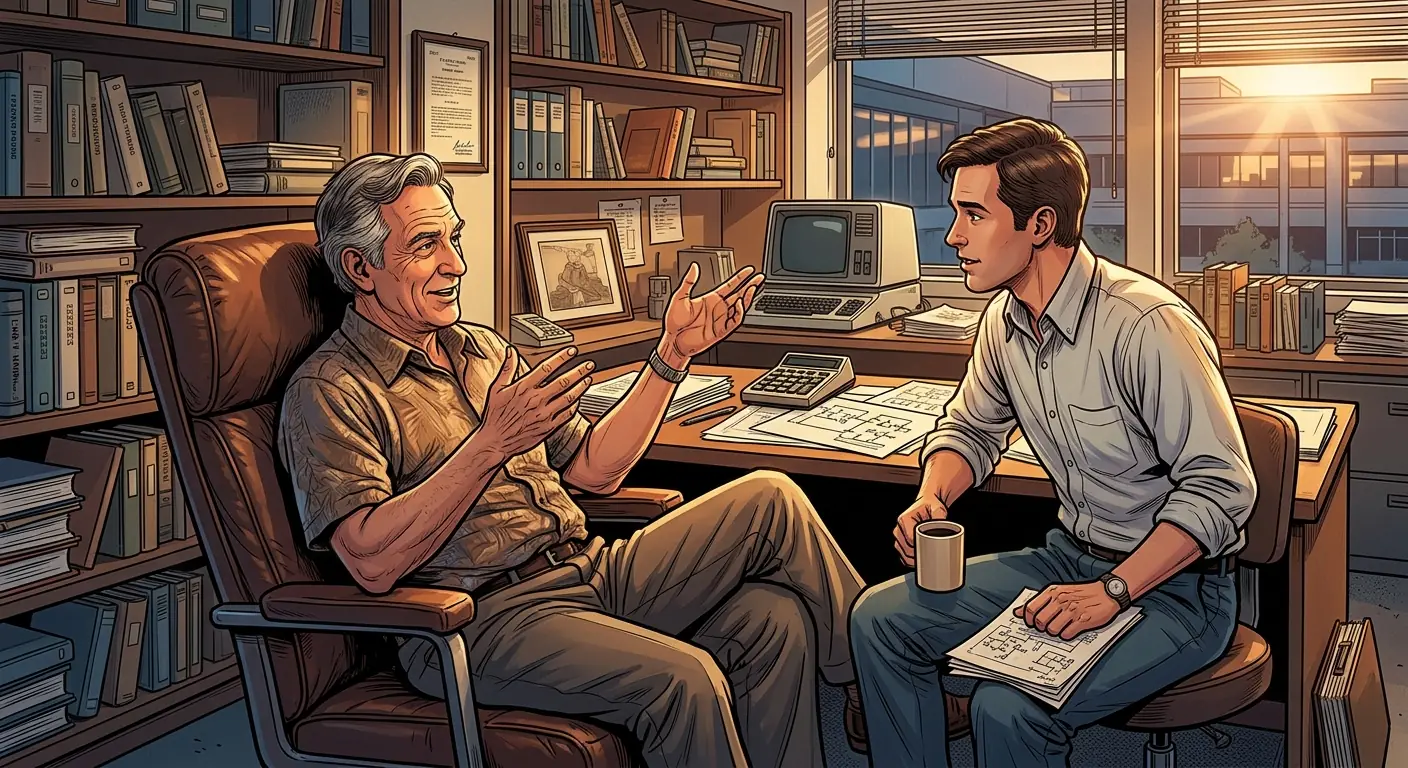
After co-founding Intel in July 1968 with Gordon Moore and Andy Grove, Robert Noyce wasn’t just a figurehead; he was the charismatic force, the “Mayor of Silicon Valley” who set the tone for a company that would define an era. While Moore was the brilliant technical mind and Grove the operational disciplinarian, Noyce was the heart and soul, the one who could inspire, mediate, and make those gut-wrenching strategic calls that steered Intel through its wild early years. He was the kind of CEO who’d roll up his sleeves, not just metaphorically, but often literally, to join engineers on the fab floor or hash out a problem over a beer. This wasn’t just good PR; it was genuinely who Noyce was, and it permeated Intel’s culture.
Leading the Charge: Intel’s Early Gambles
Intel’s initial foray wasn’t into microprocessors, which is almost unthinkable now. They started by making semiconductor memory, specifically SRAM (Static Random-Access Memory). It was a fiercely competitive market, dominated by established giants like Fairchild (ironic, isn’t it?) and Texas Instruments. Noyce, ever the pragmatist with a gambler’s streak, saw the potential for a new type of memory: the dynamic random-access memory, or DRAM. In 1970, Intel introduced the 1103 DRAM chip, which became the world’s first commercially available DRAM. This wasn’t just a product; it was a major change, quickly becoming the best-selling semiconductor memory chip in the world by 1972. It single-handedly saved Intel from early financial struggles and cemented its reputation as an innovator. This decision, championed by Noyce, was a massive gamble on unproven technology, but it paid off spectacularly, giving Intel the financial muscle to pursue even bigger ideas. Imagine betting your entire company on a completely new kind of memory. Noyce did, and won.
The Open Door & The Guiding Hand
Noyce’s leadership style at Intel was legendary. He fostered an incredibly open and non-hierarchical culture, a stark contrast to the rigid corporate structures of the East Coast. There were no executive dining rooms, no reserved parking spots, and office doors were always open – a radical concept for its time. He genuinely believed that the best ideas could come from anywhere, and that talent thrived when given autonomy and trust. He spent significant time mentoring younger engineers and managers, not just on technical issues, but on the broader vision of the company and the industry. He was known for his ability to synthesize complex technical arguments and translate them into clear, actionable strategies. He wasn’t just a boss; he was a facilitator, an enabler, and, frankly, a bit of a cheerleader. This “smart friend” approach made Intel a magnet for top talent, creating a vibrant, dynamic environment that was constantly pushing boundaries.
Rivalries and Reinvention
Of course, Intel wasn’t operating in a vacuum. Texas Instruments (TI) was a formidable rival, especially in memory. Noyce’s decision to pivot aggressively into microprocessors, particularly the Intel 4004 in 1971 and the 8080 in 1974, was another masterstroke. While the 4004 was initially designed for a Japanese calculator company, Noyce quickly grasped its broader potential. He pushed for its marketing as a general-purpose “computer on a chip.” This vision shifted Intel’s focus from being merely a memory company to becoming the architect of the digital future. This pivot was crucial, as it allowed Intel to sidestep the brutal price wars that would eventually plague the memory market. Noyce saw the writing on the wall, understood that the real value lay not just in making components, but in creating the brains of future devices. It was a strategic shift that not only defined Intel for decades but also laid the groundwork for the personal computer revolution.
⚔️ Chapter 10: The Patent Wars & The Open Hand (1960s-1970s)
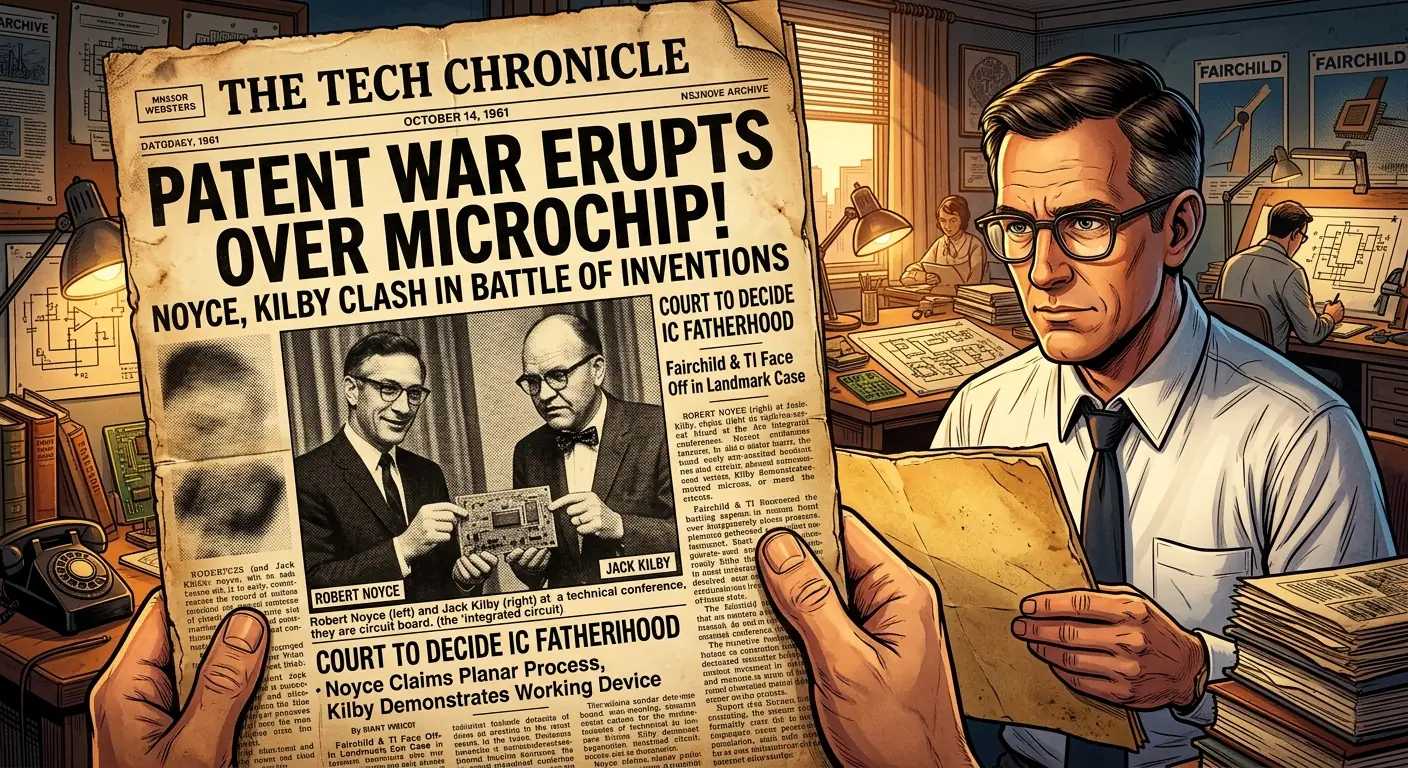
While Robert Noyce is rightly celebrated as a co-inventor of the integrated circuit, his path to that recognition was anything but smooth. The story of the integrated circuit isn’t just one of brilliant invention; it’s also a tangled tale of simultaneous discovery, corporate rivalry, and legal battles that stretched for years. It reminds us that even paradigm-shifting breakthroughs often involve more than one genius, often working in parallel, often with lawyers waiting in the wings.
The Great IC Patent Showdown
The integrated circuit, that tiny miracle of miniaturization, was, astonishingly, invented almost simultaneously by two different men in two different companies. While Noyce developed his version at Fairchild Semiconductor in 1959, Jack Kilby at Texas Instruments (TI) had conceived and demonstrated his “monolithic circuit” in 1958. Kilby’s initial concept involved connecting components with tiny wires, whereas Noyce’s innovation was the planar process and the idea of integrating all components, including interconnections, onto a single piece of silicon using photolithography and diffusion – a design that was truly manufacturable and scalable. The crucial difference was that Noyce’s design integrated the components electrically as well as physically, solving a key manufacturing challenge that Kilby’s initial wire-bonded approach didn’t fully address.
Two Paths, One Invention
The U.S. Patent Office, bless its bureaucratic heart, was utterly baffled. They had two separate patent applications for essentially the same world-changing invention. Texas Instruments filed for Kilby’s patent in February 1959, and Fairchild filed for Noyce’s patent in July 1959. What followed was a protracted legal skirmish, a “patent interference” proceeding that dragged on for ten years. It was a classic corporate slugfest: two titans of industry, Fairchild and TI, each claiming sole ownership of the future. The stakes were astronomically high – control over the fundamental building block of modern electronics. Imagine the legal bills! This wasn’t just about bragging rights; it was about billions of dollars in future royalties and market dominance.
“It was an agonizing period. You knew you had done something monumental, but the lawyers had to sort out who did it ‘first’ or ‘best’ in the eyes of the law. Meanwhile, the technology was already flying past us.” — Robert Noyce, reflecting on the patent dispute
Finally, in 1969, the Patent Office initially ruled in favor of Kilby. But Noyce, ever the fighter, appealed. In 1970, the U.S. Court of Customs and Patent Appeals partially reversed that decision, granting Noyce the patent for the key manufacturing technique of the integrated circuit – the planar process and its unique interconnections. Kilby retained the patent for the basic concept of the “miniaturized electronic circuit.” It was a split decision, a legal Solomon’s judgment that, in essence, acknowledged both men as independent inventors of different, yet complementary, aspects of the integrated circuit.
A Pragmatic Peace
While the legal battle was intense, Noyce held a remarkably pragmatic view. He recognized that the ultimate goal wasn’t just to win a patent war, but to accelerate the adoption of the technology. Both Fairchild and TI, realizing the futility and cost of endless litigation, eventually agreed to cross-licensing agreements. This meant they could both use each other’s patented integrated circuit technologies without further legal wrangling. This spirit of pragmatic cooperation, even after fierce competition, became a hallmark of the early Silicon Valley ethos, allowing innovation to flourish rather than being stifled by proprietary lock-ins. Noyce understood that sometimes, the best way to win is to share the pie, especially when the pie is getting exponentially bigger.
💰 Chapter 11: The Philanthropist & The Visionary (1980s)
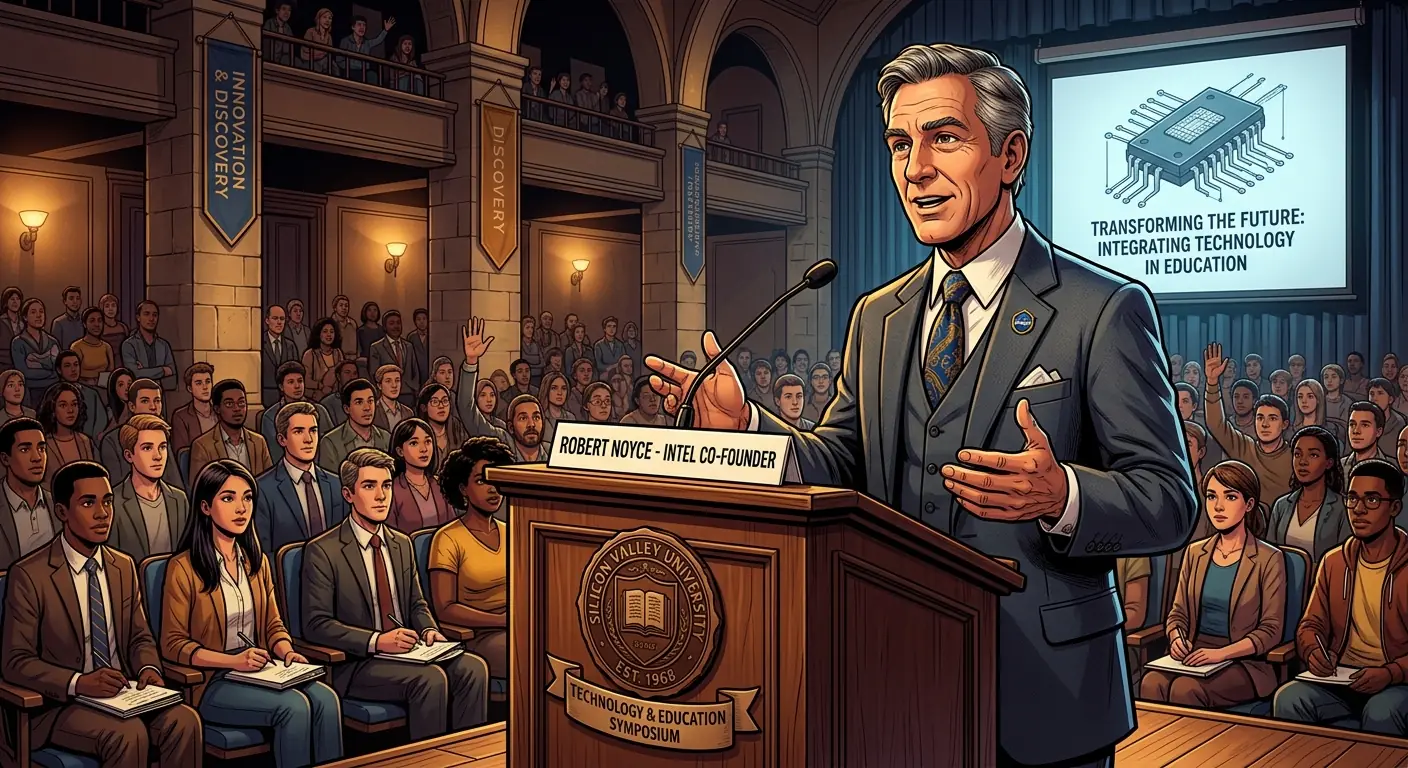
By the early 1980s, Robert Noyce had already achieved more than most could dream of. He had co-founded two seminal companies, Fairchild Semiconductor and Intel, and helped usher in the digital age. But Noyce wasn’t one to simply rest on his laurels or retreat to a life of leisure (though he certainly had the means for it). His mind was always whirring, looking for the next challenge, the next way to shape the future – not just for profit, but for progress. He stepped down as CEO of Intel in 1975, handing the reins to Gordon Moore, and then as chairman in 1979, though he remained deeply involved. It was in this later phase of his career that Noyce truly embraced his role as an industry statesman, a visionary looking beyond individual company success to the health of the entire American technology ecosystem.
Beyond the Boardroom: Sematech’s Savior
The mid-1980s were a particularly anxious time for the U.S. semiconductor industry. Japanese companies, backed by government initiatives, were rapidly gaining market share, particularly in DRAMs, threatening America’s technological dominance. It was a genuine crisis, and many feared the U.S. was losing its edge. In response, the U.S. government and a consortium of American semiconductor companies decided to form Sematech (Semiconductor Manufacturing Technology) in 1987. Its mission: to strengthen American semiconductor manufacturing and research. And who better to lead this ambitious, unprecedented collaboration than the “Mayor of Silicon Valley” himself?
Noyce was tapped to be Sematech’s first CEO. This was a monumental task. Imagine trying to get bitter rivals – IBM, Intel, Motorola, Texas Instruments, and many others – to share research, equipment, and even personnel, all while competing fiercely in the marketplace. It was like herding cats, if the cats were all billionaires with massive egos. But Noyce, with his unparalleled charisma, diplomatic skills, and deep credibility, was uniquely suited for the job. He convinced these fiercely independent companies to put aside their rivalries for the greater good of national technological leadership. Under his guidance, Sematech became a crucial hub for advanced research, helping to develop new manufacturing processes and keep American chipmakers competitive. It was a testament to his ability to inspire cooperation and rally people around a common, grand vision.
A Different Kind of Investment
Noyce’s commitment extended beyond industry consortia. He became a passionate advocate for science and technology education, recognizing that the future health of the industry depended on a pipeline of bright, well-trained minds. He served on various advisory boards and committees, tirelessly lobbying for increased funding for research and development, and for improving math and science education in schools. He saw education not just as a personal good, but as a strategic national imperative. He and his wife, Ann Bowers, were also significant philanthropists, quietly supporting educational initiatives and scientific research. He understood that wealth came with responsibility, and that giving back was just as important as building groundbreaking companies. He wasn’t just building chips; he was trying to build a better future for the next generation of innovators.
Looking to the Horizon
Even in his later years, Noyce remained an eternal optimist about technology’s potential. He famously predicted the widespread adoption of computers and the internet long before they became ubiquitous. He foresaw a world where information was instantly accessible and connectivity was seamless. He didn’t just see the next chip; he saw the next world that the chip would enable. He believed in the power of human ingenuity to solve problems and improve lives. His vision wasn’t just about faster processors or smaller devices; it was about empowering individuals, connecting communities, and advancing society. His work with Sematech and his advocacy for education were extensions of this belief: investing in the foundational elements that would allow future innovations to blossom, long after he was gone.
💔 Chapter 12: The Second Act & The Quiet Retreat (1970s-1990)
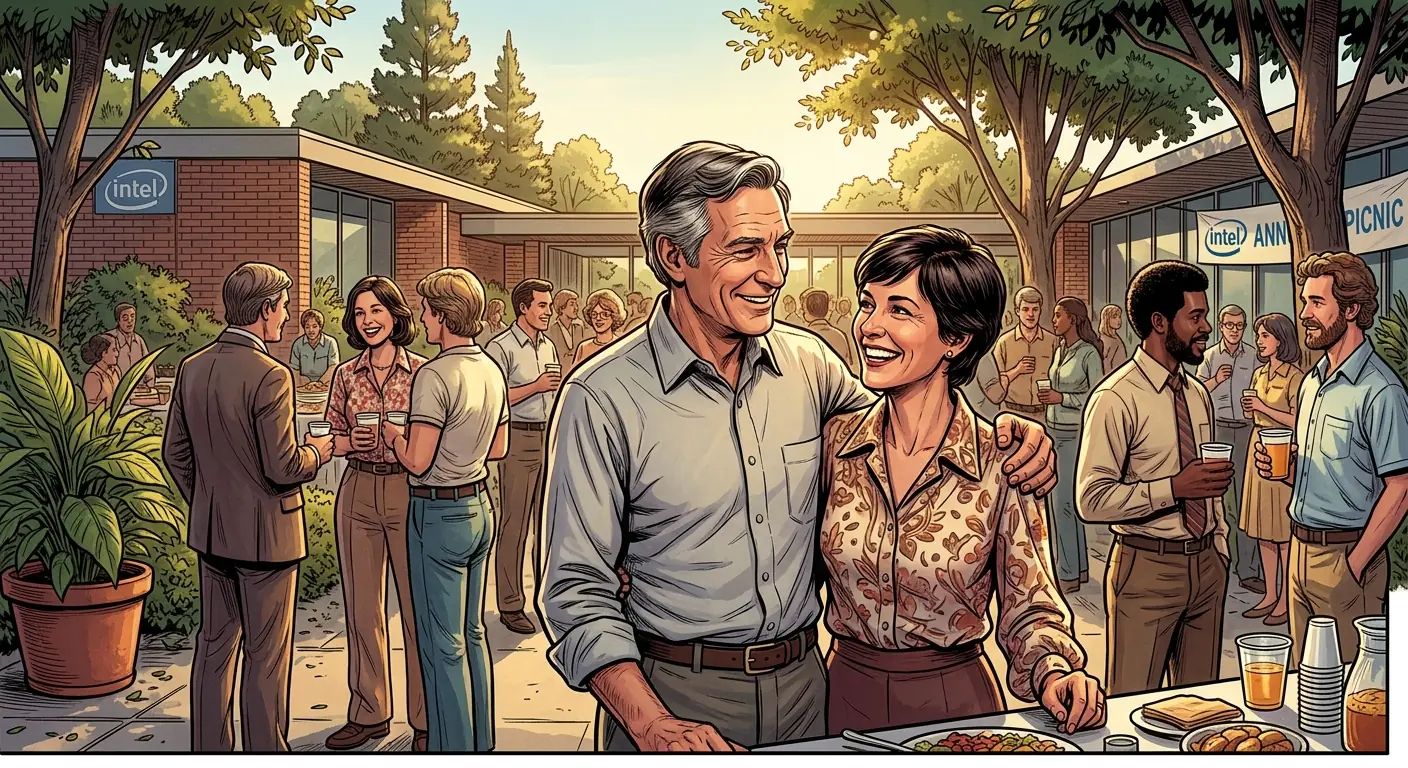
While Robert Noyce’s professional life was a whirlwind of innovation, leadership, and industry-shaping decisions, his personal journey also saw significant shifts and challenges. The man who helped lay the foundations for an entire technological ecosystem was, at heart, still a human being, navigating relationships, health, and the quest for balance. His later years saw him step back from the daily corporate grind, allowing for a quieter, yet still impactful, “second act” that revealed more of the man behind the legendary executive.
Love in the Valley: A Second Chance
Noyce’s first marriage to Elizabeth Bottcher, with whom he had four children, eventually ended in divorce in 1975. The relentless demands of building not one, but two, revolutionary companies, along with the constant travel and pressure, took their toll. It’s a common, if unfortunate, refrain in the biographies of many high-achieving founders. However, Noyce found love again. In 1977, he married Ann Bowers, a pioneering woman in her own right. Bowers had a significant career in the burgeoning tech industry, working at General Precision and then as Intel’s first Director of Human Resources. She was a sharp, insightful partner who understood the unique pressures and opportunities of Silicon Valley. Their marriage brought a new stability and joy to Noyce’s life, and she became a strong supporter of his later endeavors, including his work with Sematech and his philanthropic efforts. Their union was a testament to finding companionship and shared vision later in life, a beautiful human story amidst the silicon.
The Weight of the World (and the Heart)
The intensity of Noyce’s career, while incredibly rewarding, was not without its costs. He was a man who lived life fully, embracing adventure and challenge, but also experiencing the stresses that come with immense responsibility. In 1980, Noyce suffered a mild heart attack. This event, while not immediately life-threatening, served as a stark reminder of his mortality and the importance of health. It also likely played a role in his decision to gradually step back from the direct leadership roles at Intel, moving from CEO to chairman, and then eventually dedicating his time to broader industry initiatives like Sematech. It’s a poignant reminder that even the most brilliant minds are tethered to physical limitations. The relentless pace of innovation, the constant pressure to be at the forefront, can take a toll that even the “Mayor” couldn’t entirely escape. This health scare prompted a more reflective phase, where he began to prioritize different aspects of his life.
A Life Beyond the Chip
After his heart attack and his eventual stepping down from Intel’s active leadership, Noyce embraced a more balanced lifestyle. While still deeply engaged in the tech world through Sematech and various advisory roles, he also pursued his personal passions. He was an avid skier, a pilot, and enjoyed tennis. He loved the outdoors and spent time at his home in Aspen, Colorado, finding peace and rejuvenation away from the hustle of Silicon Valley. This wasn’t a retreat into irrelevance; it was a conscious decision to broaden his life, to enjoy the fruits of his labor, and to contribute in ways that transcended the quarterly earnings report. He remained a vibrant, curious intellect, constantly reading, learning, and engaging in discussions about the future. His quiet retreat from the corporate spotlight allowed him to become a respected elder statesman, a wise counsel whose insights were sought by many, but whose presence was no longer defined solely by the company he built. He showed that there was indeed a rich, fulfilling life to be lived even after you’ve already changed the world.
🌌 Chapter 13: The Enduring Galaxy (Legacy)
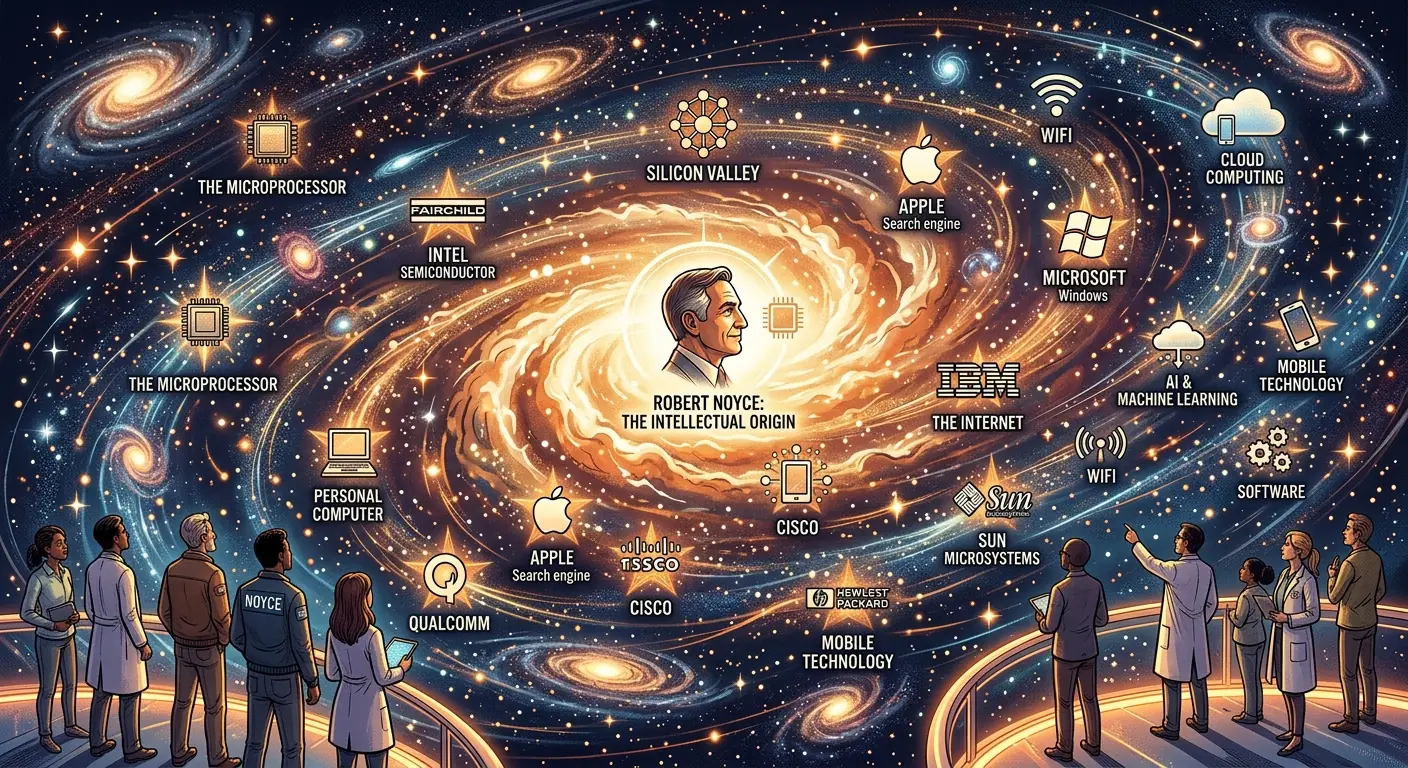
Robert Noyce passed away suddenly on June 3, 1990, at the age of 62, due to a heart attack. His death was a profound shock to Silicon Valley and the technology world. Though he left us too soon, his legacy is not just a collection of inventions or companies; it’s an entire philosophy, a way of building, leading, and innovating that continues to define the very DNA of Silicon Valley. He wasn’t just a pioneer; he was the architect of the culture that allowed the digital revolution to flourish. While his name might not be as instantly recognizable to the general public as some later tech titans, his influence is arguably more fundamental, like the unseen infrastructure upon which everything else is built.
The DNA of Silicon Valley
Noyce’s enduring impact can be found in the core tenets of Silicon Valley itself. He championed the idea of equity for employees, allowing them to share in the prosperity of the company – a radical concept that attracted top talent and fostered loyalty. He fostered flat hierarchies and an open-door policy, encouraging direct communication and valuing ideas over titles. His belief in autonomy and trust for engineers, rather than micromanagement, created an environment where creativity could thrive. The “Fairchild Tree” isn’t just a historical footnote; it’s a living testament to the entrepreneurial spirit he ignited, demonstrating that talent, when nurtured, will leave and create new ventures, further diversifying and strengthening the ecosystem. This model of constant innovation through spin-offs, fueled by shared knowledge and a willingness to take risks, is pure Noyce.
“Robert Noyce was not just an inventor; he was a cultural architect. He taught us that it was okay to fail, as long as you learned. He showed us that the best way to lead was to empower. He didn’t just build companies; he built the template for how we build companies here.” — Marc Andreessen, co-founder of Netscape
The Unseen Architect
Why then, if his impact was so profound, is he often referred to as “The Forgotten Father” (as in an earlier chapter)? Perhaps it’s because Noyce was more of a consensus-builder, a diplomat, and an enabler than a singular, often controversial, visionary like Steve Jobs. He didn’t crave the spotlight or cultivate a mythical public persona. His genius lay in his ability to bring brilliant people together, give them the tools and freedom they needed, and then step back to let them shine. He was the quiet strength, the foundational bedrock. His work with Sematech, uniting rivals for a common national goal, perfectly illustrates this: he wasn’t building his company, but strengthening the entire industry. His legacy is less about a single product with his name on it, and more about the entire industrial landscape that exists because of his principles.
A Legacy Etched in Silicon
Noyce’s contributions, from the integrated circuit itself to the very culture of innovation he fostered, are literally etched in every piece of silicon that powers our modern world. Every smartphone, every laptop, every data center owes a debt to his vision and leadership. He didn’t just invent a component; he invented the future. His lessons — the importance of collaboration, the necessity of risk-taking, the value of an open and empowering culture, and the commitment to lifelong learning — remain as relevant today as they were in the nascent days of Silicon Valley. Robert Noyce may be gone, but the galaxy he helped create continues to expand, powered by the principles he so eloquently embodied. He truly was the Mayor, not just of a valley, but of the digital age.
💡 Key Insights
- ▸ Noyce's greatest contribution wasn't technical — it was cultural. He created the management style that would define Silicon Valley: flat hierarchies, open offices, stock options for employees, casual dress, and meritocratic advancement. While East Coast corporations ran on hierarchy, formality, and deference to seniority, Noyce ran Fairchild and Intel on talent, energy, and ideas. This cultural template was adopted by virtually every tech startup that followed.
- ▸ The 'Traitorous Eight' — the group of engineers who left Shockley Semiconductor to found Fairchild Semiconductor — established the precedent that talent could leave a company and start a competitor. Before 1957, this was considered disloyal and dishonorable. After Fairchild, it became the engine of Silicon Valley's innovation ecosystem. Noyce, as the leader of this defection, effectively created the startup culture that made the Valley what it is.