Gina Rinehart: The Mining Fortune That Still Shapes Australia's Power Map
Gina Rinehart inherited a troubled mining legacy, but her real achievement was turning Hancock Prospecting and Roy Hill into a concentrated engine of private power with national political weight.

View all stories about this mogul
Gina Rinehart is often introduced as Australia’s richest person, but that label is less revealing than it sounds. Her real story is about turning a disputed inheritance and a volatile commodity base into a private power structure with national consequences. She is not just wealthy. She is structurally significant.
This is why she belongs in Empires. Rinehart’s influence extends beyond company performance into labor politics, resource nationalism, investment signaling, and the symbolic role mining still plays in Australia’s economic self-image. To understand her, you have to stop thinking only in terms of fortune rankings and start thinking in terms of leverage.
Her empire is built from dirt, distance, and discipline.
Chapter 1: She Inherited Potential, Not Stability

It is easy to tell lazy dynastic stories about Gina Rinehart because she was the daughter of iron ore explorer Lang Hancock. But inheritance alone does not explain what followed. When she became executive chairwoman in 1992, Hancock Prospecting was not yet the polished machine it later became.
Forbes notes that she rebuilt her late father’s financially distressed company. That is the crucial point. She did not simply receive a cash geyser. She received a base of assets, claims, and possibilities that still needed operational conversion. Resource fortunes are often described as geological destiny, but geology without execution can stay stranded for decades.
Rinehart’s role was to convert buried promise into concentrated private power.
Chapter 2: Mining Wealth Is Really a Logistics and Capital Story

Outsiders often romanticize mining through the image of massive pits and giant trucks. The harder truth is that mining empires are built through financing, rail, ports, timing, approvals, and the stomach to survive brutal cycles. In other words, the visible hole in the ground is only the most photogenic piece of the system.
Rinehart understood that. The rise of Hancock Prospecting and the development of Roy Hill were not just about owning ore. They were about assembling a capital-intensive chain of infrastructure and commercial confidence around that ore.
This matters because empires in extractive industries are less about discovery than conversion. You have to turn deposits into flows.
Chapter 3: Roy Hill Was the Defining Scale Move

Roy Hill is central to understanding why Rinehart’s fortune became so formidable. It was the kind of project that makes private ambition visible at industrial scale. A resource deposit becomes a real empire only when someone can finance, build, and operationalize the surrounding network needed to monetize it.
That is where many dreams fail. Roy Hill did not.
The project became Hancock’s biggest asset and helped transform Rinehart from a controversial heiress into a mogul whose weight could no longer be dismissed as inherited symbolism. Once a project that size starts moving ore, the conversation changes. The fortune gains operating legitimacy.
Chapter 4: She Built Through Control, Not Consensus
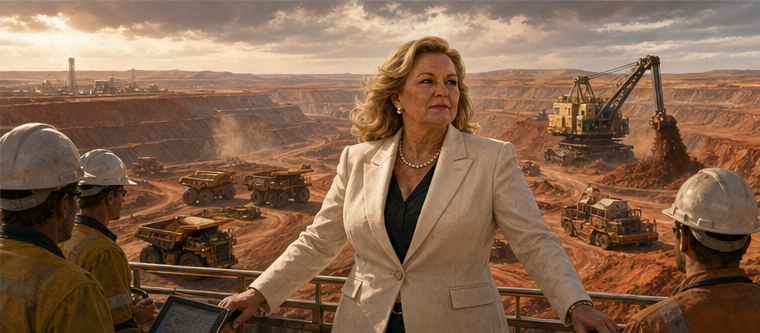
Rinehart has never been a consensus-management archetype. Her public image is not built around charm, democratized governance, or broad coalition-building. It is built around control. That can make her polarizing, but it is also part of how concentrated empires work.
Private ownership changes the rhythm of decision-making. A closely held resource empire can move with a different kind of patience and a different kind of force. It does not need to perform transparency the way a diffuse public company does. It needs to preserve strategic command over assets that matter enormously when commodity prices cooperate.
Rinehart’s style makes more sense once you see control itself as a core operating asset.
Chapter 5: Commodity Cycles Made Her Rich, but Structure Made Her Durable

Iron ore booms created enormous tailwinds for Australian mining wealth, and no honest account should ignore that. Commodity cycles matter. China mattered. Global industrial demand mattered. But tailwinds alone do not explain why some people convert booms into durable command while others merely enjoy temporary abundance.
Rinehart’s durability came from structure. Hancock Prospecting remained private. Core assets remained tightly held. Strategic decisions did not have to pass through sprawling public-market theatre. That gave her the ability to ride cycles with a different posture than many more exposed operators.
In empire terms, the cycle was the fuel. Structure was the engine.
Chapter 6: Her Fortune Became Politically Resonant
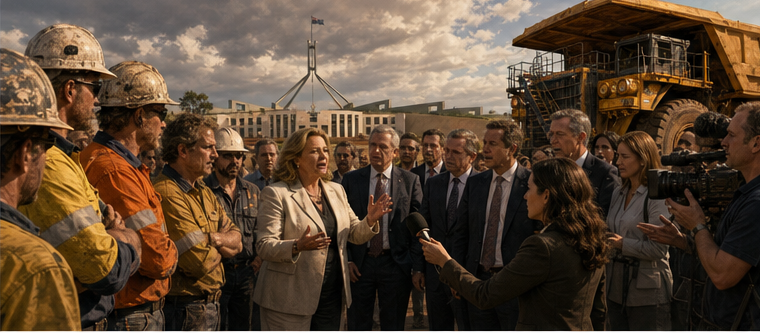
Large mining fortunes in Australia are never only economic. They become politically charged because mining touches jobs, export revenues, environmental conflict, indigenous land issues, regional identity, and national growth narratives. Rinehart’s prominence guaranteed that she would become more than a business figure.
That visibility increased both her influence and her controversy. Resource moguls do not get to stay technocratic for long. Eventually the empire starts standing in for a larger argument about what the country is, who benefits from extraction, and how power should be exercised.
Rinehart’s fortune therefore became a political symbol whether she wanted it to or not.
Chapter 7: The Company Expanded Beyond Pure Iron Ore Identity
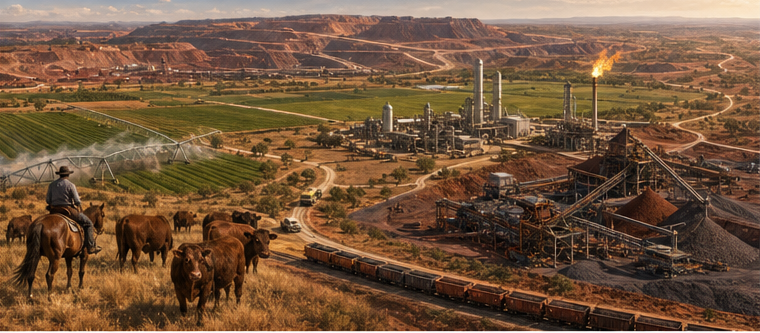
A useful sign of empire maturity is diversification without loss of core identity. Hancock Prospecting’s official materials emphasize not only mining projects but broader business interests, and Reuters recently highlighted the company’s expanding U.S. portfolio exposure to defence, gold, and rare earths.
That matters because it shows how a resource empire can begin reallocating capital beyond its original center of gravity while still being defined by it. Once a fortune is large enough, it can start treating external stakes and thematic investments as additional levers of power rather than distractions.
This is how extraction wealth evolves into a more flexible capital platform.
Chapter 8: Privacy Increased the Mystique and the Leverage

Reuters reported years ago on Rinehart’s battle to keep details of her wealth under wraps. That episode is revealing because it highlights the strategic value of opacity in private empires. Public fascination tends to focus on secrecy itself, but the deeper issue is leverage. The less outsiders know about internal economics, the harder it is to map the real boundaries of control and resilience.
Opacity has costs. It can intensify suspicion and conflict. But in private empire building it can also preserve room to maneuver. Rinehart’s world was never designed for public intimacy. It was designed for command.
That is part of why the myth around her remains so durable.
Chapter 9: She Represents a Very Old Form of Power in a Modern Economy

In an age dominated by software billionaires and platform mythology, Rinehart stands for something older and heavier. Her fortune comes from land, rights, ore bodies, and export channels. It depends on geology, industrial demand, and state frameworks, not on attention metrics or app downloads.
That old form of power still matters immensely. In some ways it matters more, because the physical economy never disappeared. Steel still needs ore. Nations still care who controls strategic resources. Industrial scale still creates political scale.
Rinehart’s relevance is a reminder that the raw-material layer of capitalism still writes huge parts of the script.
Chapter 10: Gina Rinehart’s Empire Still Shapes the National Power Map

Gina Rinehart matters because she turned resource inheritance into an operating empire with lasting strategic weight. She rebuilt Hancock Prospecting, pushed Roy Hill into reality, and turned private control over mining wealth into a platform that still influences investment patterns and public debate.
That is why her story belongs here. She is not just a rich Australian. She is one of the clearest examples of how extractive wealth, when tightly controlled and successfully scaled, can become a long-duration force in national life.
Her empire was never delicate. It was built to endure the brutality of commodities and still come out with leverage intact.
💡 Key Insights
- ▸ Rinehart's real power came from concentration: a private resource empire, a small inner circle, and exposure to commodities large enough to shape national conversations.
- ▸ She did not merely preserve inherited land and licenses. She turned distressed legacy assets into operating leverage through timing, financing, and control.
- ▸ Her fortune matters because it sits at the intersection of geology, politics, export demand, and national identity in Australia.